Staffing / Recruiting Agency Acquisition & SBA Underwriting Financial Model
Originally published: 17/07/2026 12:53
Publication number: ELQ-94203-1
View all versions & Certificate
certified

Staffing / Recruiting Agency Acquisition & SBA Underwriting Financial Model

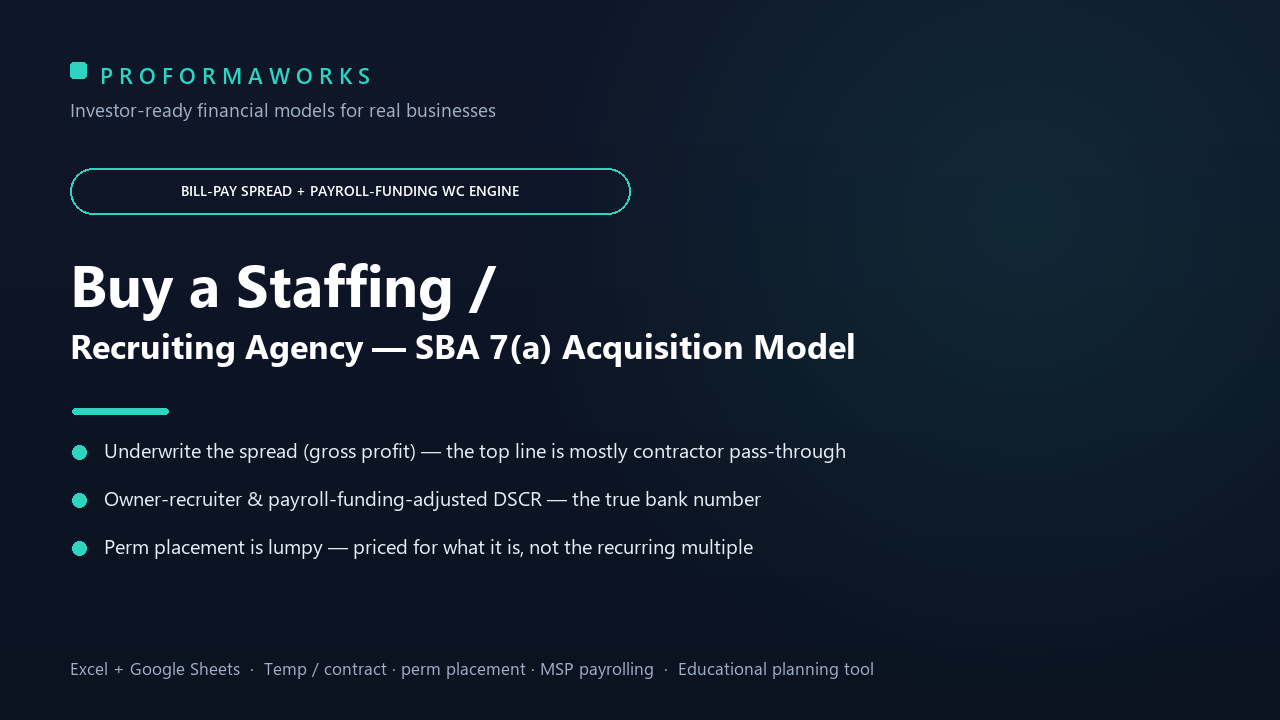
A 5-year SBA 7(a) model to buy a staffing / recruiting agency: underwrite the bill-pay spread and the DSO payroll-funding gap, not the pass-through revenue.

Description
Most staffing-agency templates are startup or operating forecasts, and most brokers headline a big revenue number. But a staffing agency's revenue is a vanity metric because most of the top line is contractor wages passed straight through, and temp staffing eats cash to run, because you pay contractors weekly but collect from clients at DSO of roughly fifty days. This lender-ready model reads the agency the way a disciplined buyer and a bank do: on the spread, the working-capital gap, and normalized SDE after a real recruiter.

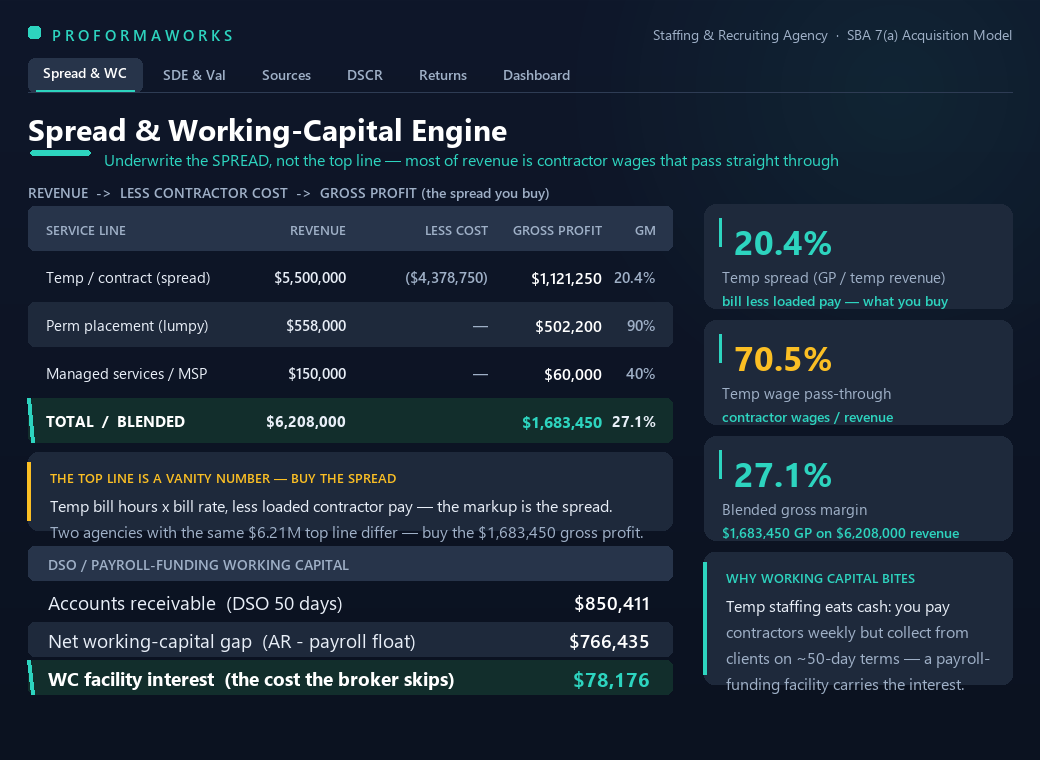
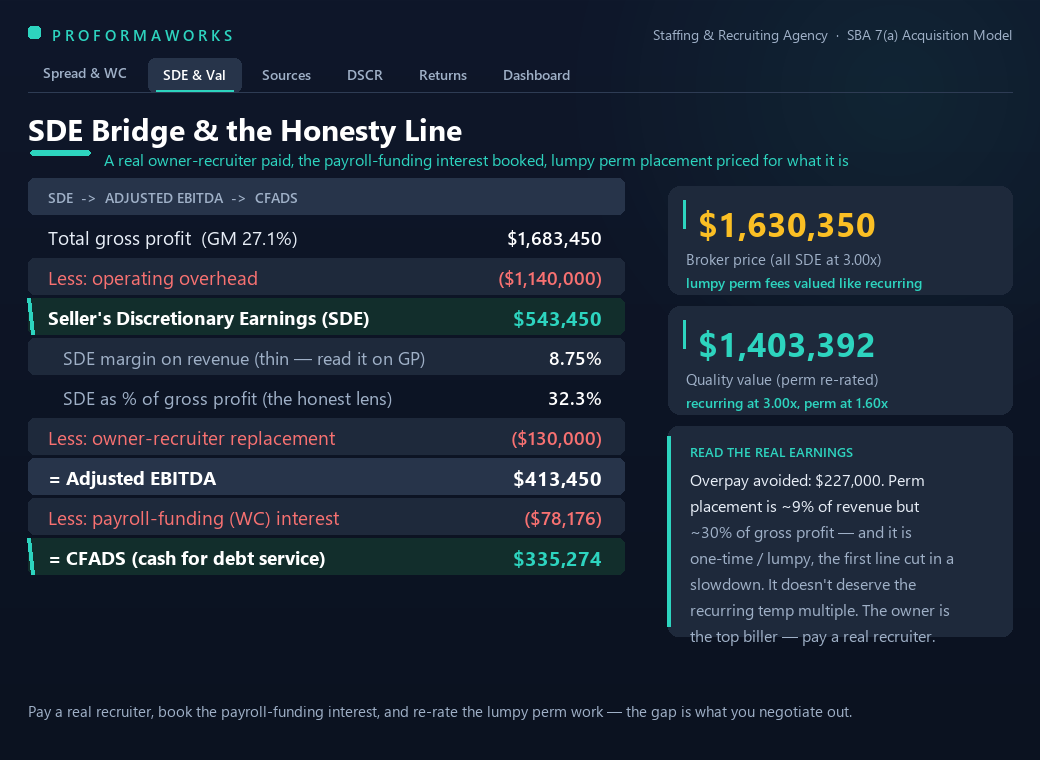
The engine is a Bill-Pay Spread plus a DSO and Payroll-Funding Working-Capital model. Gross profit is built bottom-up: temp and contract billed hours at your bill rate less the loaded contractor cost, plus direct-hire placement fees and managed services. In the base case, on about six point two million of revenue only about one point seven million is gross profit, because roughly seventy percent of the top line is pass-through contractor wages. You underwrite the spread, not the headline number that the seller shows you.

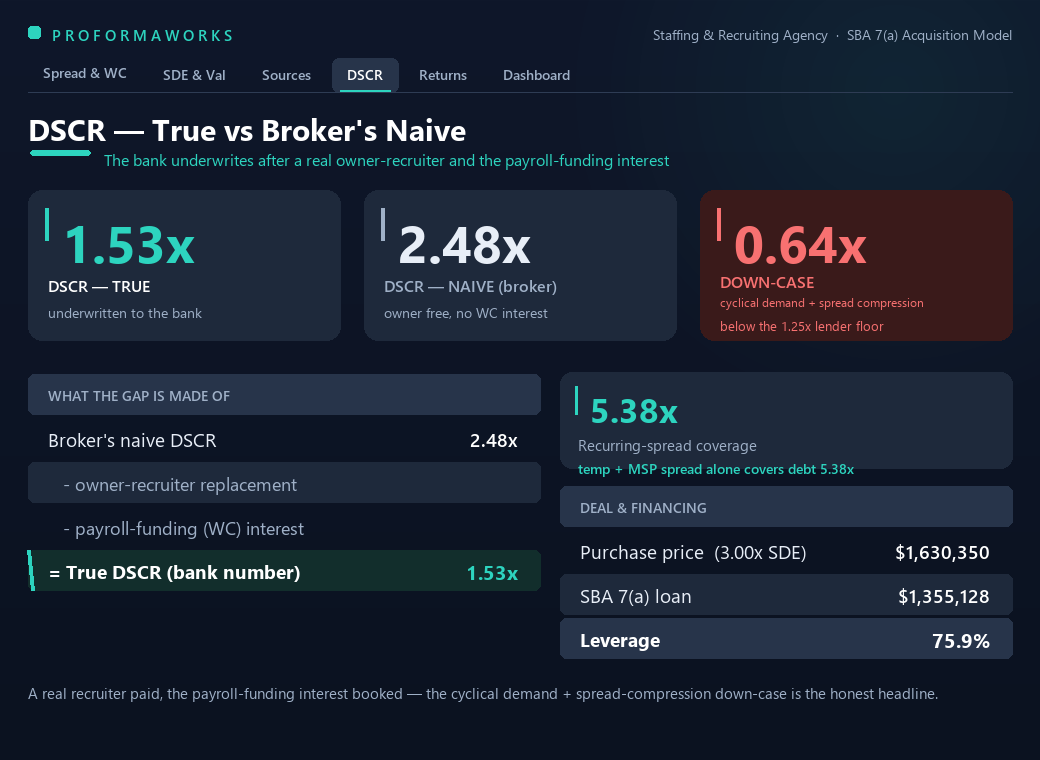
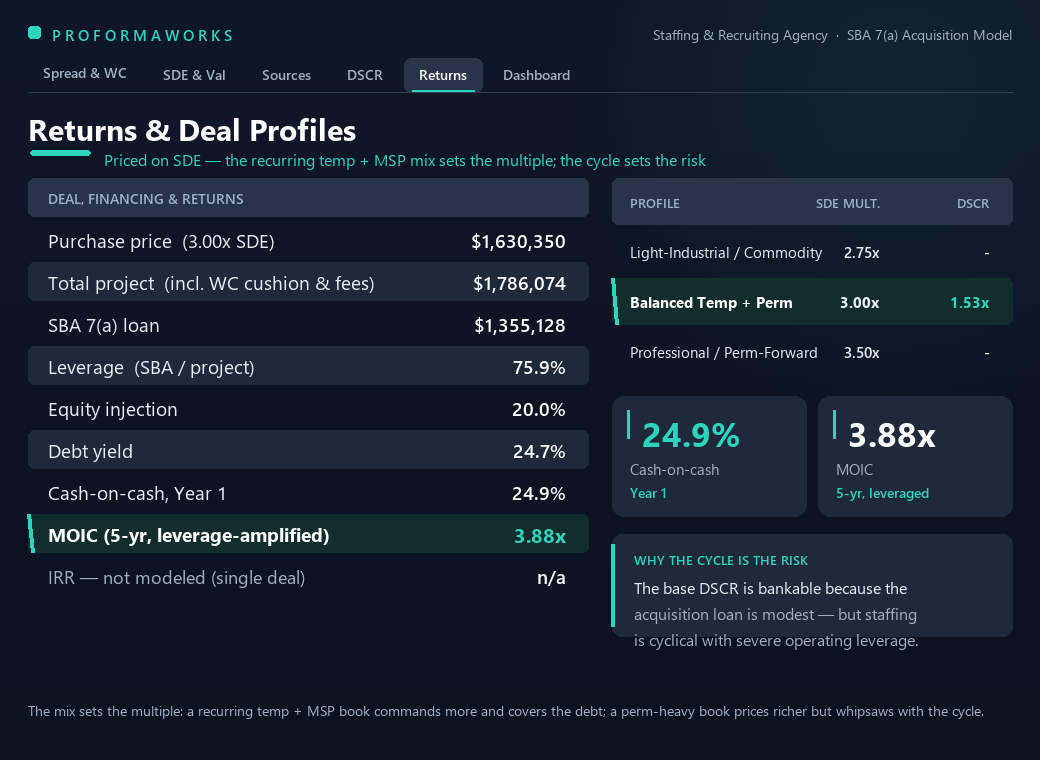
You pay contractors weekly but collect at DSO of about fifty days, so the model sizes the receivables gap and funds it on a separate payroll-funding facility, because the SBA seven a acquisition loan does not cover ongoing working capital. That facility interest hits cash flow before the debt service coverage ratio, the cost a broker sheet ignores. The model reads SDE on gross profit, pays a market-rate recruiter to replace the owner who bills and holds the client accounts, and re-rates the lumpy one-off direct-hire fees. So the true coverage ratio sits next to the flattering naive one that the broker implies. The honest down-case: staffing has severe operating leverage and is deeply cyclical, so a modest demand contraction plus spread compression drops coverage under the lender floor, and real recessions were far worse.

Inside: a ten-sheet Excel model with every calculation a formula, Google Sheets safe and no macros, a twenty-four page PDF user guide, and a benchmarks sheet with sourced ranges. Three agency profiles reload the multiple, the days-sales-outstanding, the payroll-funding rate and the client retention. This is an educational planning tool, not financial, legal, tax or investment advice.

This Best Practice includes
10-sheet Excel model (Google Sheets-safe, no macros), 24-page PDF user guide, benchmarks sheet with sourced ranges, 3 agency profiles, SBA capital stack + true-vs-naive DSCR.

Acquire business license for $99.00

Add to cart

Add to bookmarks

Discuss

Further information

Underwrite a staffing / recruiting agency acquisition to an SBA lender's DSCR — on the spread and the working-capital gap, not the pass-through revenue.

You are buying an independent staffing / recruiting agency with an SBA 7(a) loan and need a lender-ready underwrite of the spread and the payroll-funding gap.

You want a simple operating budget or a startup projection — this is an acquisition underwriting model, not a general P&L forecast.


0.0 / 5 (0 votes)

please wait...