
-
+
42
more
Originally published: 01/06/2026 16:20
Publication number: ELQ-15436-1
View all versions & Certificate
Publication number: ELQ-15436-1
View all versions & Certificate

Italy Renewable Energy Incentives 2026 — Complete Guide
50-page guide covering the full Italian renewable energy incentive landscape for 2026
fer e aste italyfer 2 offshore wind italycer pnrr grantagrivoltaico fer e premiumconto termicozes unica mezzogiorno
Description
Italy's renewable energy incentive system is one of the most complex in Europe — and one of the most rewarding for developers, investors and corporate energy managers who understand how to navigate it. This guide covers the full landscape as of May 2026, including all updates from DL 38/2026 (Iperammortamento Made-in-EU restriction removed, retroactive 1 January 2026), DL 19/2026 (PNRR CER and Agrivoltaico governance transferred to GSE) and the FER 2 June 2026 auction calendar.
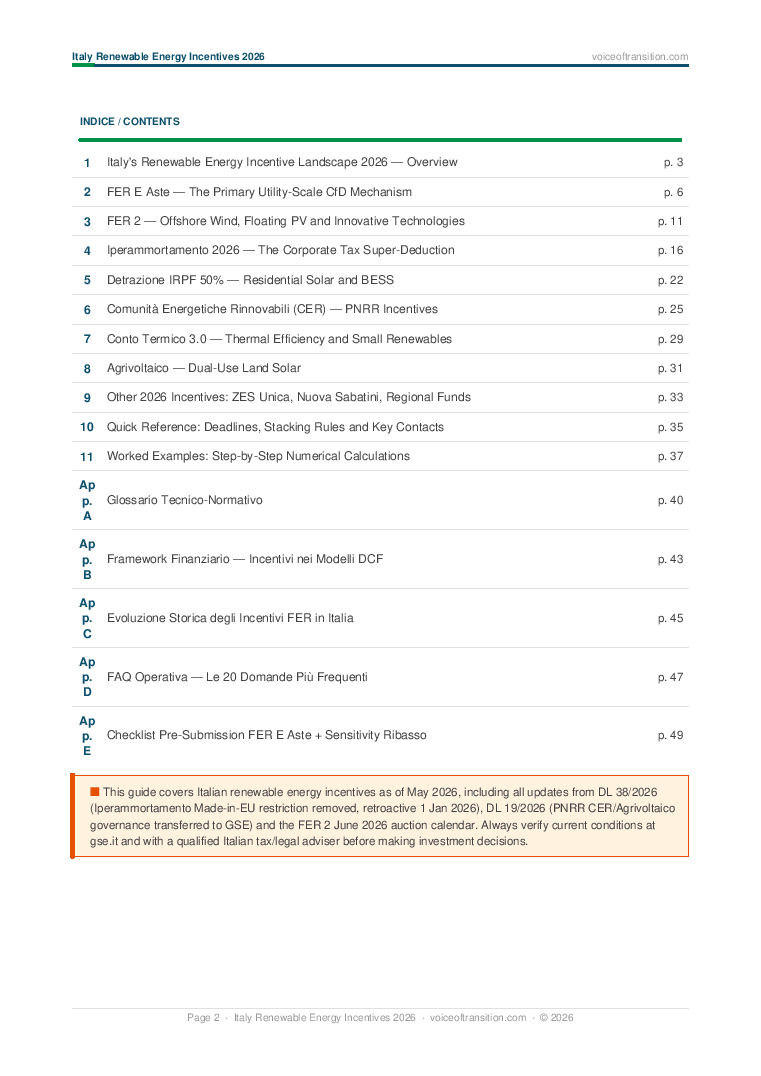
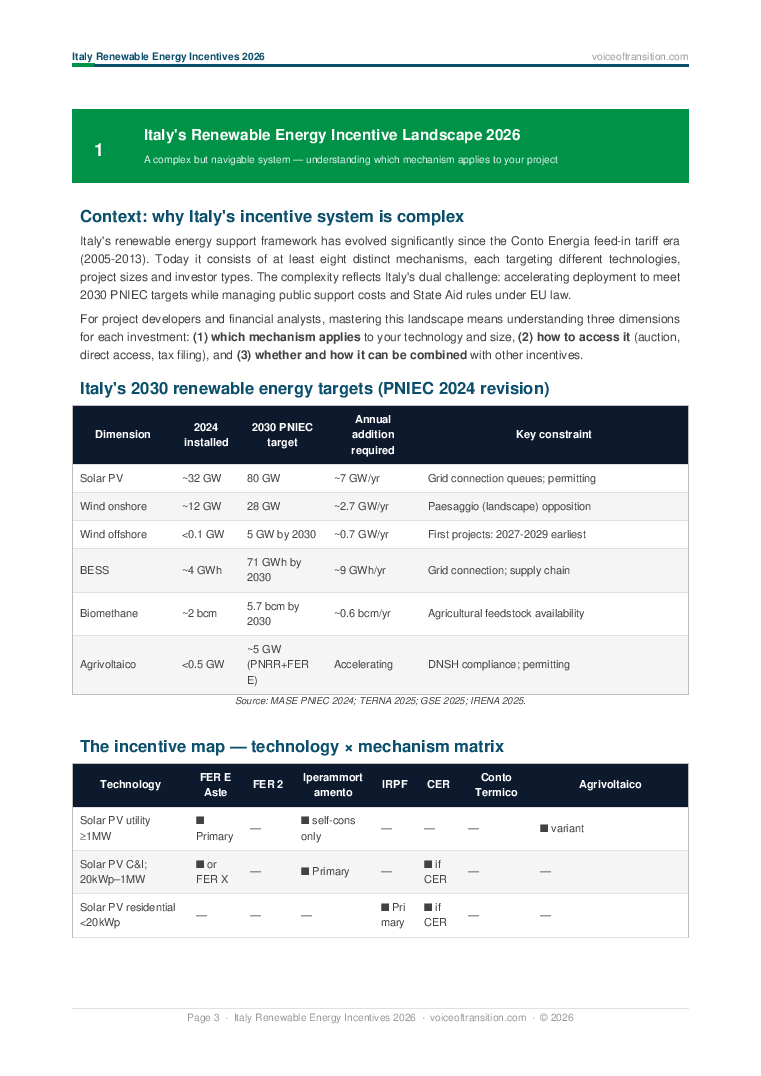
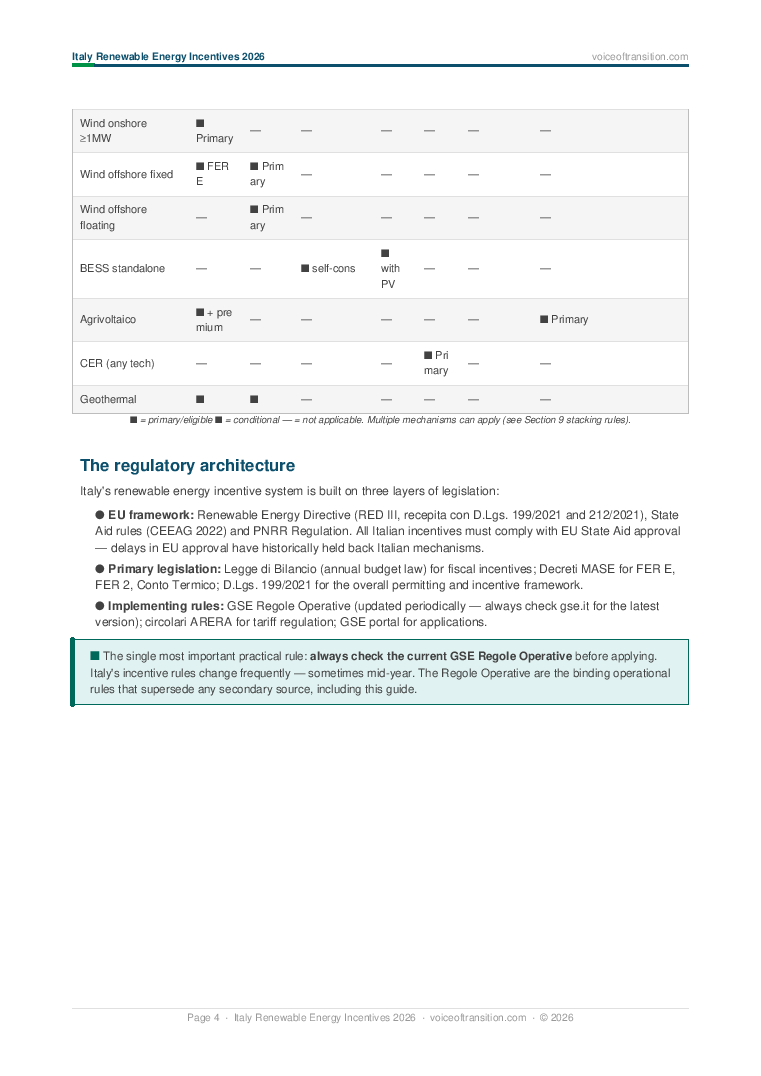
The guide opens with Italy's 2030 PNIEC targets and a complete technology-by-mechanism matrix showing at a glance which incentive applies to which project type and size. It then covers each mechanism in depth — FER E (the primary utility-scale CfD auction scheme), FER 2 (offshore wind, floating PV and innovative technologies), Iperammortamento 2026 (the corporate tax super-deduction replacing Transizione 4.0 and 5.0), the IRPF 50% residential deduction, Comunità Energetiche Rinnovabili (CER) with their PNRR capital grants, Conto Termico 3.0, Agrivoltaico, and supplementary mechanisms including ZES Unica, Nuova Sabatini and regional FESR funds.
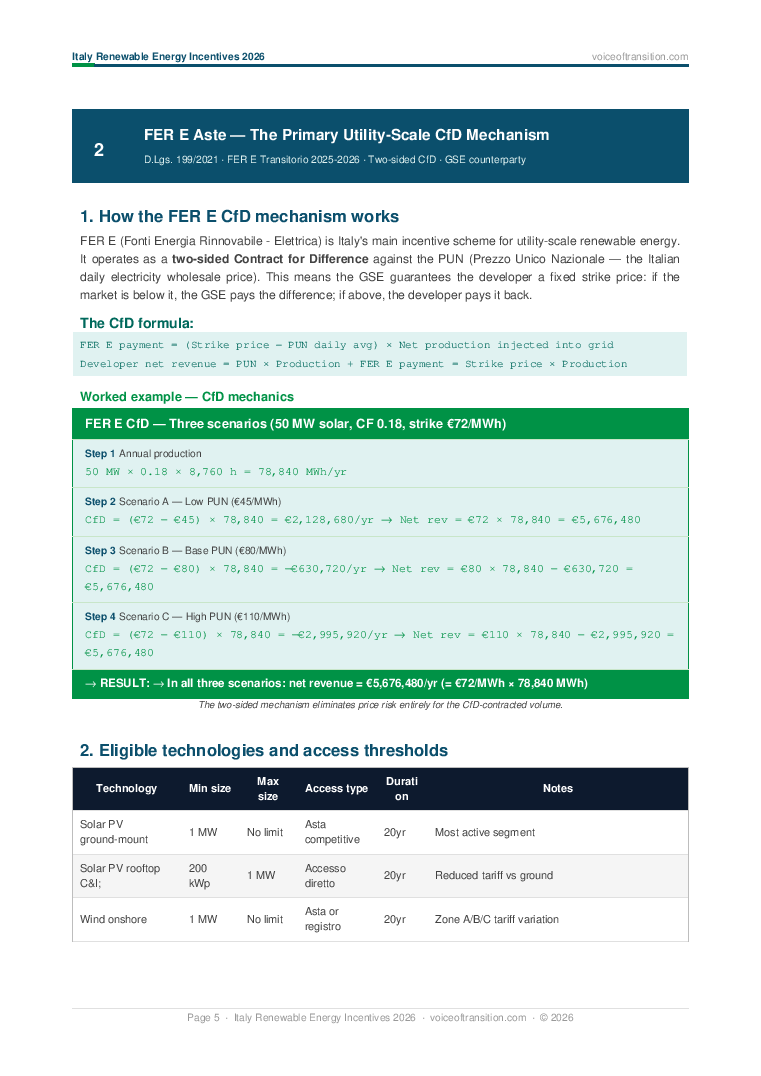
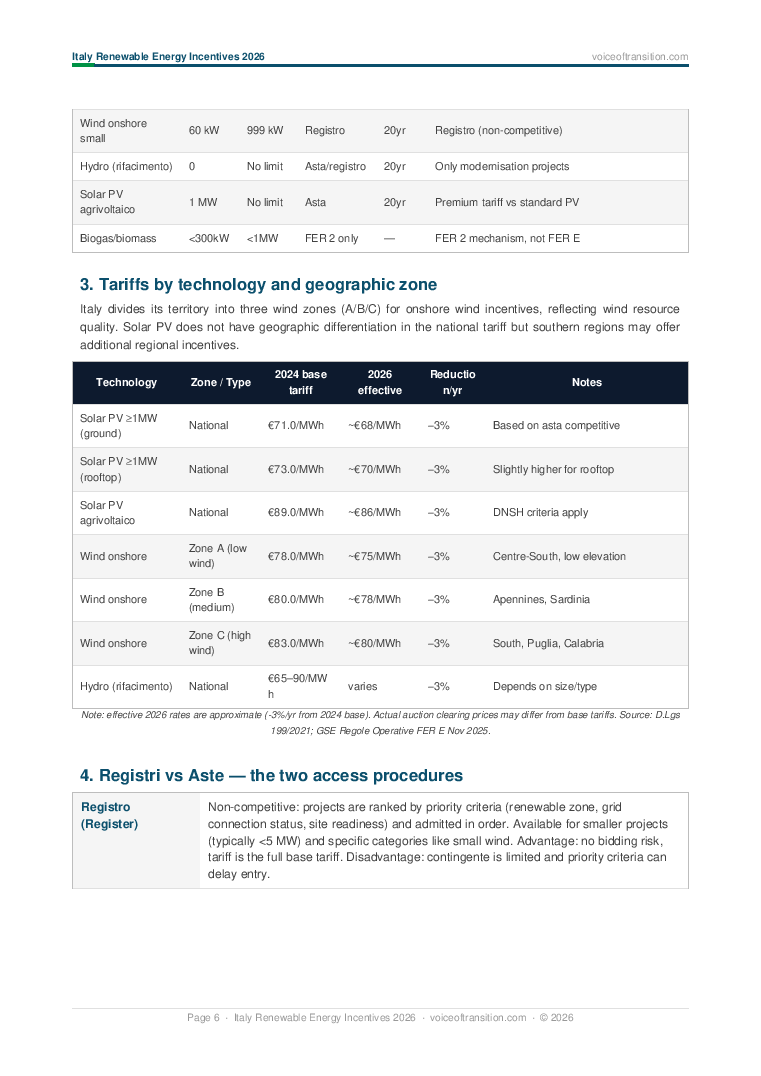
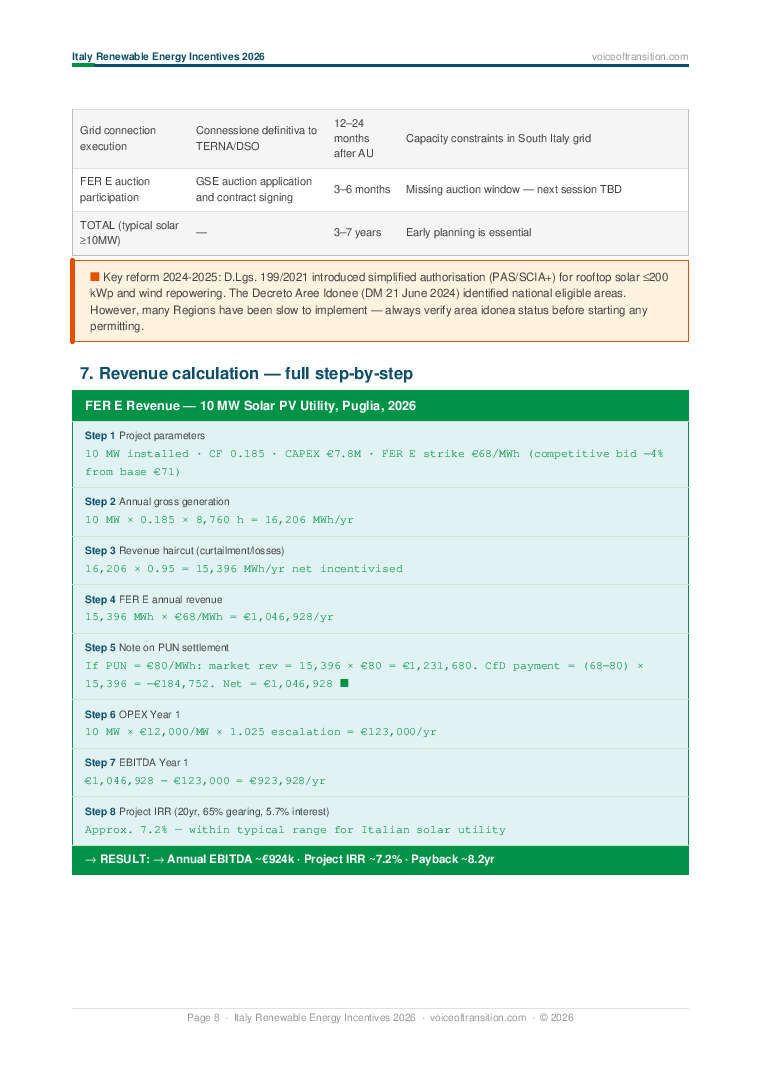
Each mechanism is explained with the same structure: how it works, eligible technologies and access thresholds, tariff tables by technology and geographic zone, application procedures, and a complete worked numerical example with every step shown explicitly. No incentive is presented without numbers.
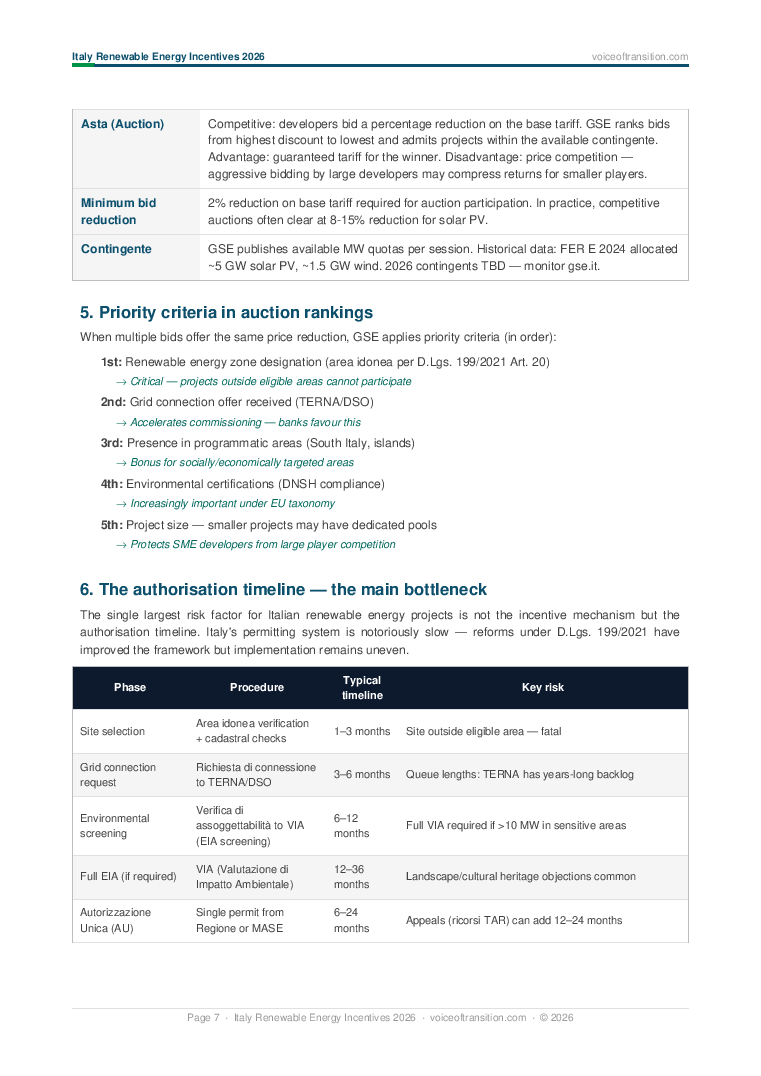
The authorisation timeline chapter explains why permitting — not the incentive mechanism itself — is the primary bottleneck for Italian renewable energy projects, with a phase-by-phase breakdown from site selection to FER E auction participation, typically 3 to 7 years for utility-scale solar.
A dedicated chapter on incentive stacking sets out what can and cannot be combined, with explicit rules for the most common combinations: FER E + ZES, Iperammortamento + FER E, CER tariff + PNRR grant, Agrivoltaico + ZES + PNRR. The guide includes four complete multi-incentive worked examples: a 50 MWp utility PV project in Puglia, a 500 kWp industrial rooftop in Lombardia, a CER in a comune of 3,000 inhabitants in Campania, and a 5 MWp agrivoltaico project in Sicily — showing in each case the full incentive stack, net CAPEX after grants, annual revenue, EBITDA and simple payback.
The financial modelling appendix identifies the ten most common errors when modelling Italian incentives — including treating IRPF as an upfront CAPEX reduction, modelling Iperammortamento as an immediate cash inflow, and applying FER E tariffs without the two-sided CfD mechanism — and provides the correct DCF structure for each project type.
The historical evolution appendix covers Italy's incentive track record from the Conto Energia era (2005–2013) to the current system, with an analysis of retroactive modifications — including the 2014 spalma incentivi — and a stress-test framework for regulatory risk in financial models.
The guide closes with a Quick Reference section covering all critical 2026 deadlines, a pre-submission checklist for FER E auctions, an auction bid sensitivity matrix (IRR and DSCR by discount percentage), a 20-question operational FAQ, and a comprehensive technical-regulatory glossary in Italian.
Italy's renewable energy incentive system is one of the most complex in Europe — and one of the most rewarding for developers, investors and corporate energy managers who understand how to navigate it. This guide covers the full landscape as of May 2026, including all updates from DL 38/2026 (Iperammortamento Made-in-EU restriction removed, retroactive 1 January 2026), DL 19/2026 (PNRR CER and Agrivoltaico governance transferred to GSE) and the FER 2 June 2026 auction calendar.
The guide opens with Italy's 2030 PNIEC targets and a complete technology-by-mechanism matrix showing at a glance which incentive applies to which project type and size. It then covers each mechanism in depth — FER E (the primary utility-scale CfD auction scheme), FER 2 (offshore wind, floating PV and innovative technologies), Iperammortamento 2026 (the corporate tax super-deduction replacing Transizione 4.0 and 5.0), the IRPF 50% residential deduction, Comunità Energetiche Rinnovabili (CER) with their PNRR capital grants, Conto Termico 3.0, Agrivoltaico, and supplementary mechanisms including ZES Unica, Nuova Sabatini and regional FESR funds.
Each mechanism is explained with the same structure: how it works, eligible technologies and access thresholds, tariff tables by technology and geographic zone, application procedures, and a complete worked numerical example with every step shown explicitly. No incentive is presented without numbers.
The authorisation timeline chapter explains why permitting — not the incentive mechanism itself — is the primary bottleneck for Italian renewable energy projects, with a phase-by-phase breakdown from site selection to FER E auction participation, typically 3 to 7 years for utility-scale solar.
A dedicated chapter on incentive stacking sets out what can and cannot be combined, with explicit rules for the most common combinations: FER E + ZES, Iperammortamento + FER E, CER tariff + PNRR grant, Agrivoltaico + ZES + PNRR. The guide includes four complete multi-incentive worked examples: a 50 MWp utility PV project in Puglia, a 500 kWp industrial rooftop in Lombardia, a CER in a comune of 3,000 inhabitants in Campania, and a 5 MWp agrivoltaico project in Sicily — showing in each case the full incentive stack, net CAPEX after grants, annual revenue, EBITDA and simple payback.
The financial modelling appendix identifies the ten most common errors when modelling Italian incentives — including treating IRPF as an upfront CAPEX reduction, modelling Iperammortamento as an immediate cash inflow, and applying FER E tariffs without the two-sided CfD mechanism — and provides the correct DCF structure for each project type.
The historical evolution appendix covers Italy's incentive track record from the Conto Energia era (2005–2013) to the current system, with an analysis of retroactive modifications — including the 2014 spalma incentivi — and a stress-test framework for regulatory risk in financial models.
The guide closes with a Quick Reference section covering all critical 2026 deadlines, a pre-submission checklist for FER E auctions, an auction bid sensitivity matrix (IRR and DSCR by discount percentage), a 20-question operational FAQ, and a comprehensive technical-regulatory glossary in Italian.
This Best Practice includes
1 PDF Guide