Real Estate Investment & Development Financial Model
Originally published: 31/08/2026 11:32
Publication number: ELQ-79739-1
View all versions & Certificate
certified

Real Estate Investment & Development Financial Model

Integrated Excel model for real estate acquisition, development, construction, financing, operations, valuation, sensitivity analysis, and investment returns.

Description

The Real Estate Investment & Development Financial Model is an integrated Excel-based financial modeling tool designed to evaluate the economics, funding requirements, operating performance, valuation, and investment returns of a real estate development project from acquisition through disposition.

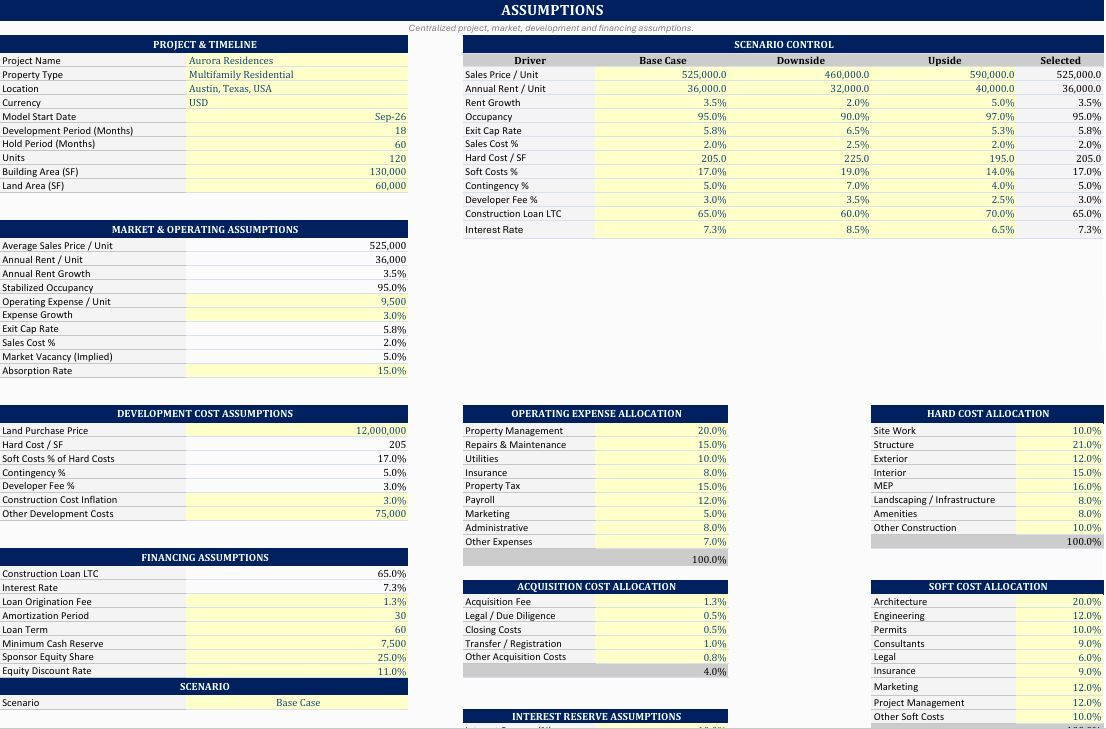
The model is structured around a centralized assumptions and scenario-control framework, allowing users to define project characteristics, development and hold periods, unit count, building area, land area, pricing, rental assumptions, occupancy, rent growth, operating expenses, construction costs, financing terms, exit assumptions, and other key project drivers. Built-in Base Case, Downside, and Upside scenarios allow users to evaluate alternative operating and market conditions.

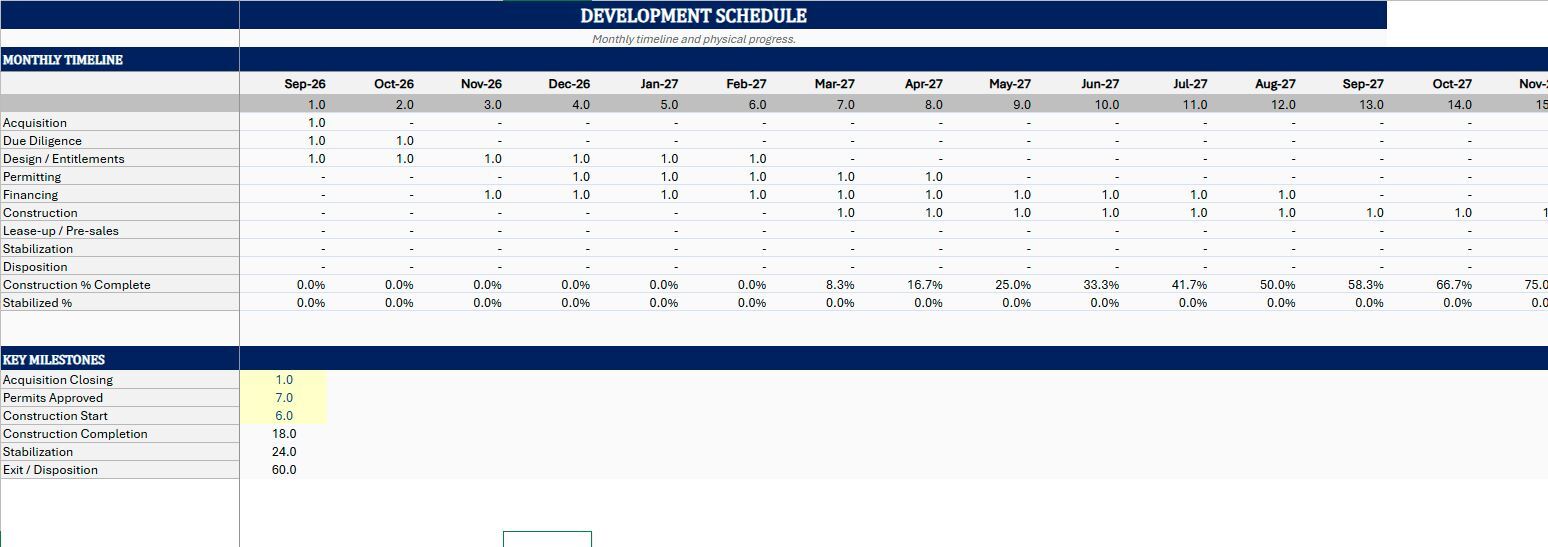
The Development Schedule provides a monthly project timeline covering acquisition, due diligence, design and entitlements, permitting, financing, construction, lease-up / pre-sales, stabilization, and disposition.

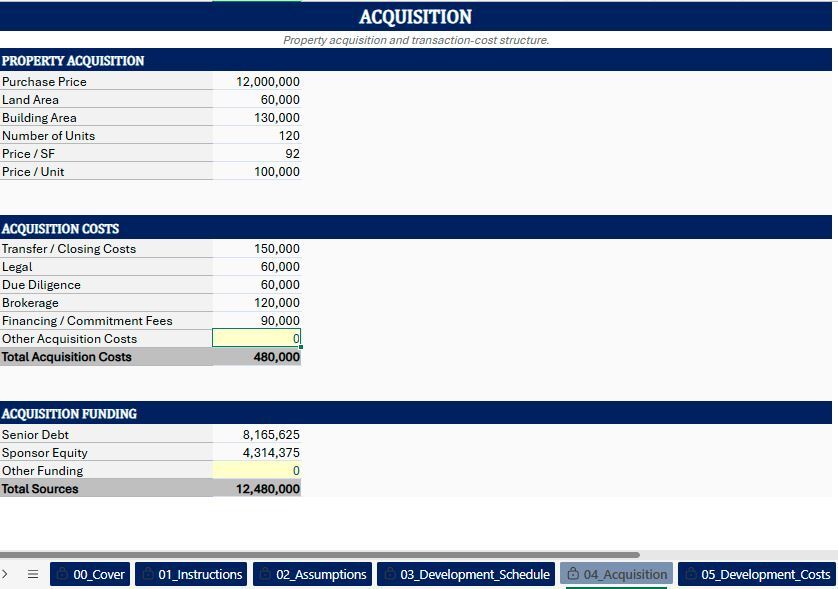
The Acquisition module calculates purchase price metrics, transaction costs, acquisition funding, and equity requirements.

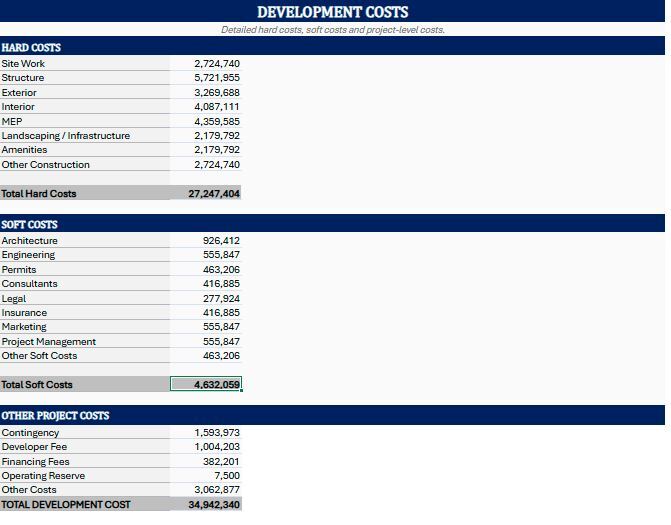
The Development Costs module provides a detailed breakdown of hard costs—including site work, structure, exterior, interior, MEP, landscaping/infrastructure, amenities, and other construction—together with soft costs such as architecture, engineering, permits, consultants, legal, insurance, marketing, and project management. Contingency, developer fees, financing costs, reserves, and other project costs are incorporated into total development cost.

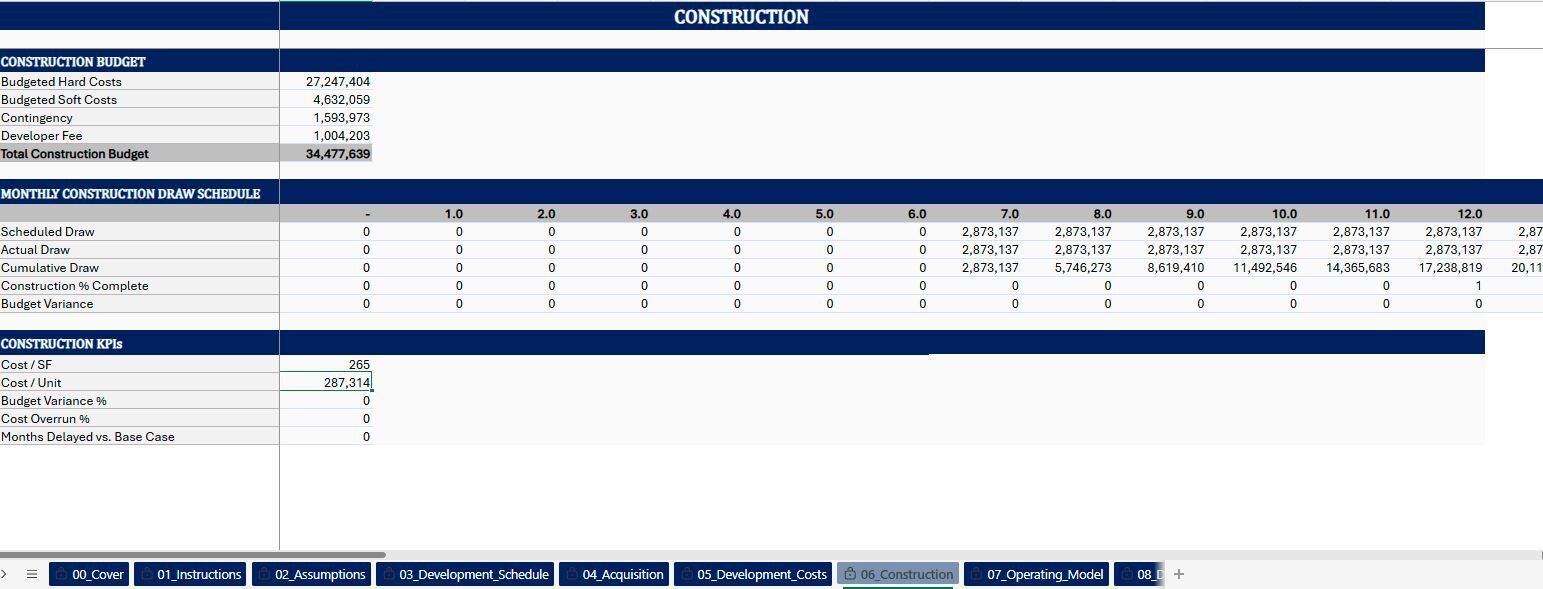
The Construction module converts the development budget into a monthly draw schedule and tracks cumulative construction spending, completion progress, budget variance, cost overruns, cost per SF, and cost per unit.

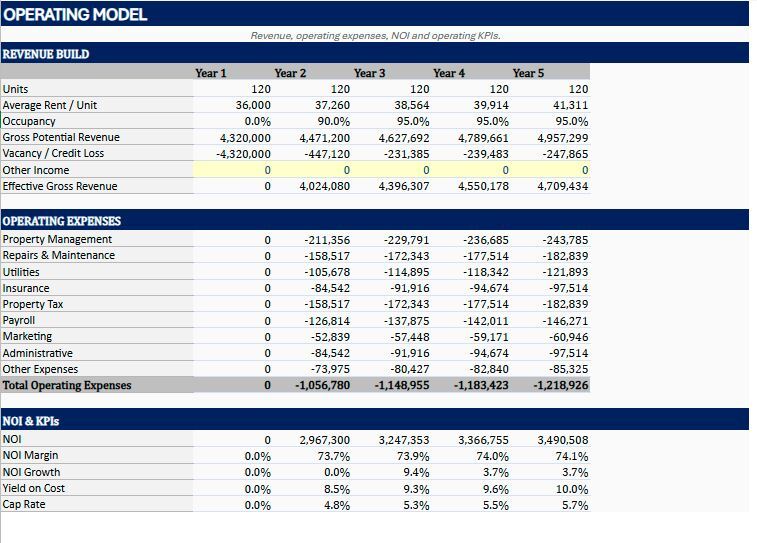
The Operating Model projects five years of revenue and operating performance using units, rental rates, rent growth, occupancy, vacancy/credit loss, other income, operating expenses, and expense growth. The model derives Effective Gross Revenue and Net Operating Income (NOI).

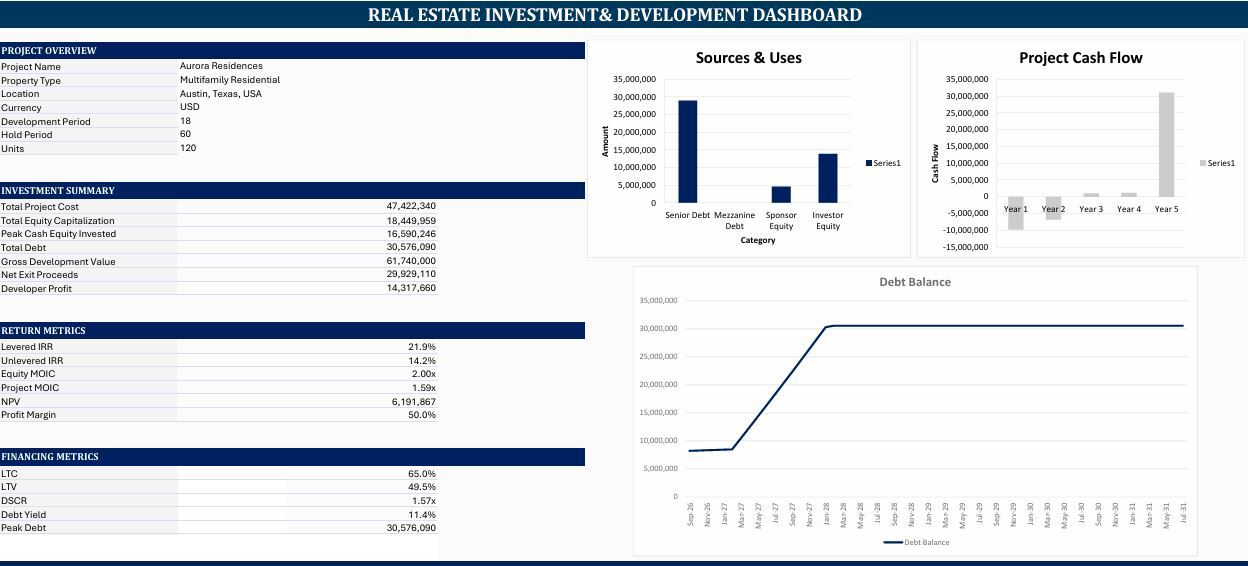
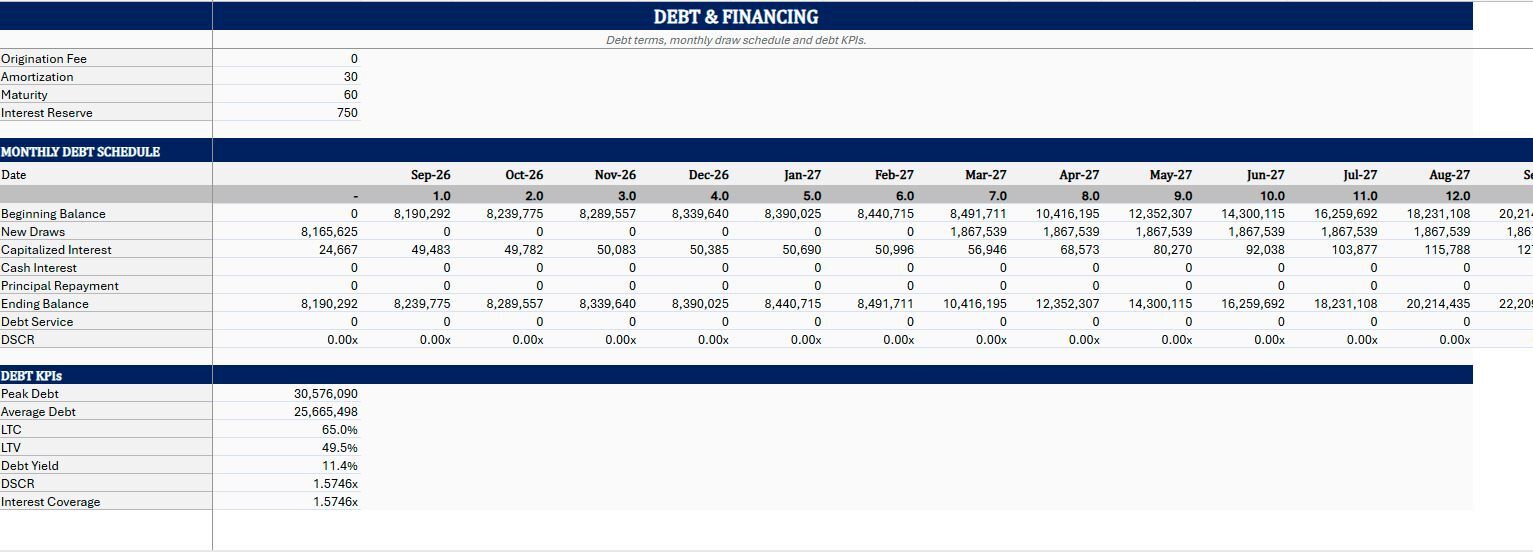
The Debt & Financing module provides a monthly debt schedule incorporating construction loan capacity, new draws, capitalized interest, cash interest, principal repayment, ending debt balances, debt service, and key financing metrics including LTC, LTV, DSCR, Debt Yield, peak debt, and interest coverage.

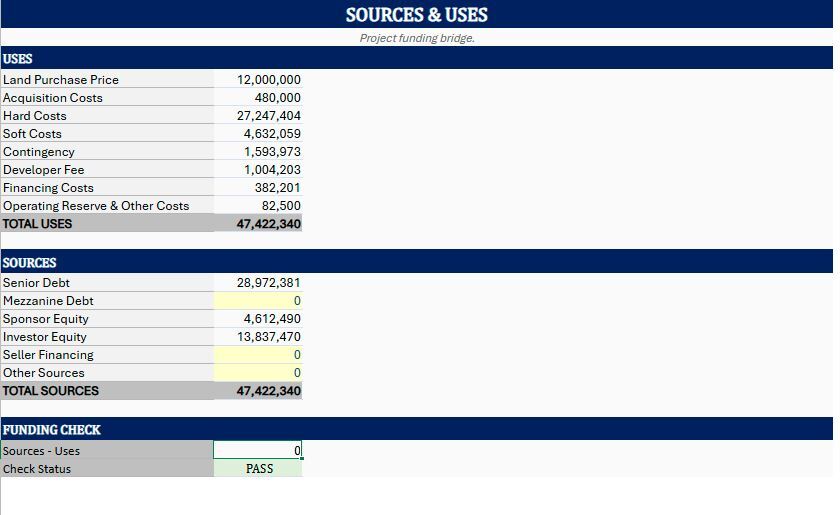
The Sources & Uses module reconciles total project funding requirements against senior debt, sponsor equity, investor equity, and other potential funding sources.

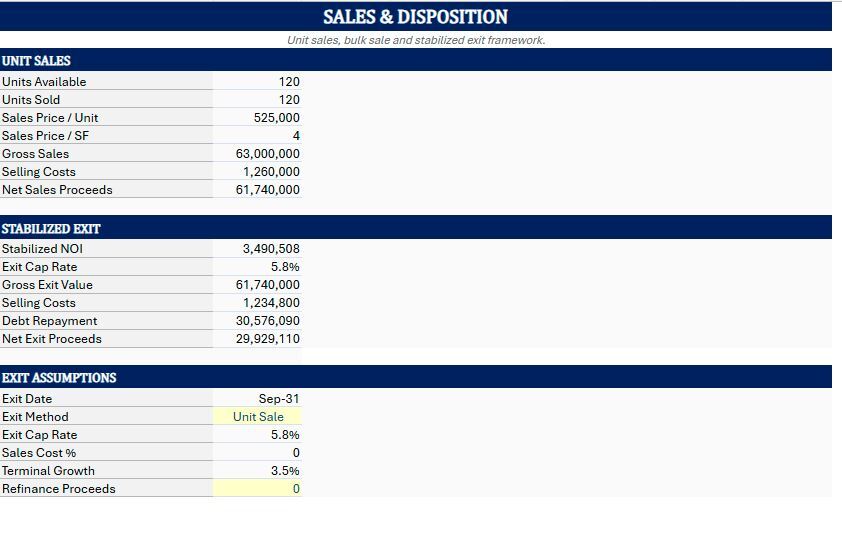
The Sales & Disposition module supports unit sales, bulk sale, and stabilized exit approaches, calculating gross sales, selling costs, exit value, debt repayment, refinancing proceeds, and net exit proceeds.

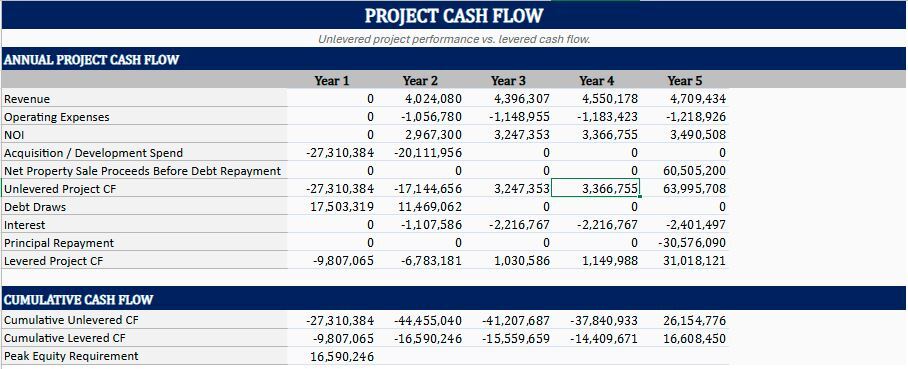
The Project Cash Flow module presents annual unlevered and levered project cash flows, including revenue, operating expenses, NOI, acquisition/development spending, property sale proceeds, debt draws, interest, and principal repayment.

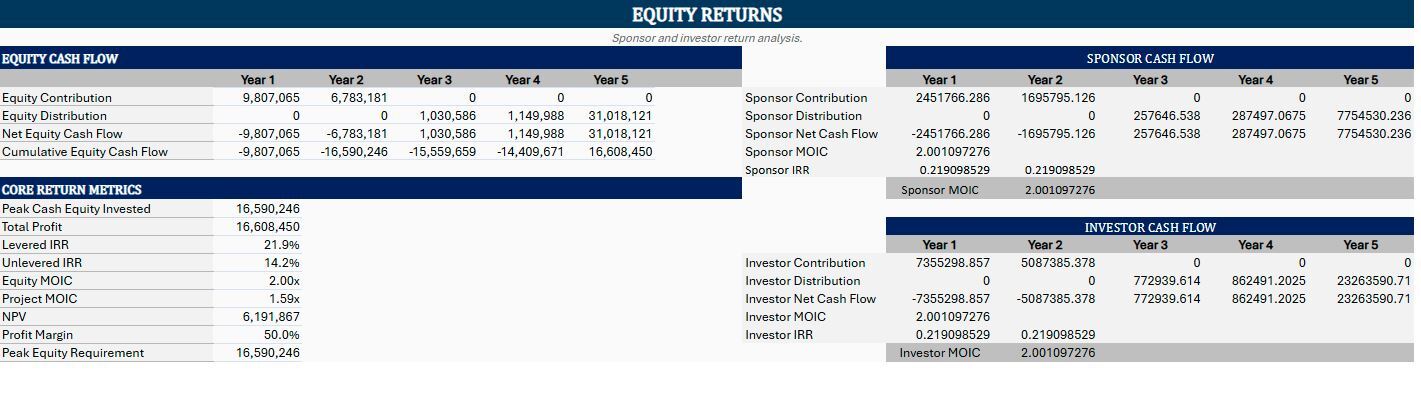
The Equity Returns module calculates equity contributions, distributions, cumulative equity cash flow, peak equity requirement, total profit, levered and unlevered IRR, Equity MOIC, Project MOIC, NPV, and profit margin. Sponsor and investor-level return calculations are also incorporated.

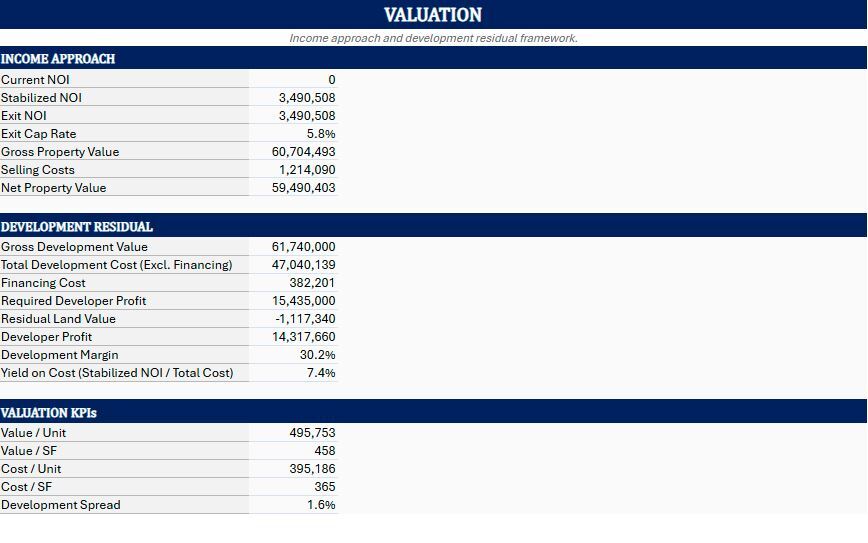
The Valuation module combines an income approach with a development residual framework, calculating gross and net property value, gross development value, development cost, financing cost, required developer profit, residual land value, developer profit, development margin, yield on cost, value per unit, value per SF, cost per unit, cost per SF, and development spread.

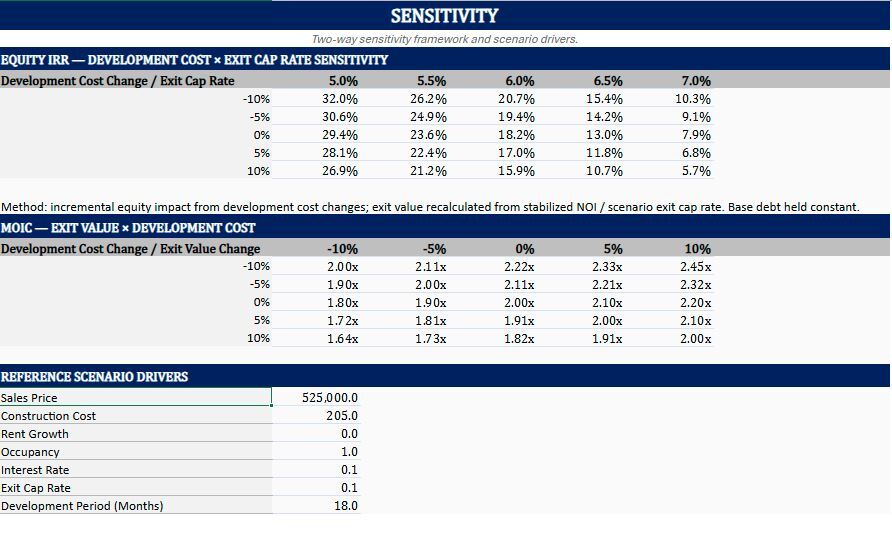
The Sensitivity module provides two-way sensitivity analysis for Equity IRR based on development cost and exit capitalization rate, as well as MOIC sensitivity based on exit value and development cost. Reference scenario drivers are also displayed for key assumptions.

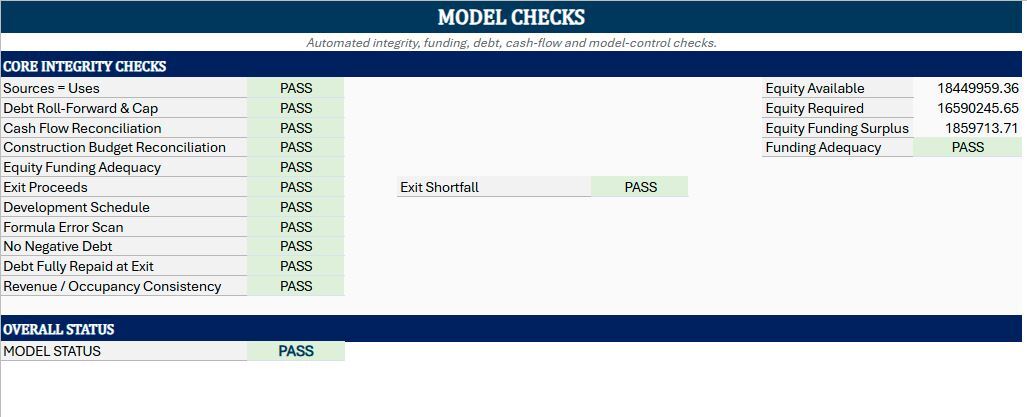
Finally, the Dashboard consolidates the principal investment, development, financing, valuation, and return metrics into an executive-level view, while the Model Checks module performs automated integrity controls covering Sources & Uses, debt roll-forward, cash flow reconciliation, construction budget reconciliation, equity funding adequacy, exit proceeds, development schedule, formula errors, negative debt balances, debt repayment at exit, and revenue/occupancy consistency.

The result is a structured, interconnected financial model suitable for analyzing development feasibility, capital requirements, financing structure, operating performance, exit strategies, valuation, risk scenarios, and investor returns.

This Best Practice includes
Blank Template (.xlsx), Demo Version (.xlsx), LibreOffice Version (.ods), User Manual (.pdf)

Acquire business license for $49.00

Add to cart

Add to bookmarks

Discuss

Further information

Provide a structured framework for analyzing real estate development projects, including project feasibility, development costs, financing requirements, operating performance, valuation, cash flow, investment returns, and sensitivity analysis.

Real estate acquisition and development projects.
Residential, commercial, or mixed-use development projects.
Projects requiring construction and development financing.
Investment feasibility and return analysis.
Projects with defined development, operating, and exit assumptions.

Pure property management or accounting purposes.
Existing stabilized properties with no development component.
Projects requiring specialized tax, legal, engineering, or construction-cost analysis.
Situations where reliable project, market, financing, or operating assumptions are unavailable.
Decisions requiring professional advice beyond financial modeling.


0.0 / 5 (0 votes)

please wait...