Integrated Three-Statement Operating Model - 10 Years, Revolver, Covenant Headroom, Cross-Checked Valuation
Originally published: 25/09/2026 16:16
Publication number: ELQ-33588-1
View all versions & Certificate
certified

Integrated Three-Statement Operating Model - 10 Years, Revolver, Covenant Headroom, Cross-Checked Valuation

Ten-year three-statement model: revolver and cash sweep with zero circular references, covenant headroom in dollars, a DCF that cross-checks itself.

Description
Three-statement templates are the most crowded shelf in financial modelling, and almost all of them have the same hole in the same place. The revolver draws when cash runs short. The interest charge depends on how much is drawn. The cash position depends on the interest charge. That is a loop, and there are only two honest ways out of it: switch on iterative calculation, which makes the file fragile and gives different answers in LibreOffice and Google Sheets, or leave the revolver out altogether and let cash go negative in a bad year.

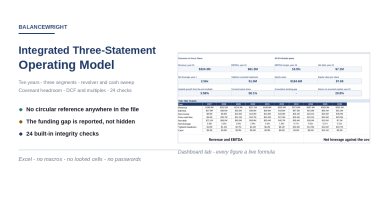
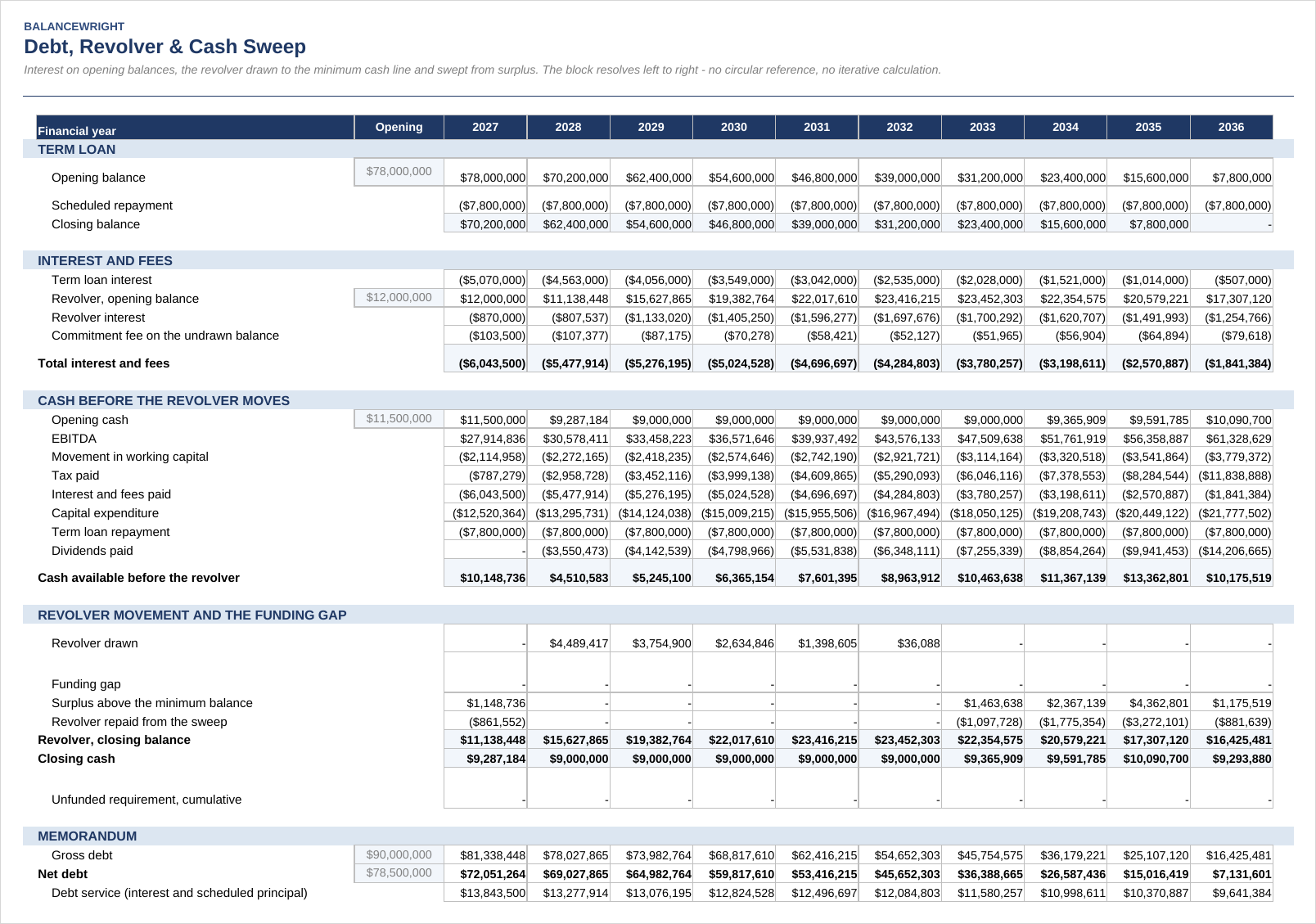
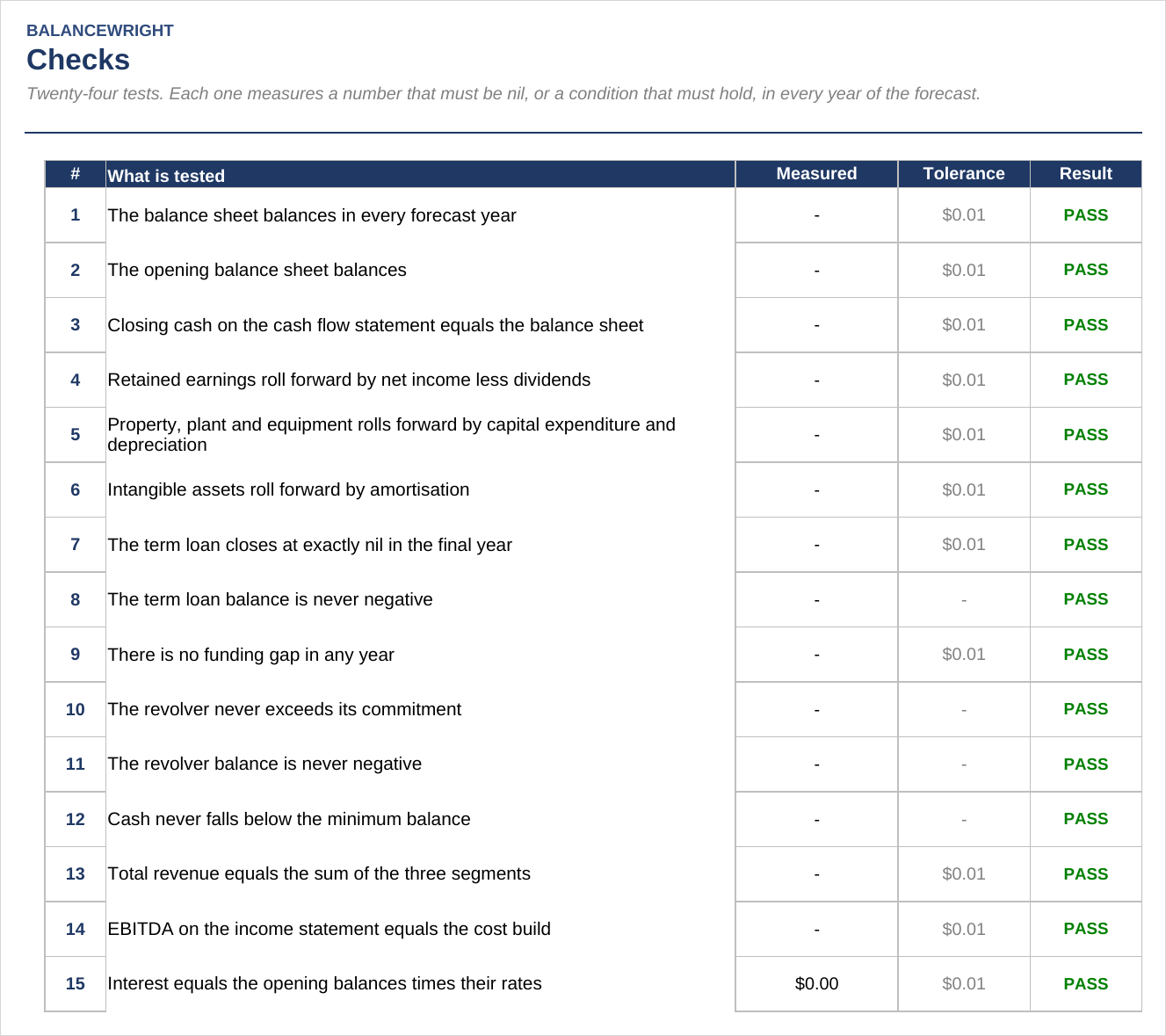
This model takes the third way. Interest is charged on the balance at the start of the year, so the interest for a year is known before that year's cash flow is computed, the revolver draw is a function of a cash position that is already settled, and the entire financing block resolves left to right in one pass. There is not a single circular reference anywhere in the file. It computes the same numbers in every spreadsheet application, first time, with iterative calculation switched off - and Check 15 proves it by recomputing every interest charge in the workbook from the opening balances and their rates.

What is in the workbook. Fourteen tabs and 2,055 live formulas across ten forecast years and an opening actual column. Revenue from three segments, each with its own volume, growth, price and price growth. Cost split into what moves with volume and what does not. Working capital on five day counts. Capital expenditure separated into maintenance, as a share of revenue, and growth, as a share of the increase in revenue, each with its own depreciation schedule. An amortising term loan whose instalment is capped at the balance outstanding, a revolving credit facility with a commitment fee on the undrawn balance, a minimum cash balance the revolver is drawn to hold, and a cash sweep. Tax through a loss carry-forward pool. A dividend that is a policy rather than an input: a share of earnings, switched off entirely in any year following a close above the leverage limit you set.

The funding gap is reported, not hidden. When the revolver is exhausted and cash would still fall below the minimum balance, this model does not let cash go negative and does not borrow more than the facility allows. It reports the shortfall, names the first year it opens, carries it on the balance sheet as an unfunded requirement so the statements still balance, and fails a check. Switch the scenario to Downside and watch it happen: the revolver reaches its limit in year eight and the gap opens.

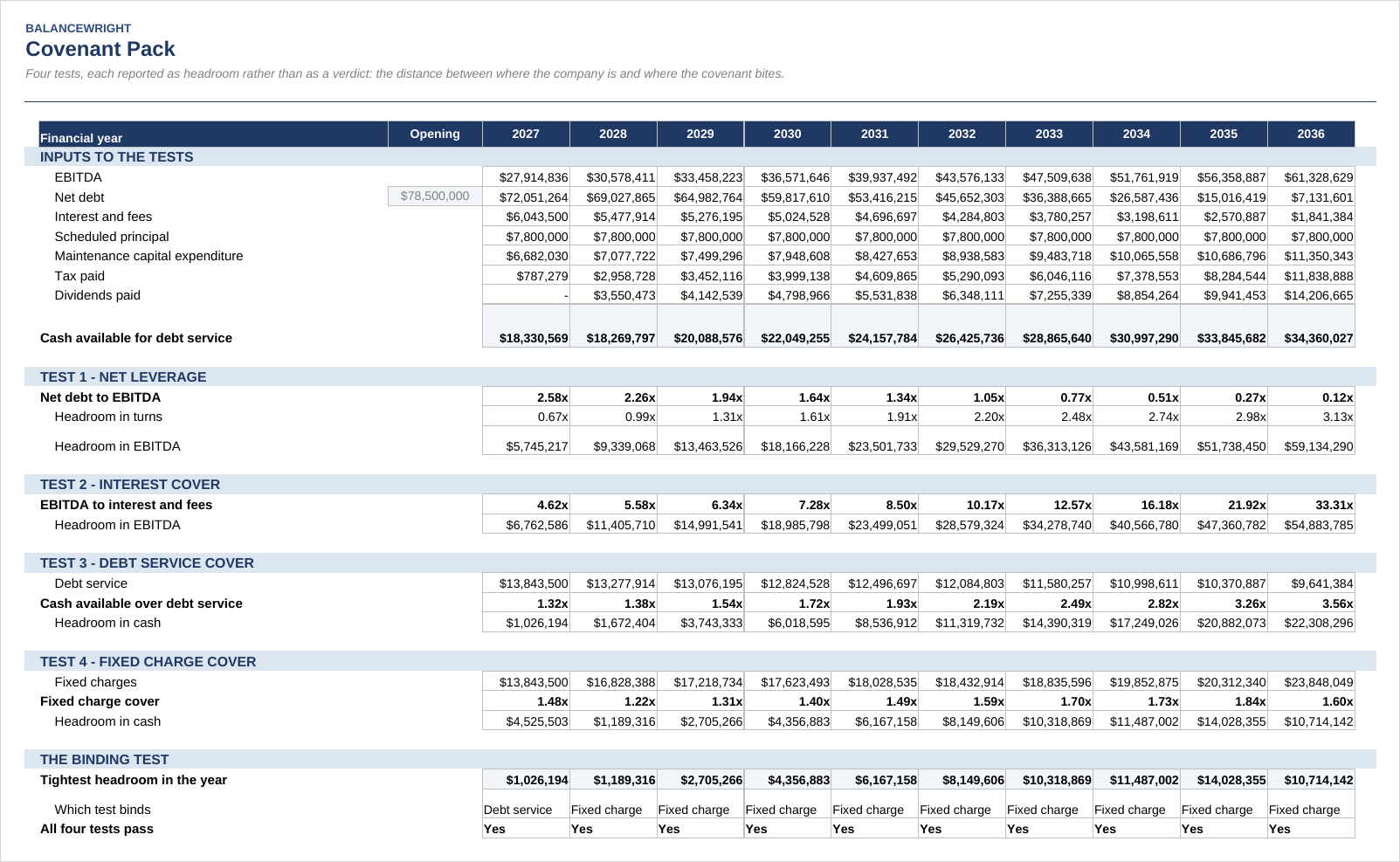
Covenants reported as headroom. Four tests - net leverage, interest cover, debt service cover and fixed charge cover - each reported three ways: the ratio, the headroom in the units the covenant is written in, and the headroom in dollars of EBITDA. The binding test is named in every year, so you can see at a glance which covenant you are actually running the company against.

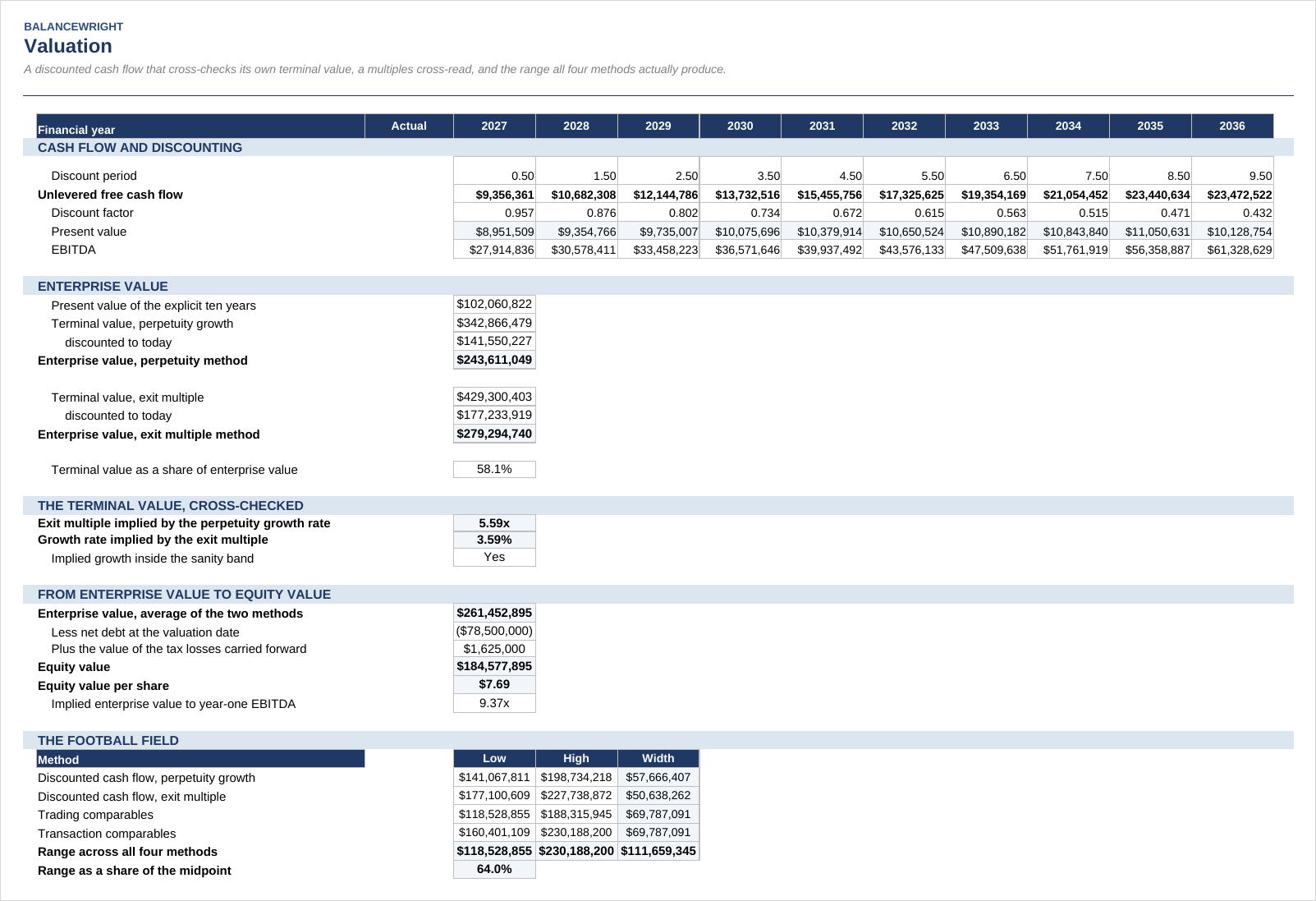
A valuation that cross-checks itself. Unlevered free cash flow discounted at the weighted average cost of capital with an optional mid-year convention, and the terminal value computed twice - once as a growing perpetuity and once at an exit multiple of final-year EBITDA. The two are then turned against each other: the perpetuity terminal value is divided by final-year EBITDA to give the exit multiple it implies, and the exit-multiple terminal value is solved back for the growth rate that would make a perpetuity worth the same, tested against a sanity band you set. That second calculation is the one almost nobody does, and it is the one that catches a terminal value nobody would defend out loud. A football field then sets all four methods side by side.

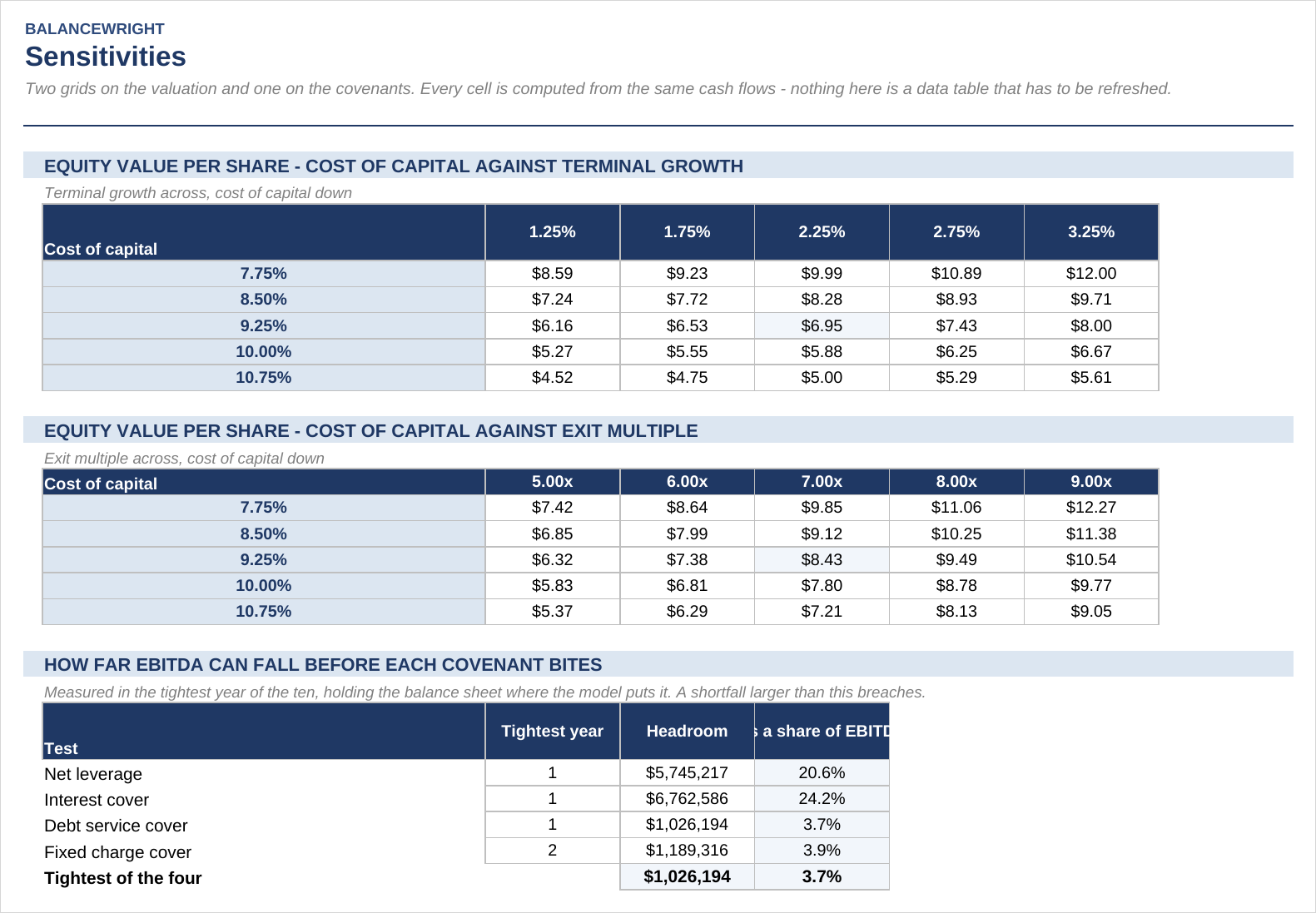
Sensitivities that do not go stale. Two twenty-five cell grids - cost of capital against terminal growth, and cost of capital against the exit multiple - and a table showing how far EBITDA can fall in its tightest year before each covenant bites. None of it is an Excel data table: every cell is an ordinary formula computed from the same cash flows the Valuation tab uses.

Twenty-four checks. Each measures a number that must be nil, or a condition that must hold, in every one of the ten years: the balance sheet balances, the cash flow statement ties to it, retained earnings roll forward by net income less dividends, the asset schedules roll forward, the term loan closes at exactly nil, the revolver never exceeds its commitment and never goes negative, cash never falls below the minimum, interest is a function of opening balances only, tax is never a credit, dividends never exceed the policy, the sensitivity grid agrees with the valuation, and the implied growth rate stays inside its band. All twenty-four pass in the worked example.


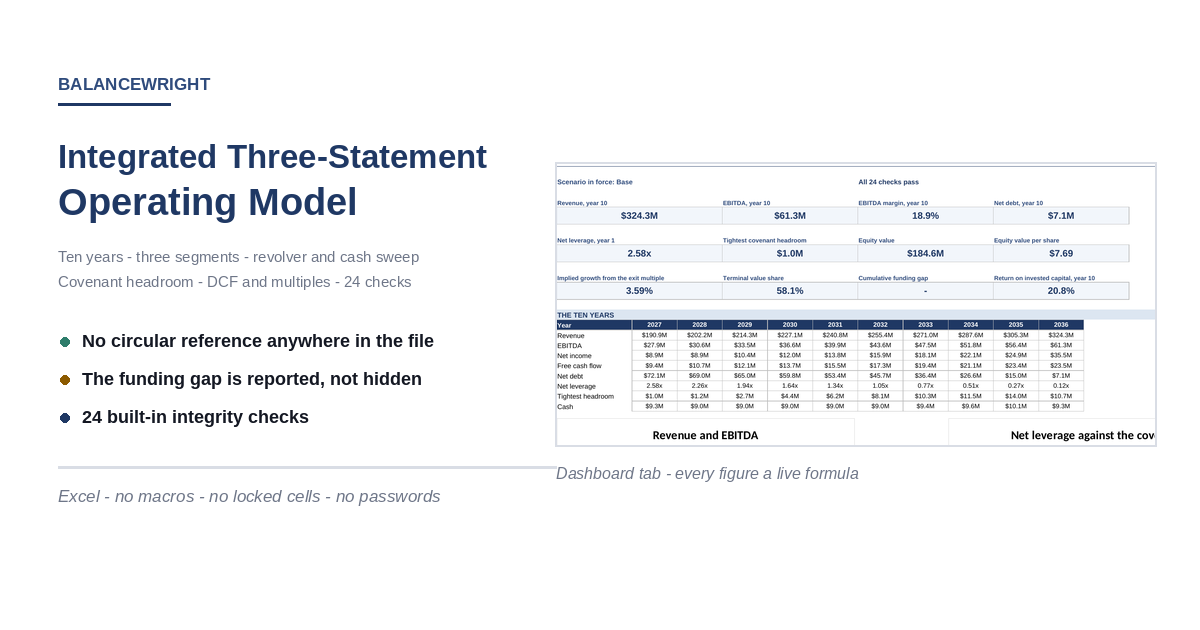
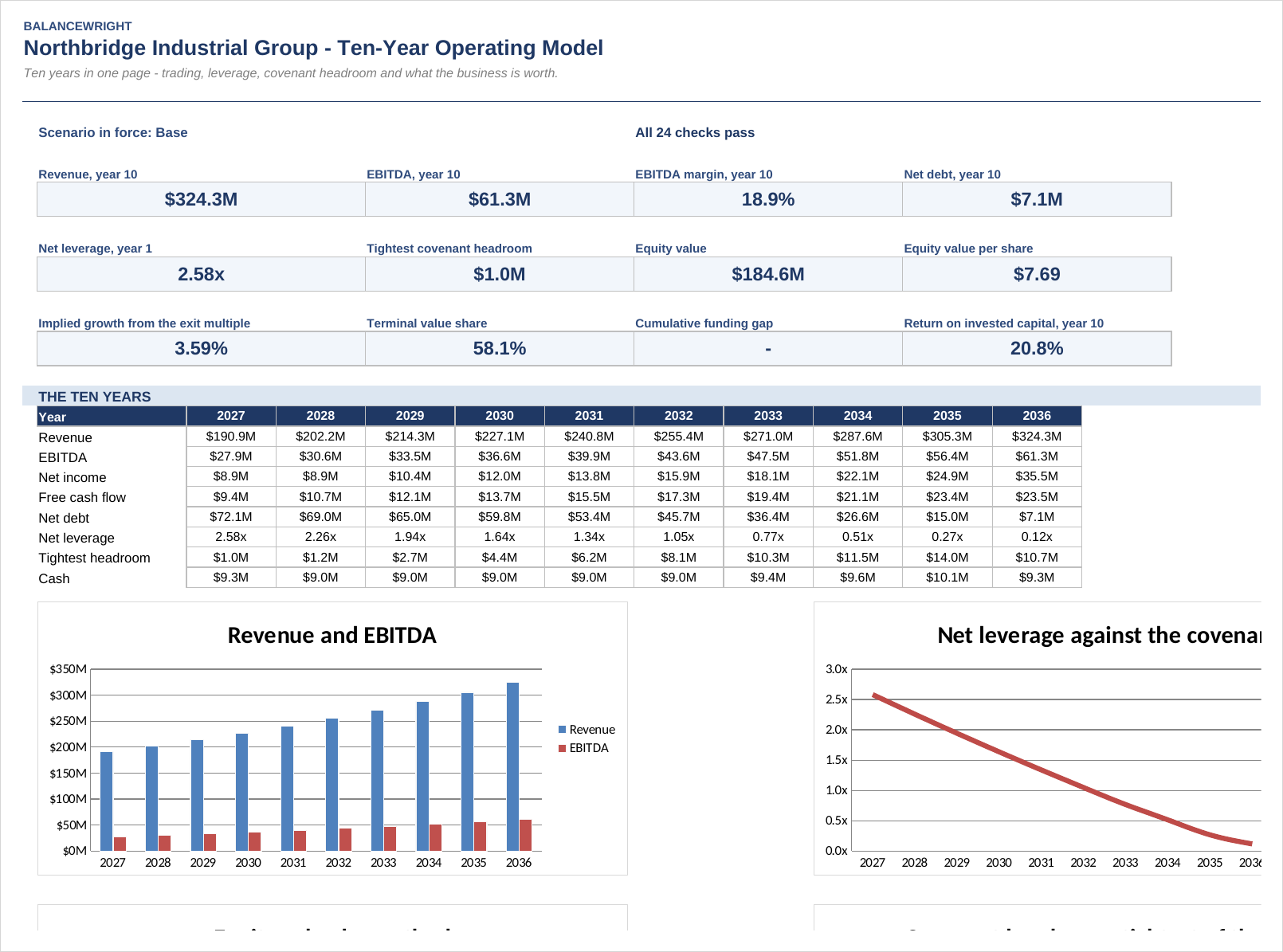
The worked example. A specialty industrial group on 191 million dollars of revenue in forecast year one, carrying 78 million of term debt and a 35 million revolver at 3.12x opening net leverage, growing revenue at 6.1 per cent a year to 324 million with EBITDA margin expanding from 14.6 to 18.9 per cent. Tightest covenant headroom of 1.0 million in year one, on debt service cover. An equity value of 185 million, 7.69 dollars a share, against a football-field range of 119 to 230 million.
What it is not. Not a consolidation - one entity, one currency, no minorities, no eliminations. Not a merger or leveraged buyout model. No deferred tax: cash tax and the tax charge are the same number, the honest simplification at this size. Revenue is recognised as billed. And it is annual, so if you need a weekly view of liquidity a thirteen-week direct cash flow is the right tool and this is not it.


Format. One Excel workbook (.xlsx), fourteen tabs. No macros, no add-ins, no external links, no password protection, no locked cells, and iterative calculation off because the file does not need it. Opens in Excel 2016 and later, Microsoft 365, LibreOffice Calc, Apple Numbers and Google Sheets. An illustrated guide is included as a second download.

This Best Practice includes
1 Excel workbook with 14 tabs and 2,055 live formulas, plus a 10-page illustrated PDF guide

Acquire business license for $79.00

Add to cart

Add to bookmarks

Discuss

Further information

Forecast a mid-market company for ten years and answer three questions a spreadsheet usually dodges: does it run out of committed facilities, how much room is left on its covenants, and what is it worth.

You need an operating model a bank, a board or a buyer can audit line by line - one that computes identically in Excel, LibreOffice and Google Sheets with iterative calculation switched off.

You need a consolidation, a merger or LBO model, deferred tax, or a weekly view of liquidity. This is one entity, one currency, annual periods.


0.0 / 5 (0 votes)

please wait...