Government Contractor Borrowing Base Control Tower
Originally published: 14/09/2026 09:14
Publication number: ELQ-72825-1
View all versions & Certificate
certified

Government Contractor Borrowing Base Control Tower

A quantitative Excel tool for receivables eligibility, facility assumptions, reconciliation, and borrowing-base sign-off.

Description
Business challenge
Borrowing-base reporting for government contractors requires more than totaling open invoices. Each reporting cycle can involve aging tests, billing conditions, retainage, offsets, concentrations, contract-specific restrictions, and lender-defined exclusions. When those decisions are made across disconnected workpapers, the final collateral figure can be difficult to reproduce and explain. This quantitative Excel tool organizes the review into one traceable workflow.

Demonstration evidence
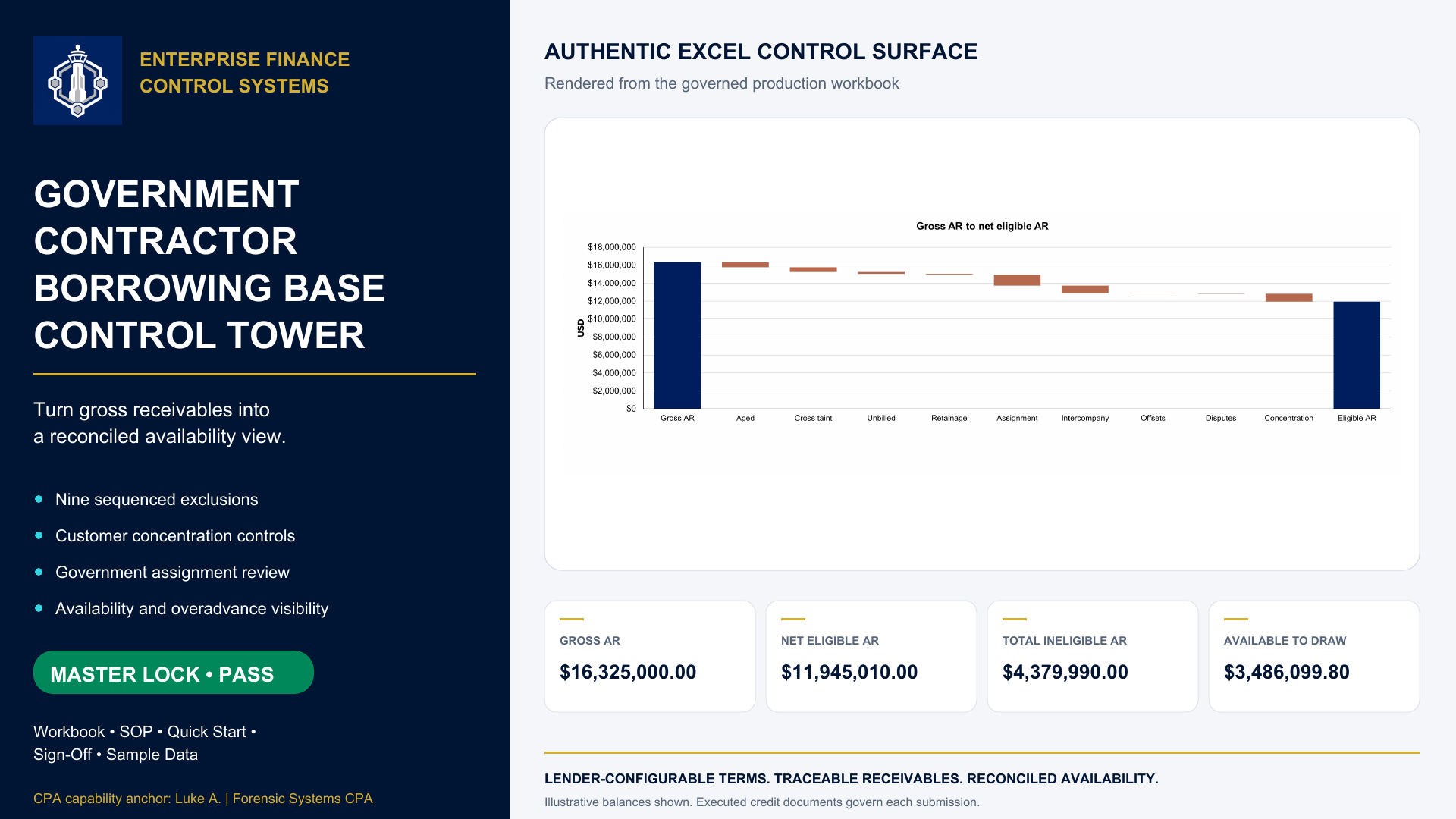
The supplied example includes 1,200 fictional enterprise accounts-receivable and billing records. It evaluates nine ineligible-receivable criteria and applies an 85% facility advance-rate assumption. The workbook contains 50,317 formulas and fifteen formula-driven integrity checks. In the included demonstration, the reconciliation delta is $0.0000. These facts describe the delivered sample model and are not guarantees for another company, data set, or credit agreement.

Practical workflow
Users begin by mapping authorized receivables and billing information into the controlled input structure. They confirm current facility rules, review the exclusion analysis, investigate exceptions, reconcile eligible receivables to the borrowing-base calculation, and document the final approval. The calculation trail remains visible so reviewers can understand why an item was excluded and how a movement affected available collateral.

The visible exception trail also gives preparers and reviewers a common basis for resolving disputed classifications before the final collateral position is approved and communicated.

Delivered materials
The five-file customer suite contains the Excel model, an operating procedure, a Quick Start Guide, a borrowing-base sign-off template, and fictional sample data. Three customer PDFs support onboarding, recurring operation, responsibility assignment, exception handling, escalation, and acceptance. This combination is intended to reduce implementation ambiguity and create a consistent reporting record.

Intended audience
The tool is designed for controllers, treasury teams, credit professionals, finance transformation leaders, and government-contractor accounting groups. It can support recurring certificate preparation, lender discussions, internal review, and controlled handover between preparers and approvers.

Important boundary
The included records are synthetic and must be replaced with authorized company data. This model is a decision-support control tool. It does not replace lender requirements, legal interpretation, contract review, regulatory obligations, accounting policy, or professional judgment. Validate every exclusion rule, advance rate, cap, concentration, reporting obligation, and approval requirement against the governing facility and current facts before operational use.

This Best Practice includes
1 Excel model, 3 customer PDFs, and 1 fictional sample-data CSV.

Acquire business license for $499.00

Add to cart

Add to bookmarks

Discuss

Further information

Provide a visible path from source receivables through exclusions, eligible collateral, borrowing-base calculation, reconciliation, and sign-off.

Use when controlled source mapping, lender-rule validation, exception review, reconciliation, and documented approval are required.

Do not use as lender approval, legal advice, regulatory assurance, an accounting opinion, or a substitute for current facility terms.


0.0 / 5 (0 votes)

please wait...