3-Statement Financial Model with DCF, Comparables, & LBO Returns – Excel & Google Sheets
Originally published: 07/08/2026 13:06
Publication number: ELQ-82010-1
View all versions & Certificate
certified

3-Statement Financial Model with DCF, Comparables, & LBO Returns – Excel & Google Sheets

An integrated three-statement operating model valued three ways: discounted cash flow (DCF), trading comparables, and precedent transactions with an acquisition

Description
What this is

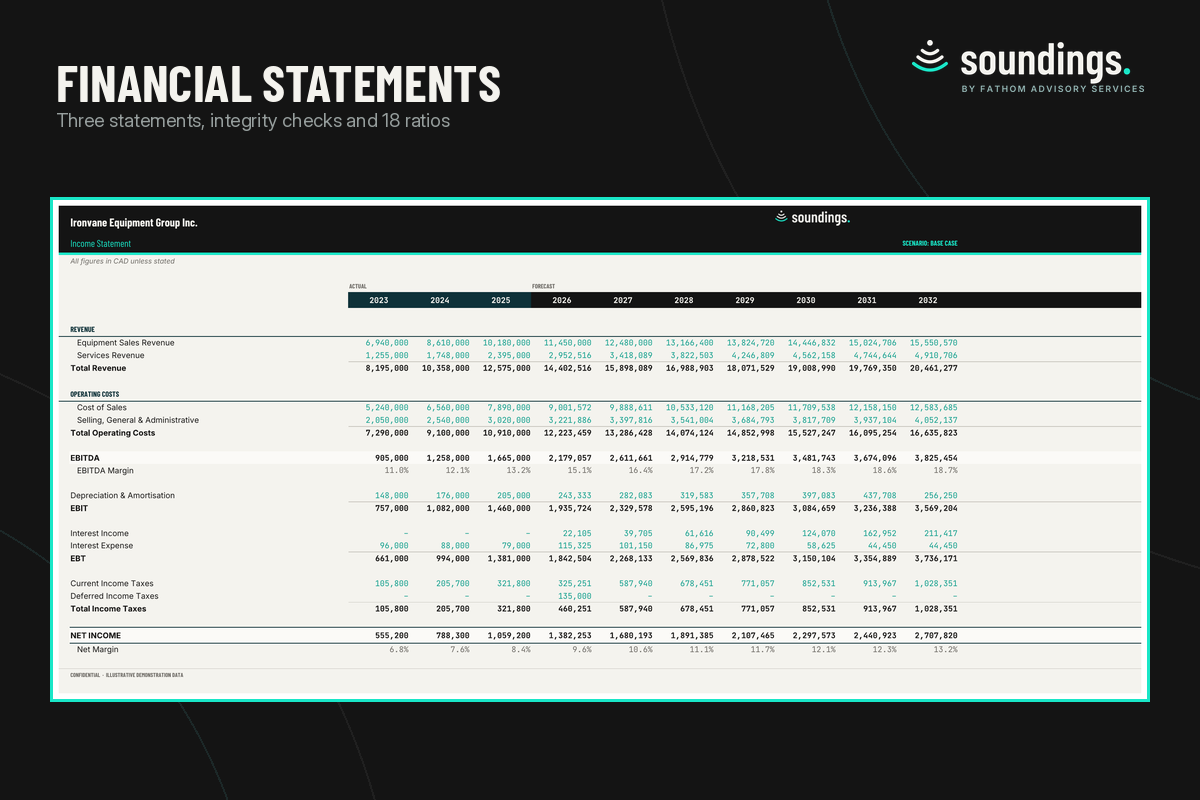
A complete three-statement operating model including income statement, cash flow statement, and balance sheet, fully linked with three valuation approaches built on top of it, an acquisition returns overlay, and the documentation a reviewer will ask for.


You enter three years of historical accounts on one input sheet and set your assumptions. The model produces a forecast of three to ten years, an enterprise value, an equity value, a defensible range across four methods, and the monthly cash profile of the first year.


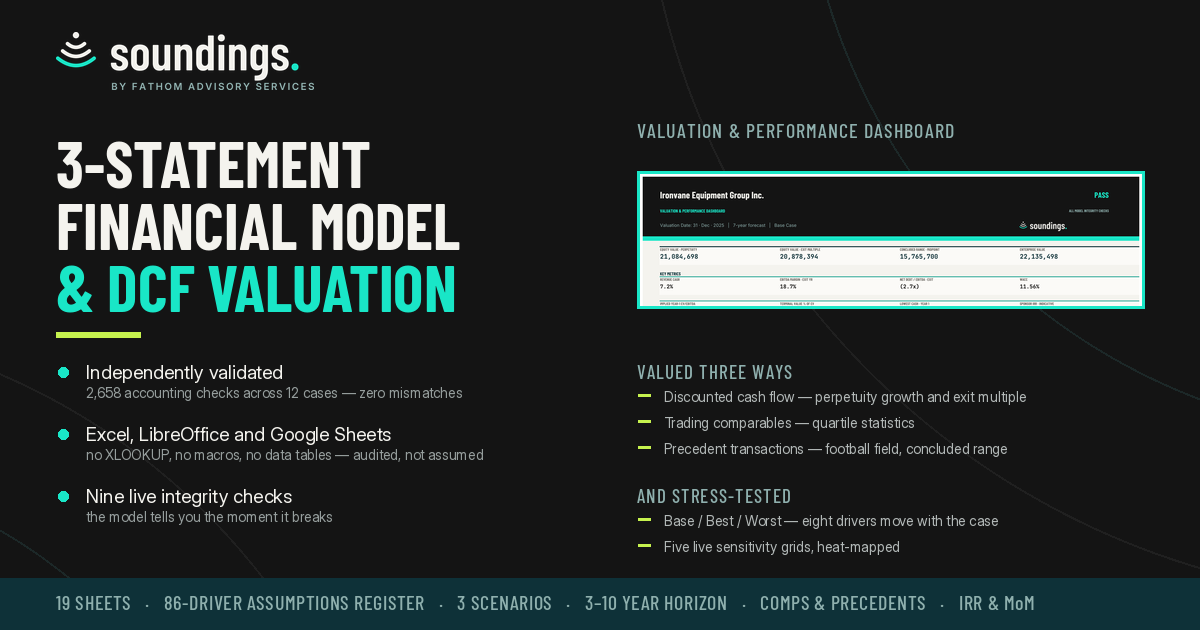
It was built by a professional engineer who builds project finance models for a living, and it is double checked by an automated release gate before every version ships. Thirty-two families of accounting identity including every roll-forward, articulation, and discounting step are re-derived from the recalculated values and tested independently of the model’s formulas. 2,658 assertions across twelve scenario and horizon combinations, with zero mismatches.


19 Worksheets

Cover – Contents, nine model integrity checks, headline outputs, colour legend

Instructions – Eight steps, six rules, and instructions for how to extend the model without breaking it

Disclaimer – Terms of use

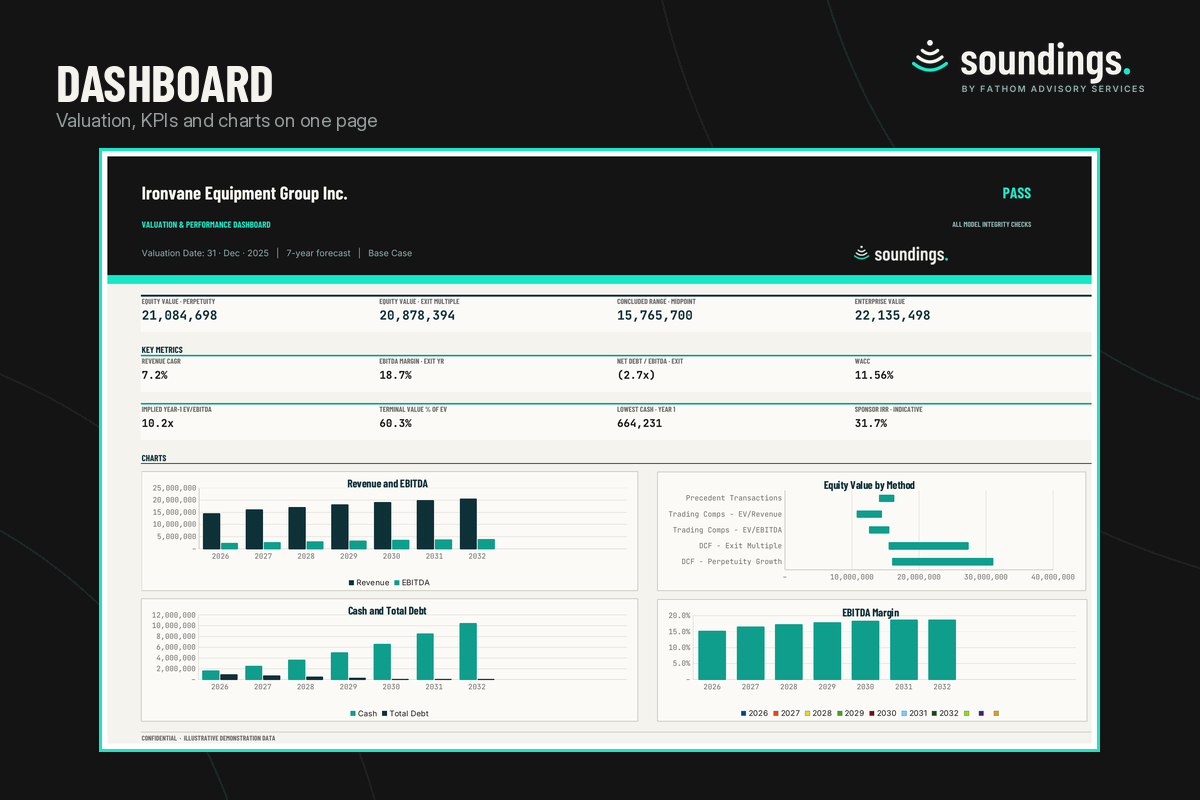
Dashboard – Valuation, eight KPI tiles, and four charts on one page

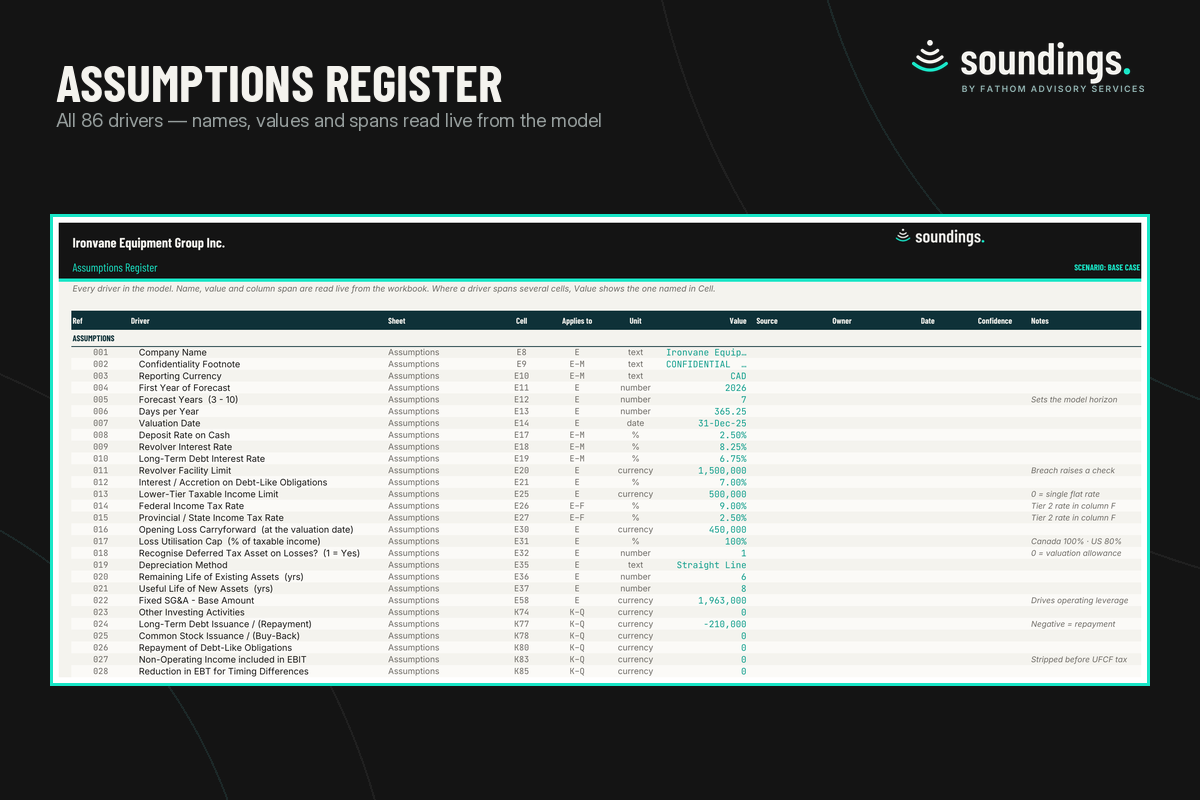
Assumptions Register – All 86 drivers (name, live value and column span) read from the workbook with columns to record source, owner, date, and confidence

Summary – Performance, cash and free cash flow with charts

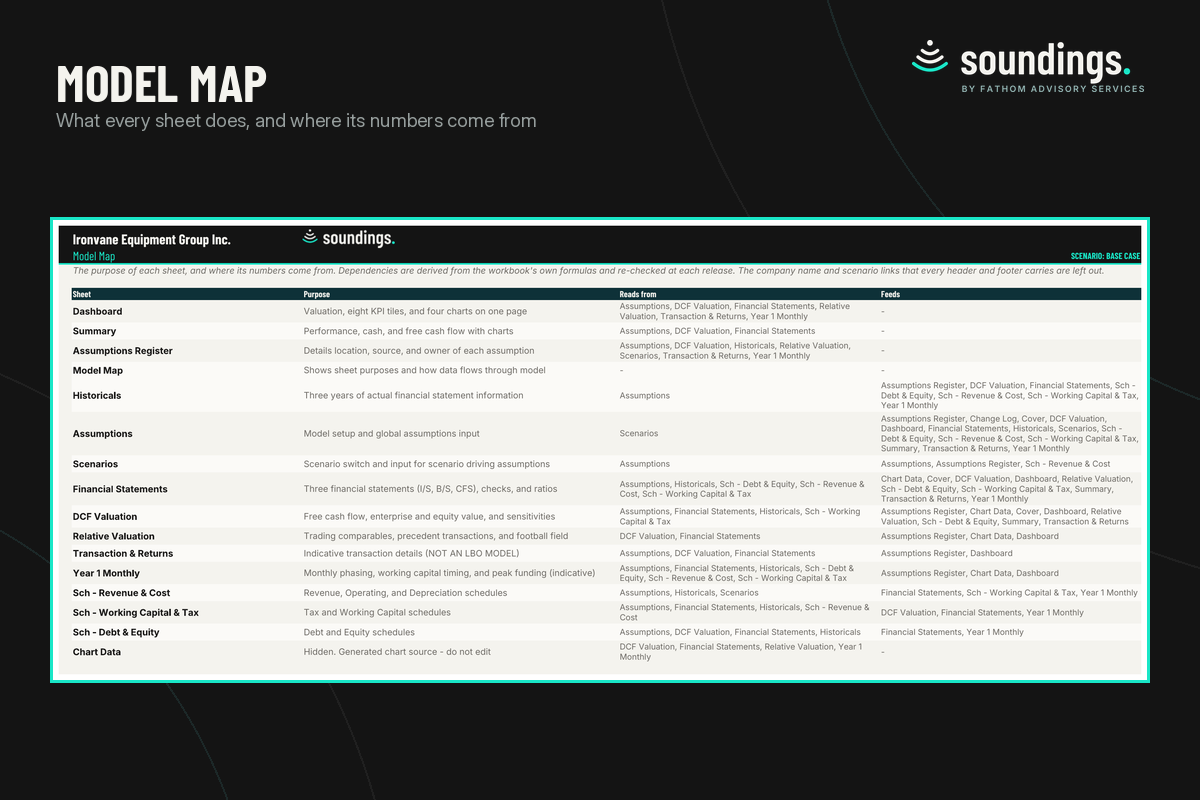
Model Map – What each sheet does and where its numbers come from

Change Log – Record of what you changed and why

Historicals – Three years of actuals

Assumptions – Setup, rates, two-tier tax, loss carryforwards, WACC, depreciation

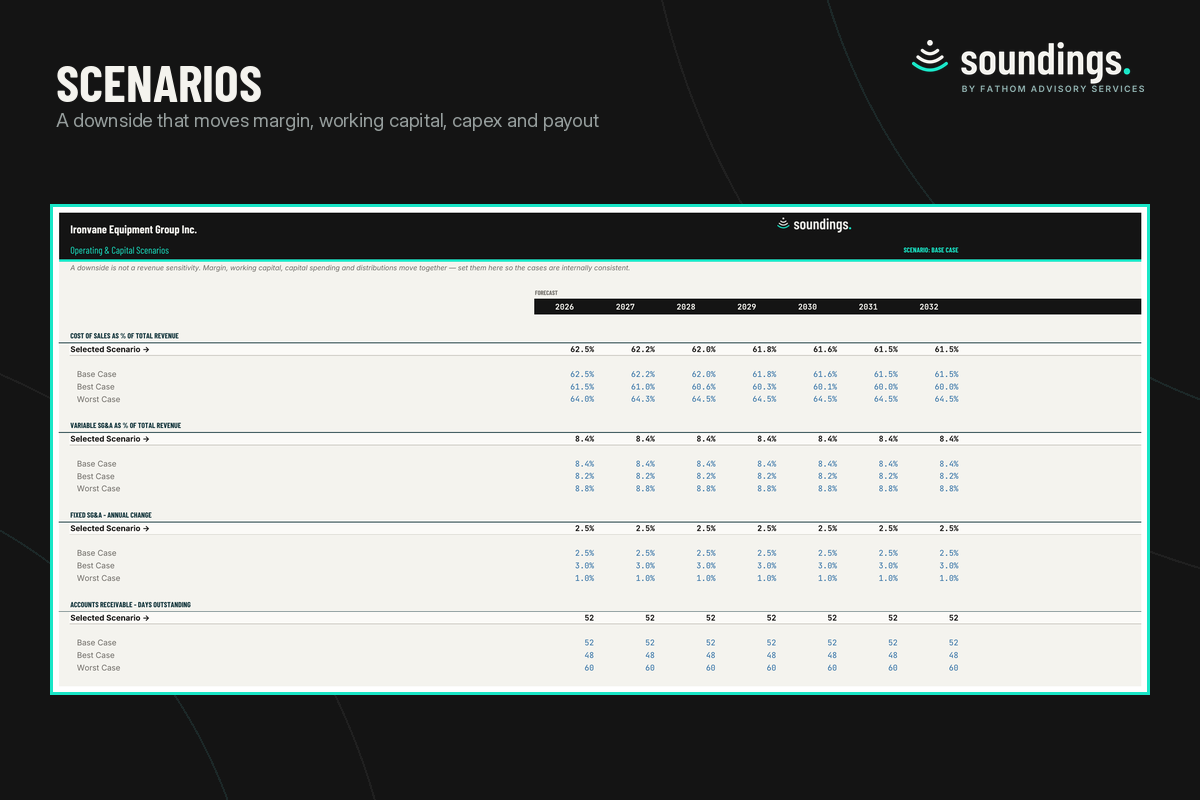
Scenarios – Base / Best / Worst switch and every driver that differs by case

Financial Statements – Three statements, integrity checks, and 18 ratios

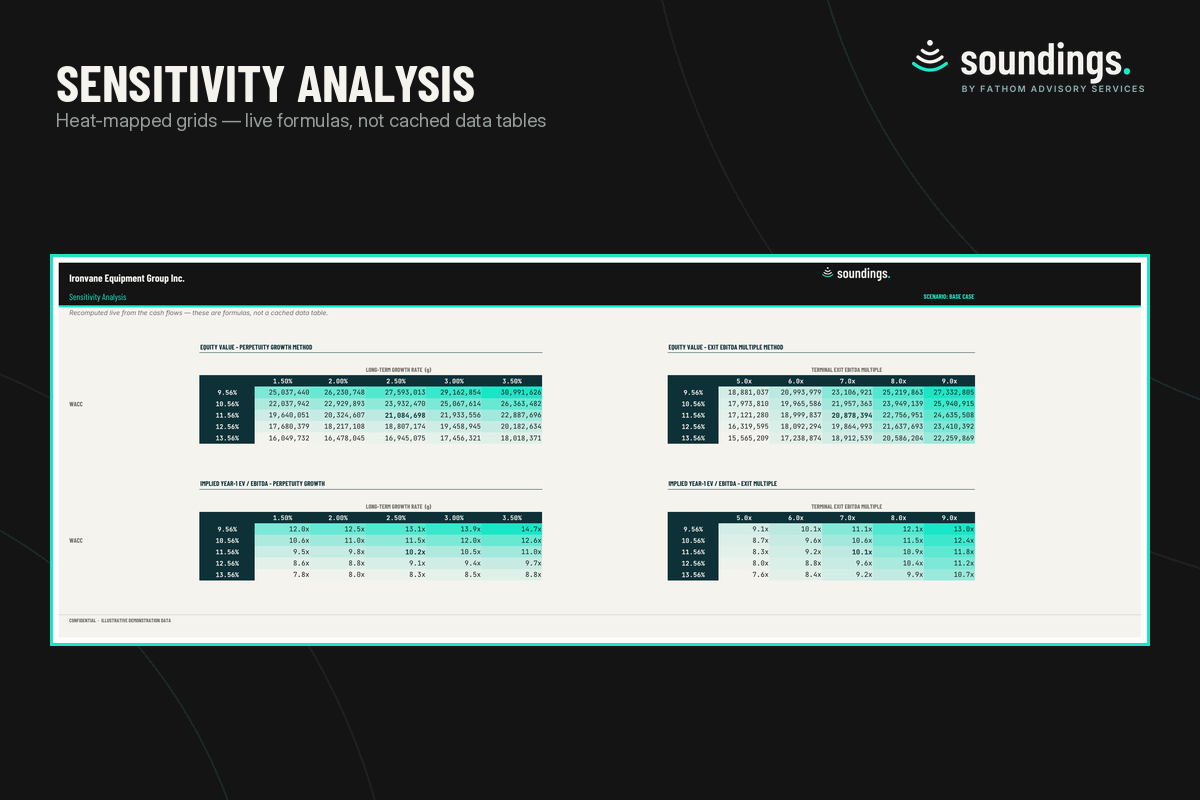
DCF Valuation – Free cash flow, enterprise and equity value, four heat-mapped sensitivity grids, net debt bridge

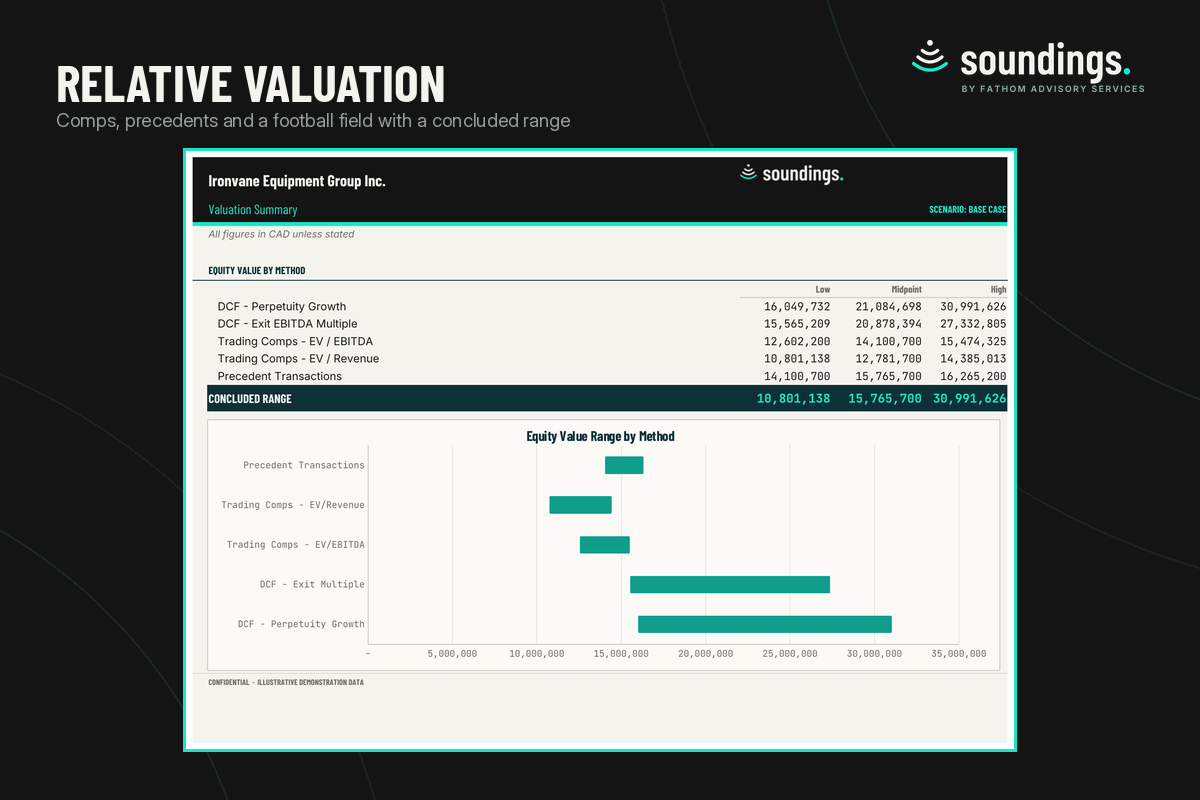
Relative Valuation – Trading comparables, precedent transactions, quartiles, football-field chart

Transaction & Returns – Sources and uses, acquisition debt, exit, IRR, and money multiple

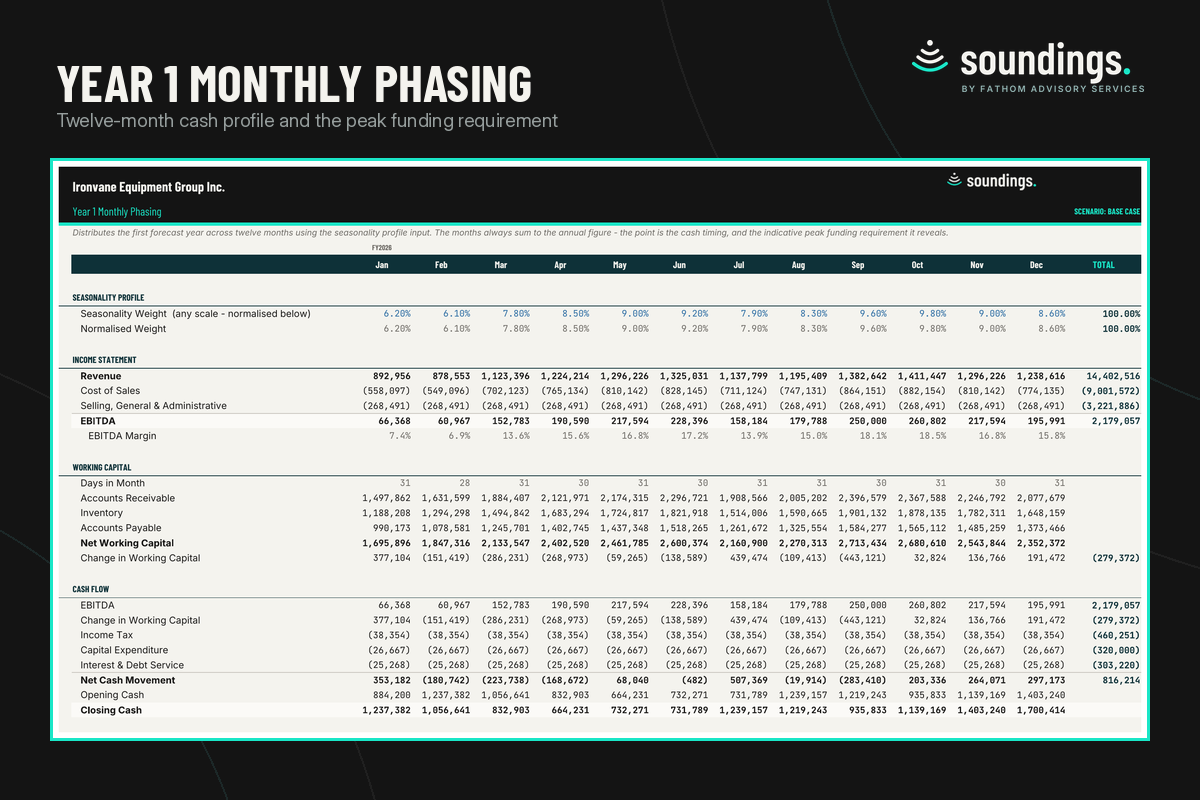
Year 1 Monthly – Twelve-month phasing, working capital timing, peak funding requirement

Revenue & Cost Schedule – Revenue build, operating cost, depreciation by capex vintage

Working Capital & Tax Schedule – Two-tier tax, loss carryforward roll-forward, working capital

Debt & Equity Schedule – Cash, revolver, term debt, debt-like obligations, dividends, retained earnings

Live Assumptions Register

Most templates ship with a static list of assumptions that is typed out once and never updated. This file ships with a live Assumptions Register including every driver’s name, its current value, and the columns it spans, all pulled live from the sheet the driver actually lives on. Rename a revenue line on the Historicals sheet and the register follows. Change the forecast horizon and the column spans change with it. There are 86 drivers, each located to the sheet and cell, with source, owner, date and confidence columns for you to complete to ensure robust traceability.


Scenario Analysis

Most templates flex revenue and call it a downside. A real downturn arrives all at once: you lose pricing power, customers pay slower, inventory builds, and you cut capital spending and distributions. The model considers eight drivers that move with the case: cost of sales, variable SG&A, fixed overhead growth, receivable days, inventory days, payable days, capital expenditure, and dividend payout alongside the revenue build.

Valuation Three Ways (DCF, Comparables, and Precedent Transactions)

A DCF on two terminal value methods that cross-check each other, a trading comparables analysis with quartile statistics, and a precedent transactions analysis with all four valuations on a football-field chart with a concluded range.

Nine Model Integrity Checks

The model ships with nine live integrity checks:

  • Balance sheet balances

  • Cash never negative

  • Equity never negative

  • Interest coverage above 1.0x

  • Revolver within facility

  • Cash flow ties to the balance sheet

  • Retained earnings roll-forward ties

  • Other long-term liabilities never negative

  • Long-term growth below WACC

All nine checks are reported on the Cover and Dashboard.

Built to Run Anywhere

No macros. No circular references. No iterative calculation. No XLOOKUP, no dynamic arrays, no data tables. Zero modern-Excel-only functions, zero array formulas. Runs unmodified on Excel 2016 and later, Excel for Mac, Microsoft 365, LibreOffice Calc, and Google Sheets.

Who It Is For
  • Business owners preparing for a sale or raise

  • Corporate finance and transaction advisers

  • Fractional CFOs

  • Accountants building a valuation for a client

  • Search funds and independent sponsors sizing an acquisition

  • Analysts who want a clean, audited base model rather than a blank sheet

Best suited to an established business with real history. It expects three years of actuals, so it is not a pre-revenue startup model.

Note on demonstration data

The file ships populated with a fictional company, Ironvane Equipment Group Inc., and a fictional peer set, so every calculation is visible before you touch it. All figures are illustrative.

This Best Practice includes
1 Excel Model

Acquire business license for $189.00

Add to cart

Add to bookmarks

Discuss

Further information

A complete three-statement operating model including income statement, cash flow statement, and balance sheet, fully linked with three valuation approaches built on top of it, an acquisition returns overlay, and the documentation a reviewer will ask for.

Business owners preparing for a sale or raise | corporate finance and transaction advisers | fractional CFOs | accountants building a valuation for a client | search funds and independent sponsors sizing an acquisition | analysts who want a clean, audited base model rather than a blank sheet.

Not a startup financial model as it requires historical financial statements as an input.


0.0 / 5 (0 votes)

please wait...