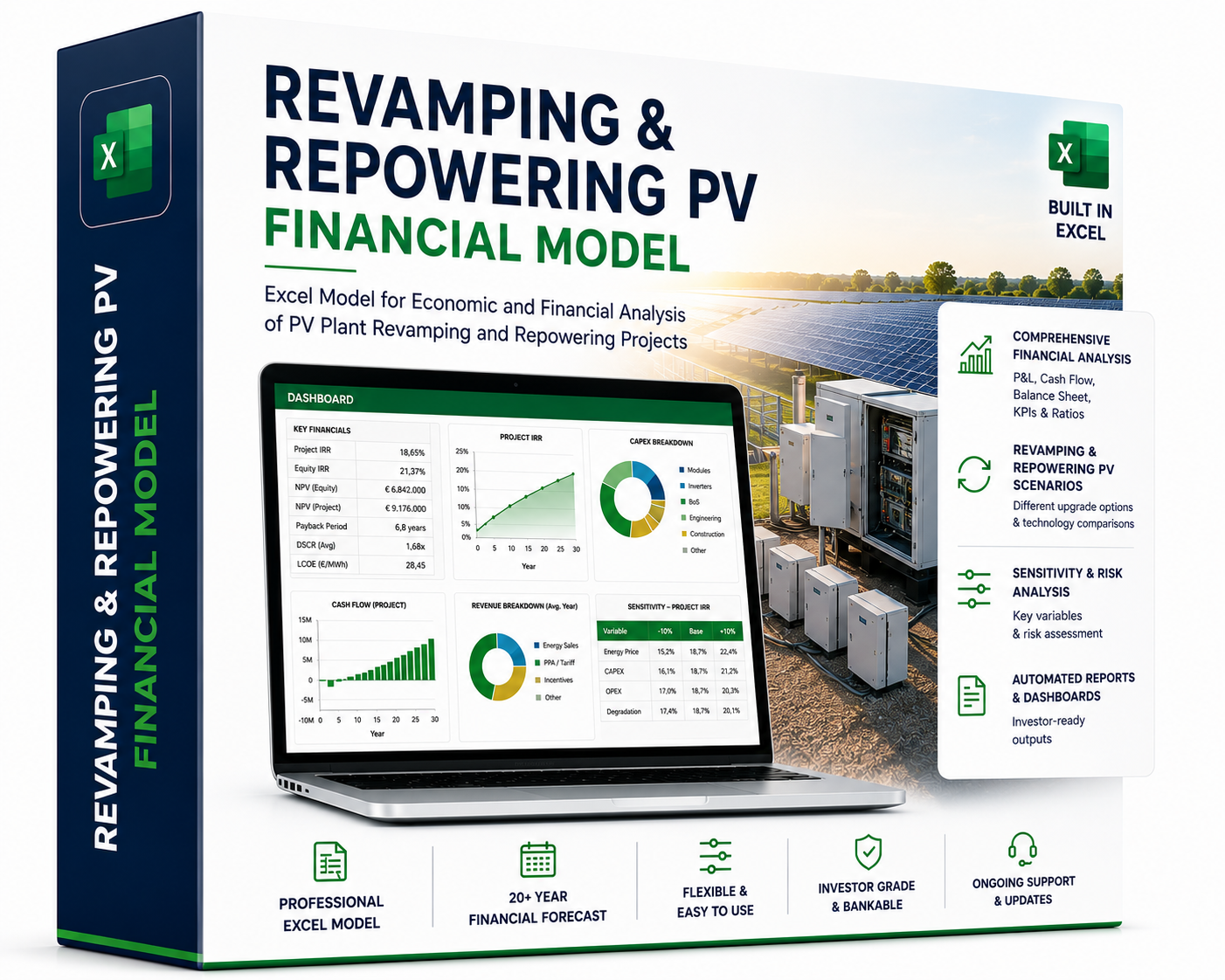


Solar Retrofit & Repowering Model — Evaluate Revamping, Repowering Existing Solar PV Plants
Originally published: 01/06/2026 16:17
Publication number: ELQ-28953-1
View all versions & Certificate
certified

Solar Retrofit & Repowering Model — Evaluate Revamping, Repowering Existing Solar PV Plants

Production-ready Excel model for financial evaluation of existing solar PV plants. 8 countries, 5 analysis modes As-is, Revamping, Repowering, Spalma-incentivi

Description
If you develop, advise on or finance revamping and repowering of existing solar PV plants, you know the problem: the financial case is fundamentally different from a greenfield project. The baseline is not zero — it is a degraded plant still earning an incentive that will expire at a known date. The decision is not just whether to invest, but whether investing beats doing nothing, and by how much. And in Italy, you have five distinct regulatory options under D.L. 21/2026 that each have completely different financial profiles. No greenfield model handles any of this correctly.

This model does.
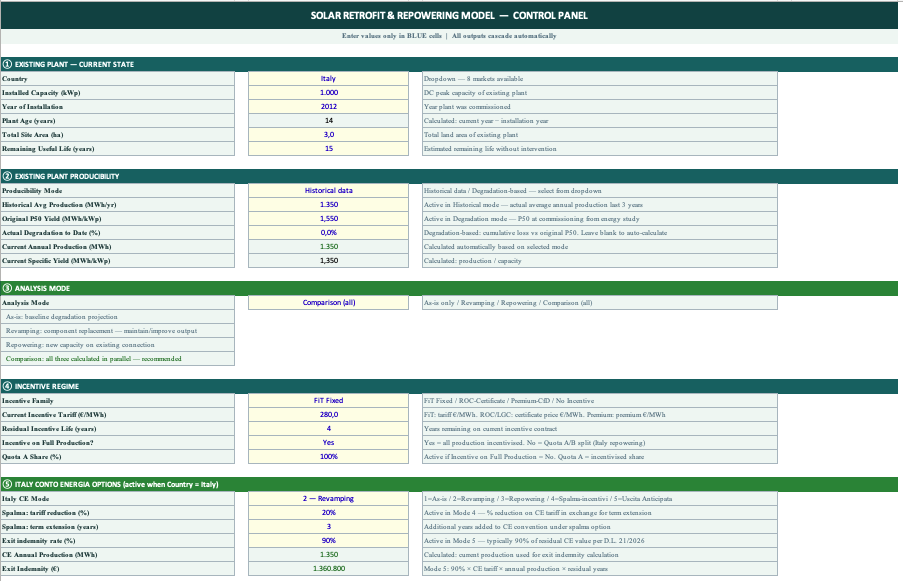
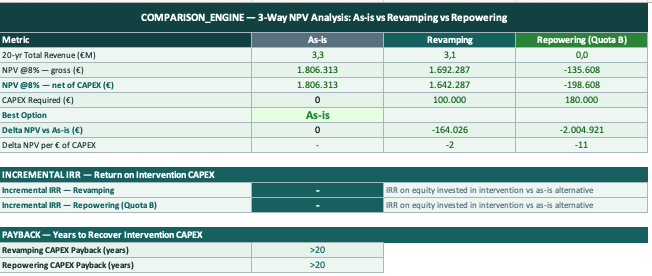
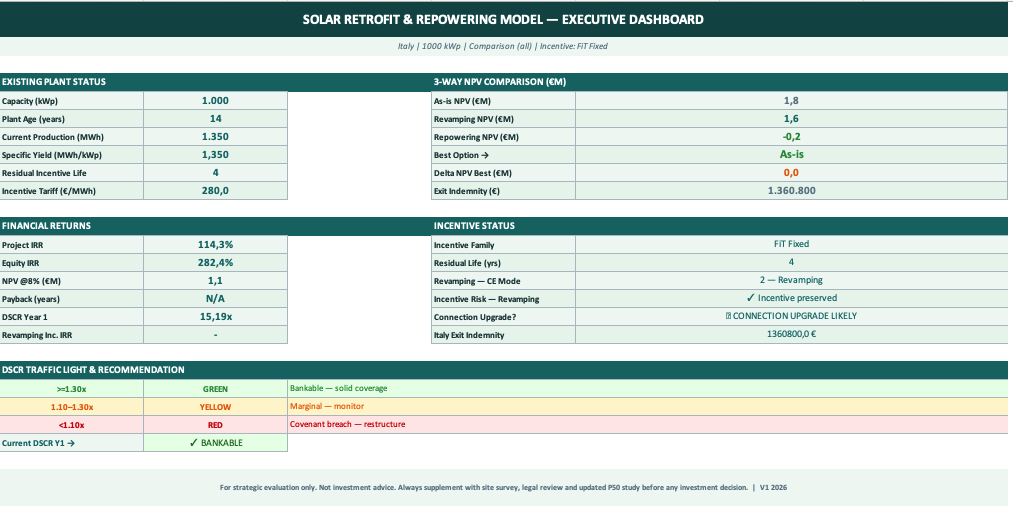
Open it, enter the existing plant data — capacity, year of installation, current production, incentive tariff and residual life — and every output updates automatically. The model runs the As-is baseline, the Revamping scenario and the Repowering scenario in parallel, compares their NPVs, and tells you which option creates the most value and by how much. All from a single control panel.


What makes it different from adapting a greenfield model
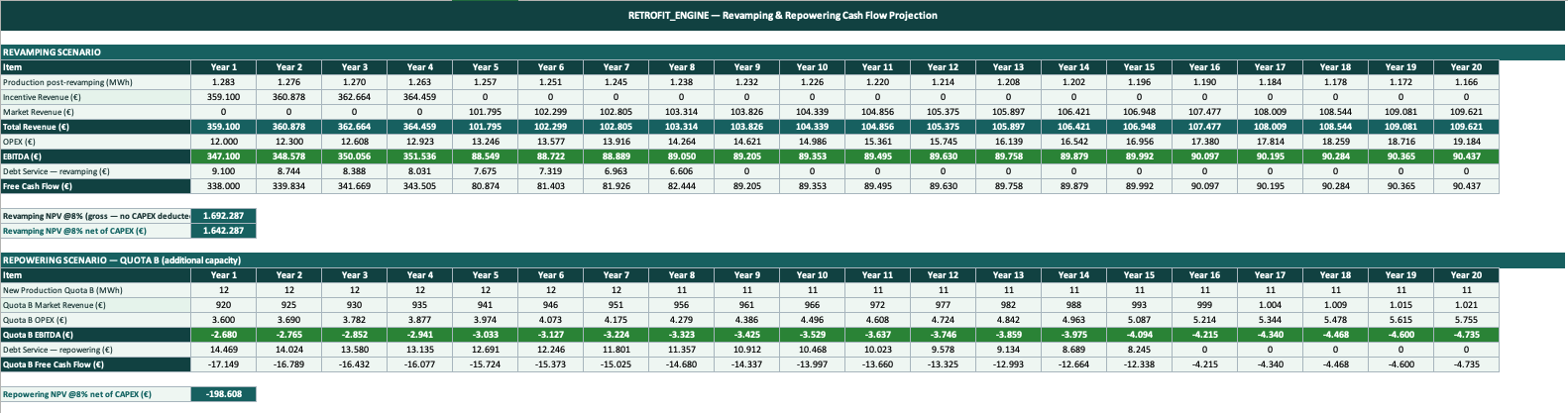
The baseline engine is the core differentiator. Every analysis starts from a degradation projection of the existing plant — using either historical average production data or a degradation-based calculation from the original P50 — producing a realistic As-is cash flow that accounts for ongoing component deterioration, OPEX escalation and incentive expiry at a defined future date. Without this baseline, there is no meaningful comparison. A revamping or repowering investment only makes sense if its incremental NPV over the As-is scenario justifies the capital outlay, and the model calculates that comparison directly.

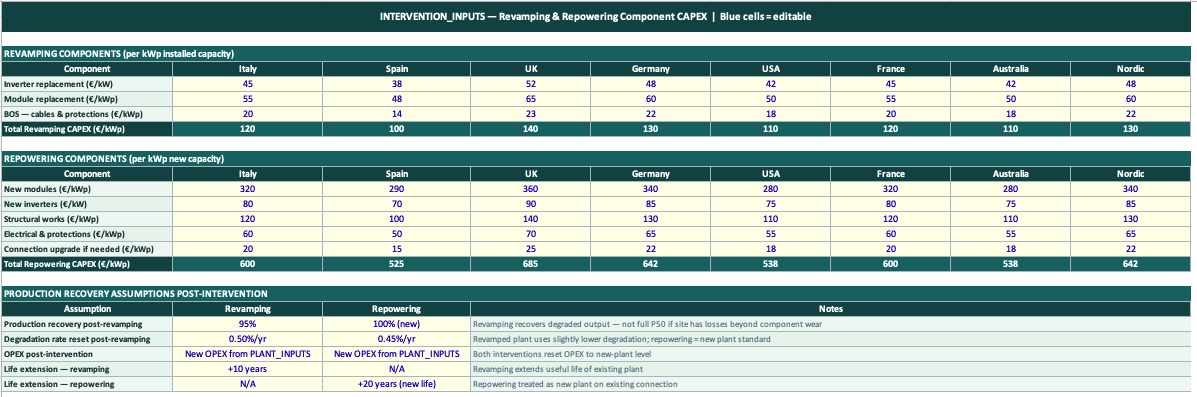
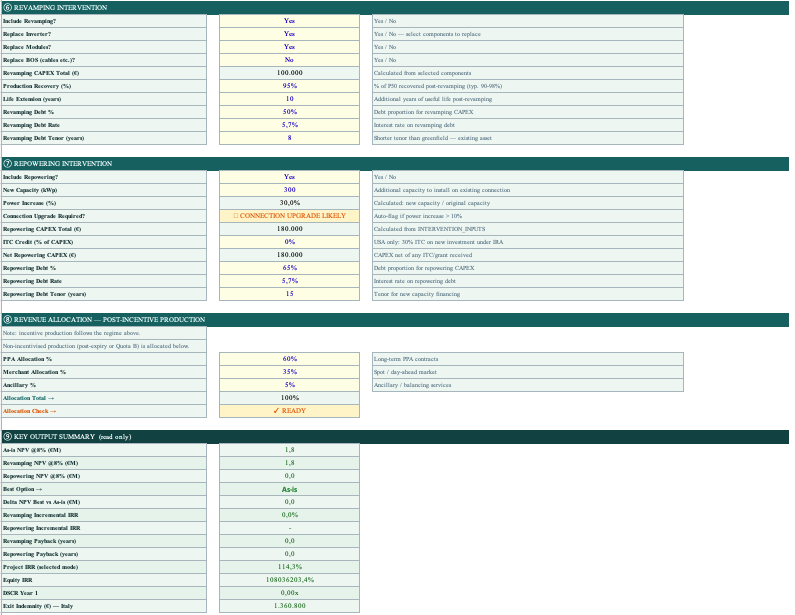
The intervention module separates Revamping — inverter, module and BOS replacement to recover degraded output and extend life by ten years — from Repowering — new capacity installed on the existing grid connection, with a separate debt and revenue structure for the new increment. Component CAPEX is broken down by country across eight markets: Italy, Spain, UK, Germany, USA, France, Australia and Nordic. Post-intervention production recovery assumptions reflect engineering reality: revamping recovers to 95% of P50 with a reset degradation rate of 0.50%/year; repowering is treated as a new plant at 0.45%/year.

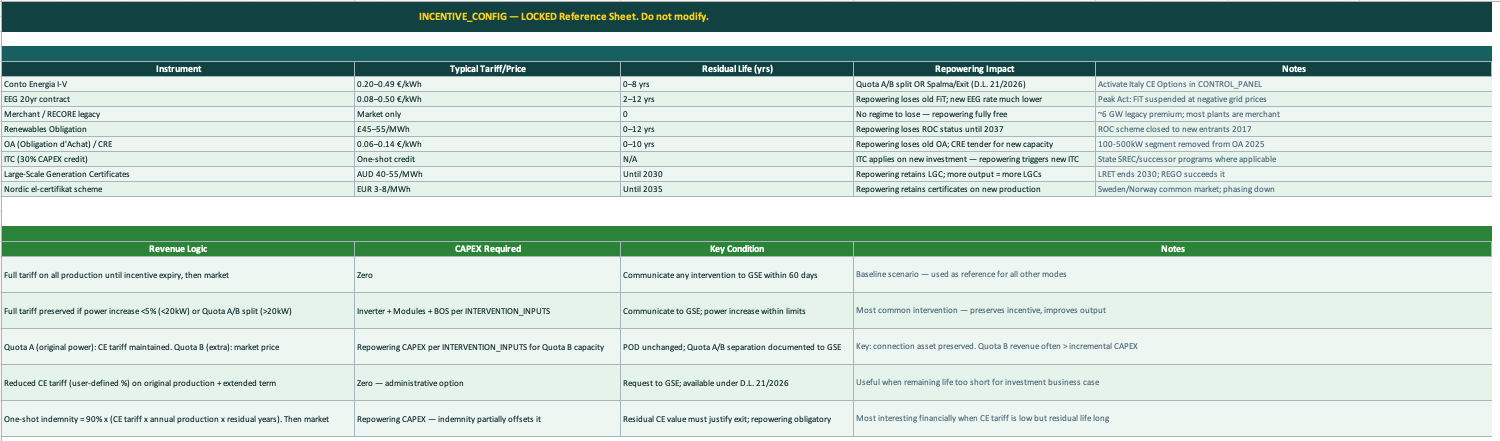
The incentive engine handles four incentive families — FiT Fixed, ROC/Certificate, Premium/CfD and No Incentive — with country-specific logic for each. UK ROC status, German EEG, French OA, Australian LGC and Nordic el-certifikat are all pre-configured and correctly reflect what happens to incentive revenue when a plant is revamped versus repowered.

The Italy Conto Energia module is the most detailed section and addresses a specific need that no other model on the market covers correctly. Under D.L. 21/2026, Italian operators of CE I-V plants have five distinct options, and the model evaluates all five in the Italy CE Mode selector. Mode 1 — As-is — projects the remaining CE tariff income until expiry, then market revenue. Mode 2 — Revamping — preserves the full CE tariff if power increase stays below 5%, or applies the Quota A/B split for larger interventions. Mode 3 — Repowering — separates Quota A production under the original CE tariff from Quota B new capacity at market price, with the incremental revenue from Quota B frequently justifying the repowering CAPEX. Mode 4 — Spalma-incentivi — models the voluntary tariff reduction in exchange for term extension, which can be financially attractive when the remaining incentive life is short. Mode 5 — Uscita Anticipata — calculates the exit indemnity at 90% of residual CE value under D.L. 21/2026, which then partially offsets the mandatory repowering CAPEX.
Post-incentive revenue for all modes is allocated across PPA, Merchant and Ancillary streams with country-specific benchmark prices, fully user-configurable.


Who this is for
Asset managers and O&M teams managing portfolios of operating solar PV plants approaching the end of their original incentive period. Developers evaluating revamping and repowering opportunities in Italy, Spain, Germany and the UK where large volumes of first-generation plants are entering their repowering window. Financial advisors structuring the financing of revamping or repowering investments where the incremental IRR and debt service coverage need to be demonstrated to lenders. M&A teams running valuations on operating PV assets where the treatment of residual incentives and potential repowering upside is material to the transaction price.


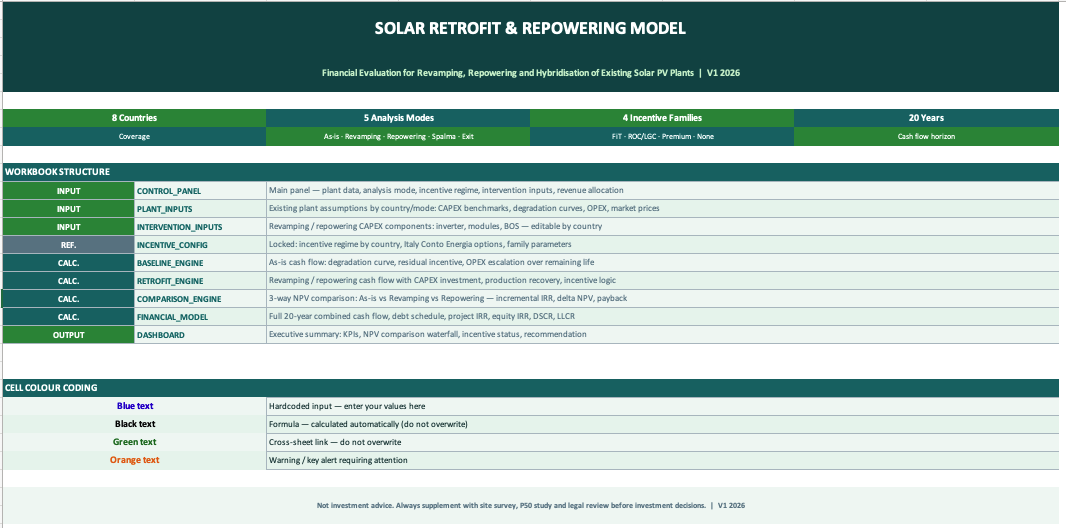
Workbook: Cover · CONTROL_PANEL · PLANT_INPUTS · INTERVENTION_INPUTS · INCENTIVE_CONFIG · BASELINE_ENGINE · RETROFIT_ENGINE · COMPARISON_ENGINE · FINANCIAL_MODEL · DASHBOARD.


For custom versions, country extensions or specific requests, contact us at [email protected]

This Best Practice includes
1 Excel Model, 1 PDF Guide

Acquire business license for $169.00

Add to cart

Add to bookmarks

Discuss

Further information

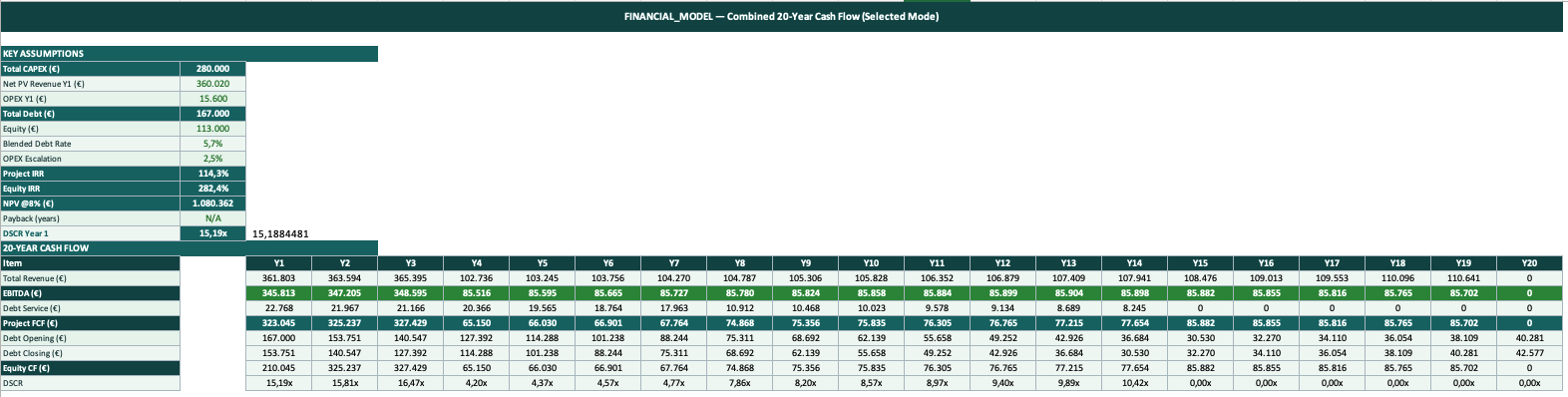
This model enables developers, advisors and asset managers to evaluate the financial case for revamping, repowering or maintaining an existing solar PV plant across 8 international markets, producing a three-way NPV comparison — As-is versus Revamping versus Repowering — alongside incremental IRR, payback and a full 20-year DCF for the selected intervention. It models the existing plant baseline using degradation curves and historical production data, applies country-specific incentive regimes across four families including Italy Conto Energia I-V with all five D.L. 21/2026 options, structures separate financing for revamping and repowering investments with appropriate tenor assumptions, and allocates post-incentive production across PPA, Merchant and Ancillary revenue streams with country-calibrated benchmark prices.

This model is best suited to operating solar PV plants of 100 kWp and above that are in the revamping or repowering evaluation window — typically plants aged 8-15 years with degraded output and an incentive contract within 5-8 years of expiry. It works particularly well for Italian Conto Energia plants under D.L. 21/2026 where the regulatory framework creates five distinct strategic options that need to be evaluated financially before a decision is made, and for UK plants with residual ROC status where the impact of repowering on certificate entitlement is a critical financial variable. It is also well suited to portfolio-level screening where multiple plants need to be assessed for revamping or repowering priority using a consistent financial methodology.

This model evaluates the financial case for revamping and repowering decisions and does not replace a site-specific technical assessment — production recovery assumptions post-revamping depend on the actual condition of the plant and should be validated with an independent technical advisor before any investment commitment. It is not designed for greenfield solar PV projects, which have a different financial structure and should use the Solar PV Ultimate Model. The Italy CE options module is calibrated for D.L. 21/2026 as of April 2026 — any subsequent regulatory changes to the spalma or exit indemnity mechanics should be reflected in the INCENTIVE_CONFIG parameters before use. It should not be used as the sole basis for a final investment or transaction decision without site survey, P50 energy study and legal review of the applicable incentive regime.


0.0 / 5 (0 votes)

please wait...