Publication number: ELQ-57115-1
View all versions & Certificate

Job Bands and Career Progression Policy Manual
This comprehensive policy manual establishes a standardized 4-band, 8-level framework for career development, compensation, and performance management.
Strategic Framework for Organizational Excellence
This Job Bands and Career Progression Policy Manual establishes a sophisticated, market-aligned framework designed specifically for Pakistani mid-sized organizations employing 100-500 employees. The manual provides a comprehensive structure for talent management, compensation benchmarking, and career development across all organizational levels, creating a transparent system that supports both individual growth and organizational objectives.
Core Framework Architecture
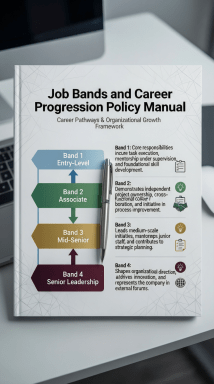
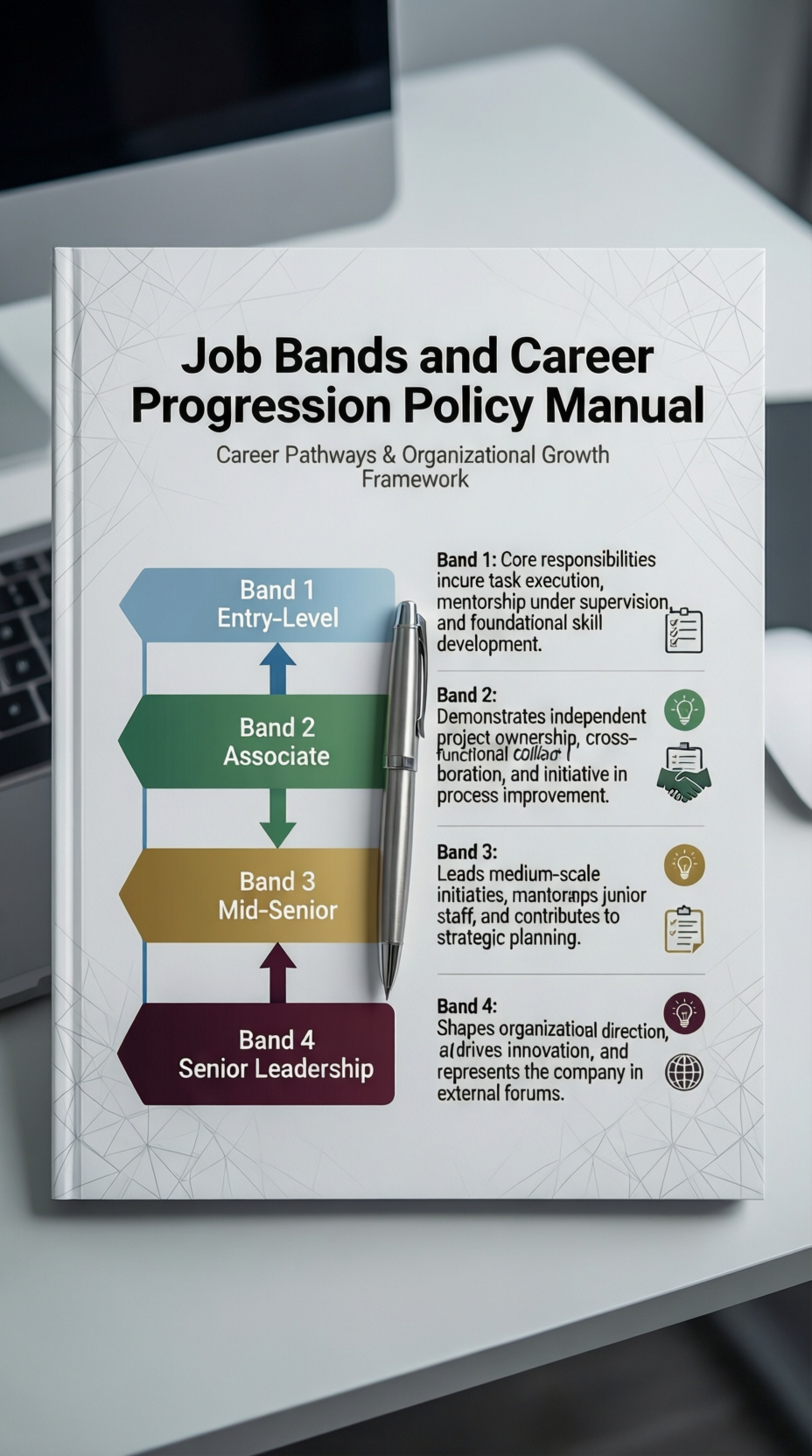
The policy implements a precisely calibrated 4-band, 8-level structure that balances organizational hierarchy with practical career progression pathways. Each band represents a distinct professional tier with clearly defined responsibilities, compensation ranges, and development expectations:
Band A (0-3 years experience) establishes the foundation for new talent with monthly compensation ranging from PKR 40,000 to PKR 130,000. This band encompasses entry-level positions through junior professional roles where employees develop core competencies under supervision while contributing to routine operational tasks.
Band B (3-7 years experience) represents professional proficiency and emerging leadership with compensation between PKR 90,000 and PKR 300,000 monthly. Employees at this level have developed specialized expertise, can lead small teams or projects independently, and begin demonstrating leadership potential that prepares them for management responsibilities.
Band C (7-15 years experience) encompasses departmental leadership positions with substantial compensation ranging from PKR 200,000 to over PKR 1,000,000 monthly. Managers at this level exercise strategic influence within their functional areas, bear P&L responsibility, develop talent pipelines, and translate organizational strategy into executable departmental plans.
Band D (15-20+ years experience) represents the executive leadership tier with compensation from PKR 700,000 to PKR 8,000,000+ monthly. These enterprise-level leaders provide organizational vision, manage board relationships, drive transformation initiatives, and are accountable for the company's overall performance and market position.
Operational Excellence ComponentsPerformance Management Integration
The manual features band-specific performance metrics with precise weightings that align individual contributions with organizational priorities. For example, Band A performance emphasizes quality of work (30%) and learning agility (25%), while Band D evaluation focuses predominantly on enterprise performance (50%) and strategic vision execution (25%). This tiered approach ensures performance assessments are relevant to each career stage while maintaining consistent evaluation standards across the organization.
Rigorous Promotion Protocols
The framework establishes transparent, objective criteria for advancement between bands. Movement from Band A to B requires demonstrable technical proficiency and consistent performance ratings of 3.5/5 or higher for two consecutive years. Progression to management (Band C) demands leadership assessment center participation and business case presentations to senior leadership. Executive promotions (Band C to D) involve board evaluations and multi-year performance analysis, ensuring only truly exceptional candidates advance to strategic leadership positions.
Industry-Specific Calibration
Recognizing Pakistan's diverse economic landscape, the manual incorporates sophisticated industry adjustment factors. Banking and financial services command premium compensation (+25-40% above base rates), while telecommunications and oil & gas sectors offer significant advantages (+20-35%). Value-add sectors like textiles and retail operate at different benchmarks (-5% to +5%), with geographic adjustments further refining compensation for Tier 2 cities (-10-15%) and Tier 3 locations (-20-25%).
Strategic Implementation Advantages
This policy manual delivers substantial organizational benefits beyond basic compensation standardization:
- Talent Retention Enhancement: Clear visibility into career progression requirements reduces uncertainty and increases employee commitment. The framework explicitly identifies development needs at each transition point, enabling targeted skill development that prepares high-potential employees for advancement opportunities.
- Budget Optimization: The structured overlap between bands (15-20%) creates flexibility for exceptional performers while maintaining internal equity. Detailed authority matrices prevent unnecessary grade inflation by clarifying decision-making scope at each level, from task-level execution (Band A) to enterprise vision-setting (Band D).
- Market Competitiveness: Regular benchmarking protocols ensure compensation remains aligned with industry standards across Pakistan's major economic sectors. The manual's industry-specific modifiers allow HR professionals to accurately position roles within competitive talent markets while maintaining internal consistency.
- Performance Accountability: The integrated performance-to-bonus mapping creates direct connections between contribution and reward, with exceptional performers (rating 5) receiving 150-200% of target bonus while unsatisfactory performers (rating 1) receive no bonus and enter performance improvement protocols.
Organizational Transformation Impact
When properly implemented, this framework transforms how organizations approach talent management by replacing subjective advancement decisions with objective, transparent criteria. The detailed promotion requirements eliminate ambiguity about what excellence looks like at each career stage, while the comprehensive competency expectations provide clear development roadmaps for ambitious employees.
The manual's integration of performance metrics with compensation decisions creates powerful motivational alignment, particularly through its progressive focus areas: skill development at junior levels, technical mastery in professional roles, strategic thinking in management positions, and enterprise transformation at executive levels.
For Pakistani mid-sized enterprises specifically, this framework offers a critical competitive advantage in attracting and retaining talent in a challenging market environment. By establishing professional development pathways comparable to multinational organizations while maintaining appropriate local context, companies can build sustainable leadership pipelines that support long-term growth ambitions.
Implementation Excellence Guidance
The manual includes practical implementation guidelines that address common organizational challenges, including recommended annual review cycles, change management protocols for introducing the framework, and detailed processes for handling exceptions. The comprehensive appendices provide ready-to-use templates for promotion requests and performance improvement plans, ensuring consistent application across departments and minimizing administrative burden on HR professionals.
This policy manual represents more than a compensation framework—it's a strategic talent management system designed to build organizational capability through structured career development. By providing both employees and managers with clear expectations and transparent progression paths, organizations can create a performance-oriented culture that simultaneously drives business results and supports individual professional aspirations.
The comprehensive nature of this document—spanning from entry-level expectations through executive leadership requirements—ensures that career development remains a strategic priority at every organizational level, creating sustainable competitive advantage through exceptional talent management practices specifically calibrated for the Pakistani business environment.
This Best Practice includes
1 PDF