BESS Project Financial Model - Battery Energy Storage, Two-IRR Bridge
Originally published: 07/08/2026 12:45
Last version published: 14/08/2026 07:10
Publication number: ELQ-26679-2
View all versions & Certificate
certified

BESS Project Financial Model - Battery Energy Storage, Two-IRR Bridge

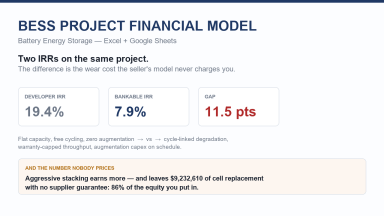
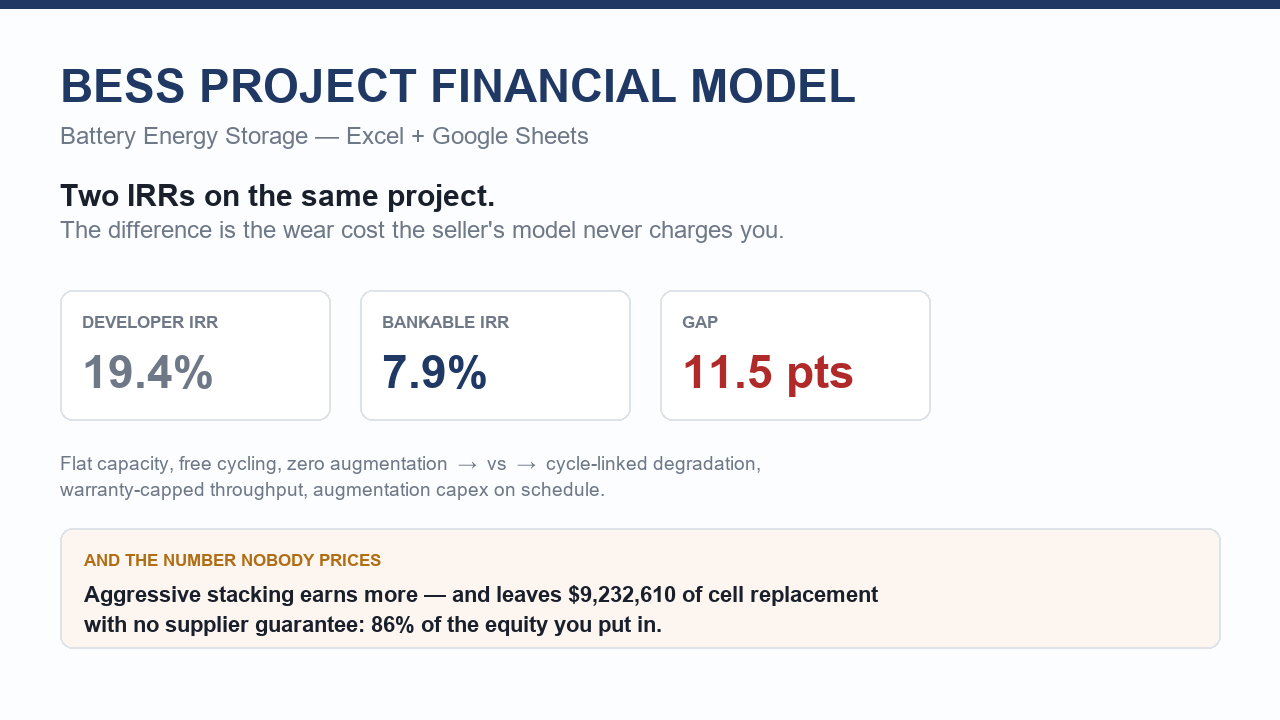
Two IRRs on the same BESS project: the developer view, and the bankable one after degradation, warranty limits and augmentation capex.

Description
Two IRRs on the same project. The difference is the wear cost the seller's model never charges you.

A professional Excel and Google Sheets financial model for battery energy storage projects. Underwrite the project, size the debt against a real DSCR, and see what degradation actually costs before you commit equity.

Most BESS models draw capacity as a flat line and let you cycle the asset as hard as you like. The industry spent 2026 discovering that this is not how batteries behave: field data from operators running storage at scale has compressed expected asset life from fifteen years toward five, and multi-market revenue stacking, which maximises revenue, is precisely what accelerates the wear.
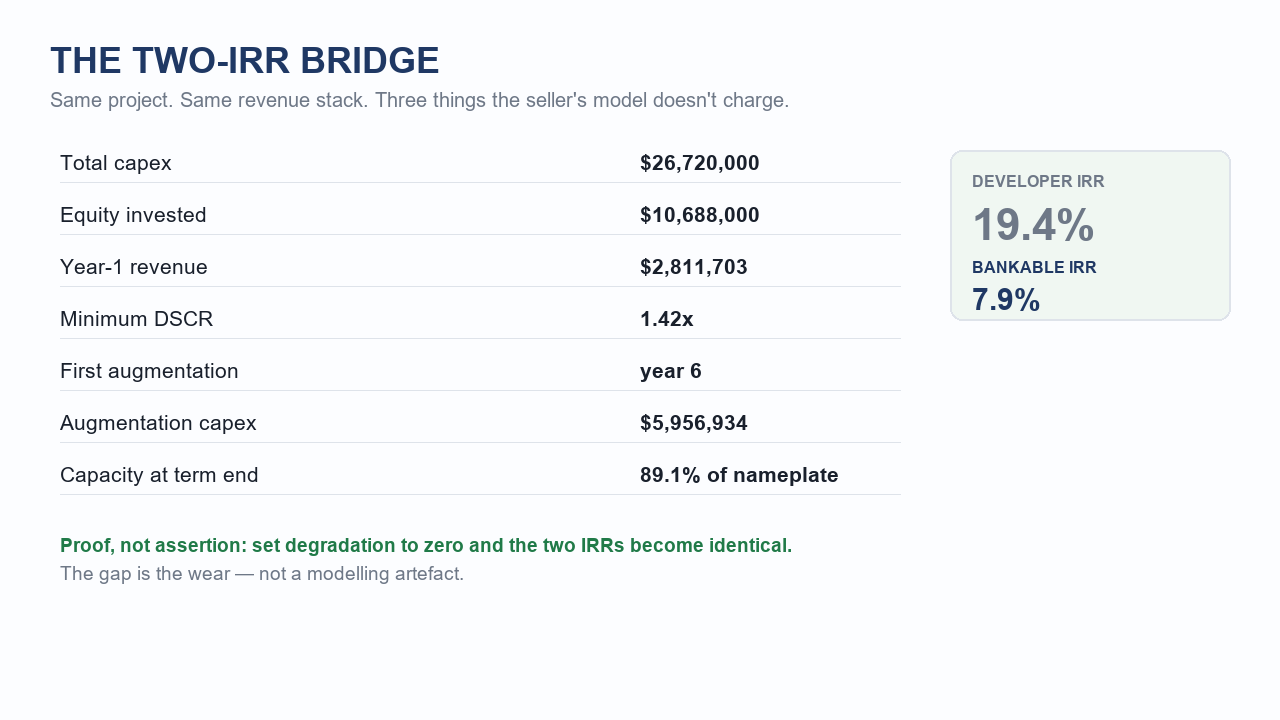
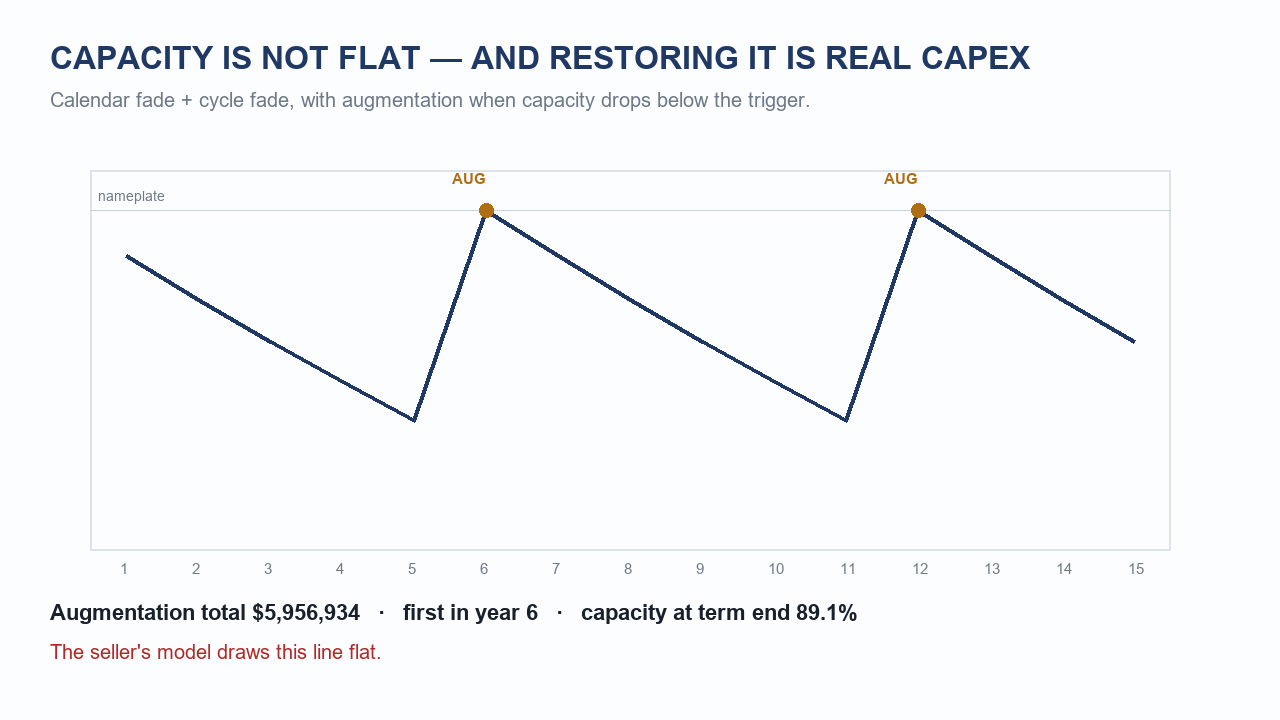
This model prints the optimistic view and the bankable view side by side. The developer view assumes flat capacity, unconstrained cycling and no augmentation. The bankable view applies cycle-linked degradation, caps throughput at the warranty envelope, and schedules augmentation capex as a dated event that restores nameplate capacity.

Proof rather than assertion: set both degradation inputs to zero and the two IRRs become numerically identical. The gap is the wear, not a modelling artefact, and the quality suite checks exactly that.

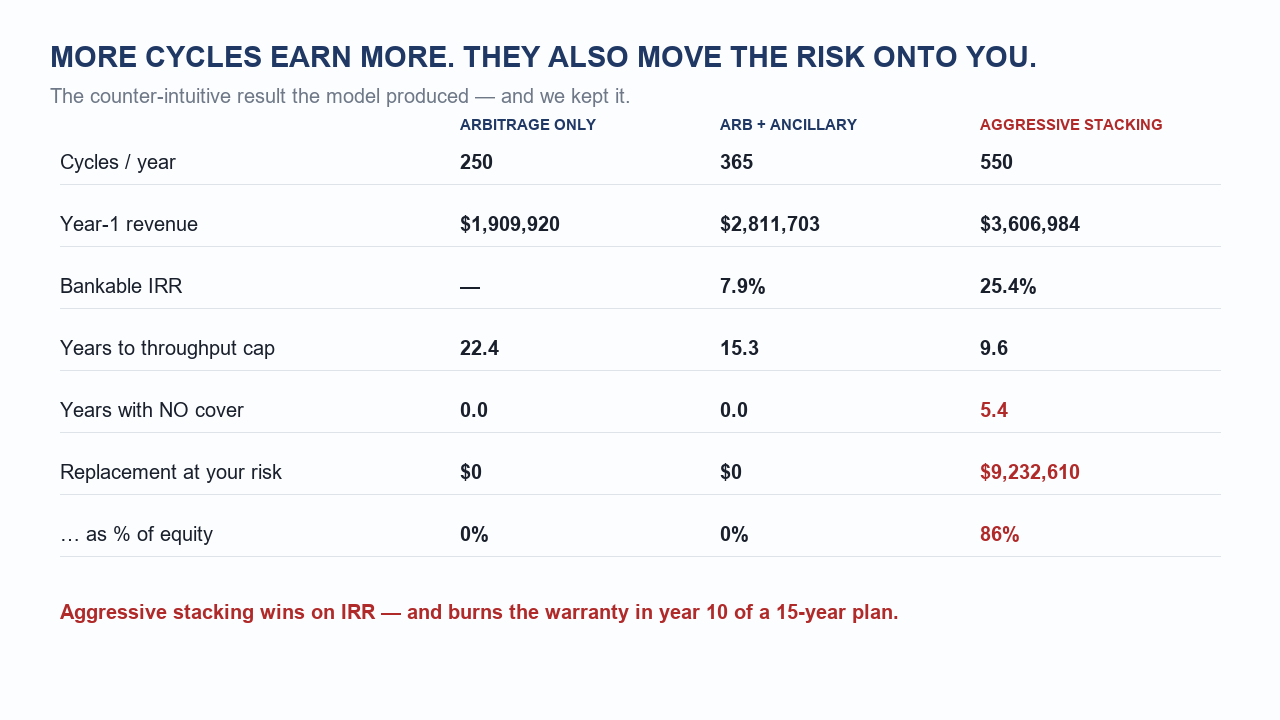
We built this model expecting to show that cycling harder lowers the bankable return. It does not: aggressive stacking earns the highest IRR. We changed the thesis rather than bend the parameters. What cycling harder really does is move risk onto you, exhausting guaranteed throughput years early and leaving cell replacement with no supplier cover. That exposure is quantified in dollars, separately, and deliberately not hidden inside the IRR through an invented risk premium.

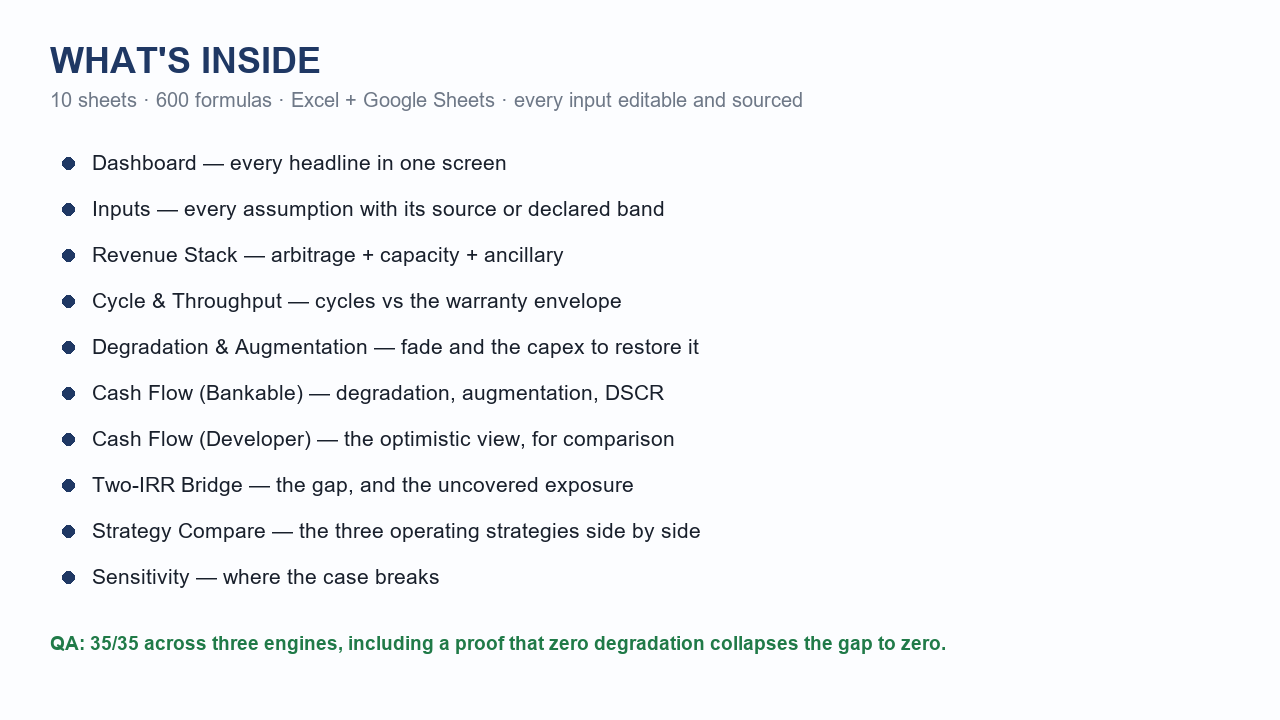
Ten sheets and six hundred formulas: dashboard, sourced inputs, revenue stack covering arbitrage, capacity payments and ancillary services, cycle and throughput against the warranty envelope, degradation and augmentation, two cash flow views, the two-IRR bridge with the uncovered exposure, a three-way operating strategy comparison, and sensitivity.

Capex figures come from the NREL 2025 utility-scale storage cost update, degradation and asset life from 2026 industry field reporting, and the investment tax credit from the Inflation Reduction Act. Inputs without a public source are marked as declared model inputs with a stated band. Educational and planning tool, not financial, tax or legal advice.

This Best Practice includes
model.xlsx (10 sheets, 600 formulas) + 4-page user guide (PDF) + README

Acquire business license for $49.00

Add to cart

Add to bookmarks

Discuss

Further information

Underwrite a BESS project on numbers a lender will accept, and see what degradation and warranty limits really cost.

You are developing, buying or financing a battery energy storage project and need a defensible IRR and DSCR.

You need hourly dispatch optimisation over an 8760 price series, or tax-equity partnership structuring.


0.0 / 5 (0 votes)

please wait...