Airline Financial Model – RASK-Based Revenue Forecasting (No Sector Inputs)
Originally published: 27/11/2025 13:56
Last version published: 12/01/2026 09:15
Publication number: ELQ-46763-2
View all versions & Certificate
certified

Airline Financial Model – RASK-Based Revenue Forecasting (No Sector Inputs)

A streamlined 5-year airline financial model using a RASK-based revenue approach, eliminating sector-level inputs while delivering full P&L, cash flow, and KPIs

Description

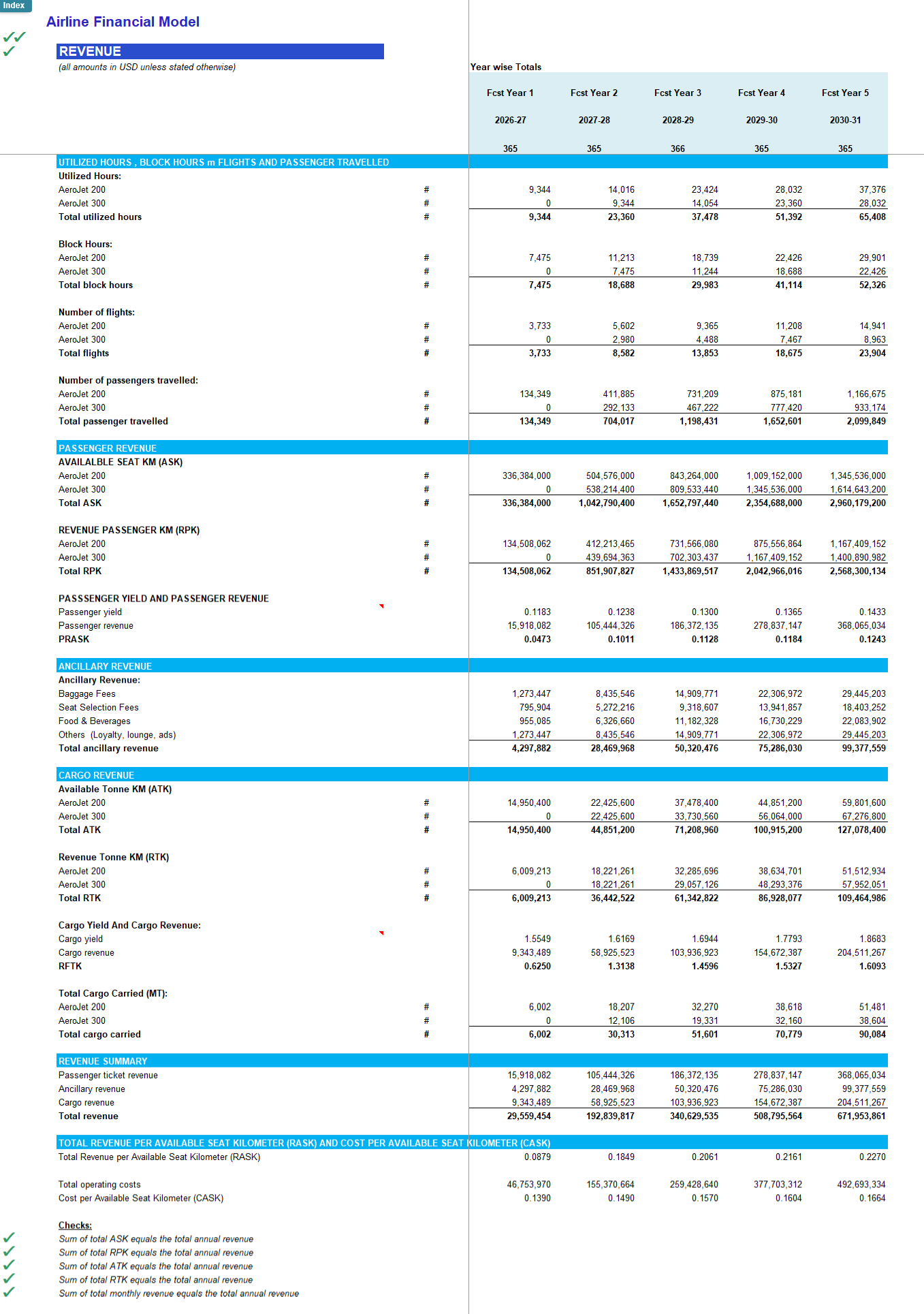
This financial model is meticulously designed to analyze and forecast the financial performance of a commercial airline using a RASK-based revenue methodology, eliminating the need for route-level or sector-level inputs. The model delivers a scalable and streamlined forecasting framework where passenger revenue, cargo revenue, and ancillary income are driven by ASK/ATK-based assumptions, not by individual route distances or sector schedules. 


The model supports a mixed fleet of leased and purchased aircraft and captures all major revenue, cost, operational, and financing drivers essential to airline performance evaluation. Core operating parameters—such as block hours, turnaround times, aircraft utilization, load factors, cargo tonne-kilometres, fuel burn, and fleet additions—are integrated into a comprehensive financial structure that remains simple to operate while retaining analytical rigor. Built over a 5-year (60-month) forecast horizon with detailed monthly and annual outputs, the model supports strategic planning, fleet budgeting, capital allocation, valuation, investor communication, and financial decision-making for airlines operating with both leased and owned aircraft.


Model Structure – 5 Main Sections


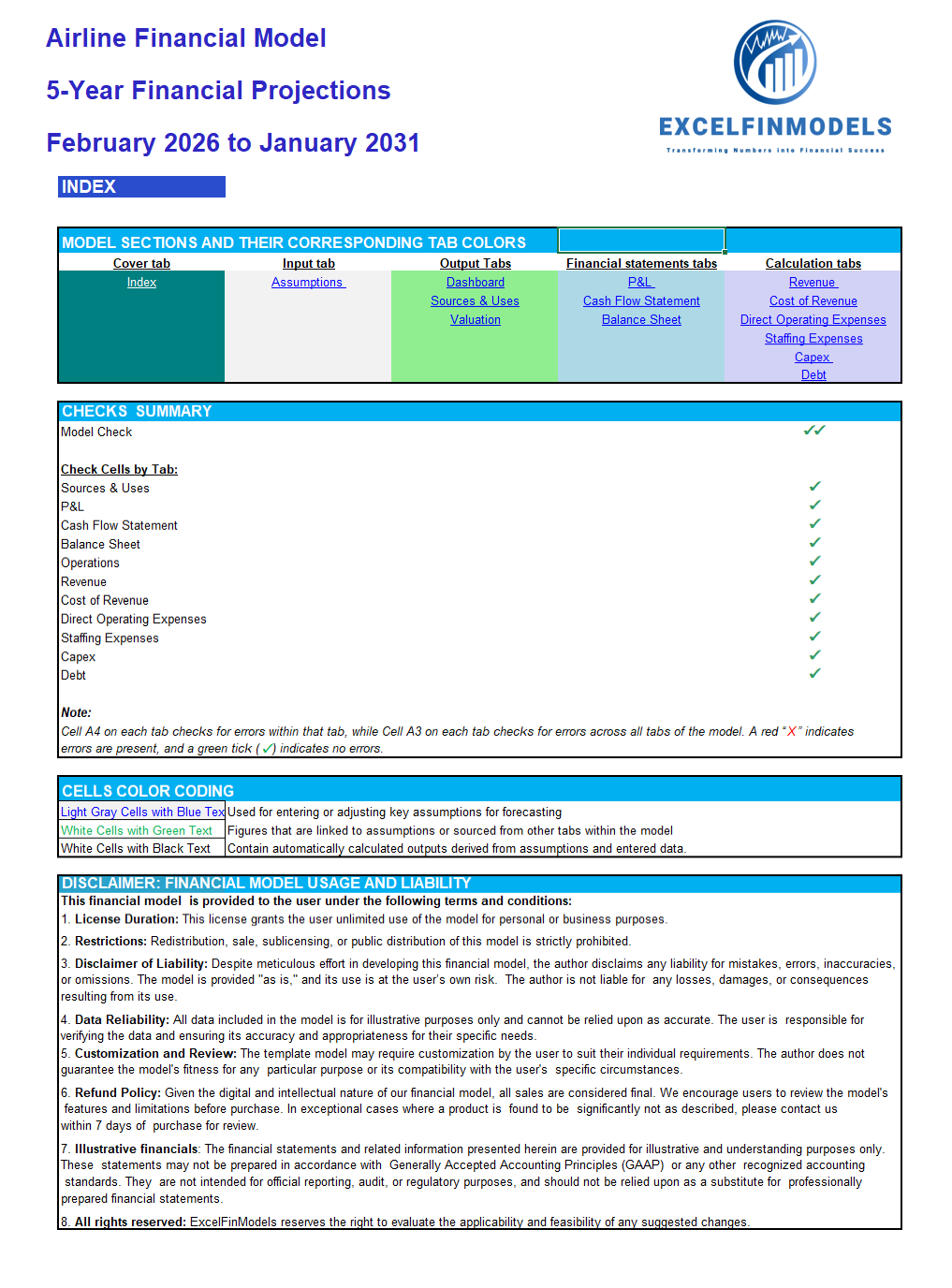
1. Cover Section

  • Index of all tabs with color mapping

  • Summary of validation checks

  • Color-coding legend for assumptions, links, formulas, and outputs

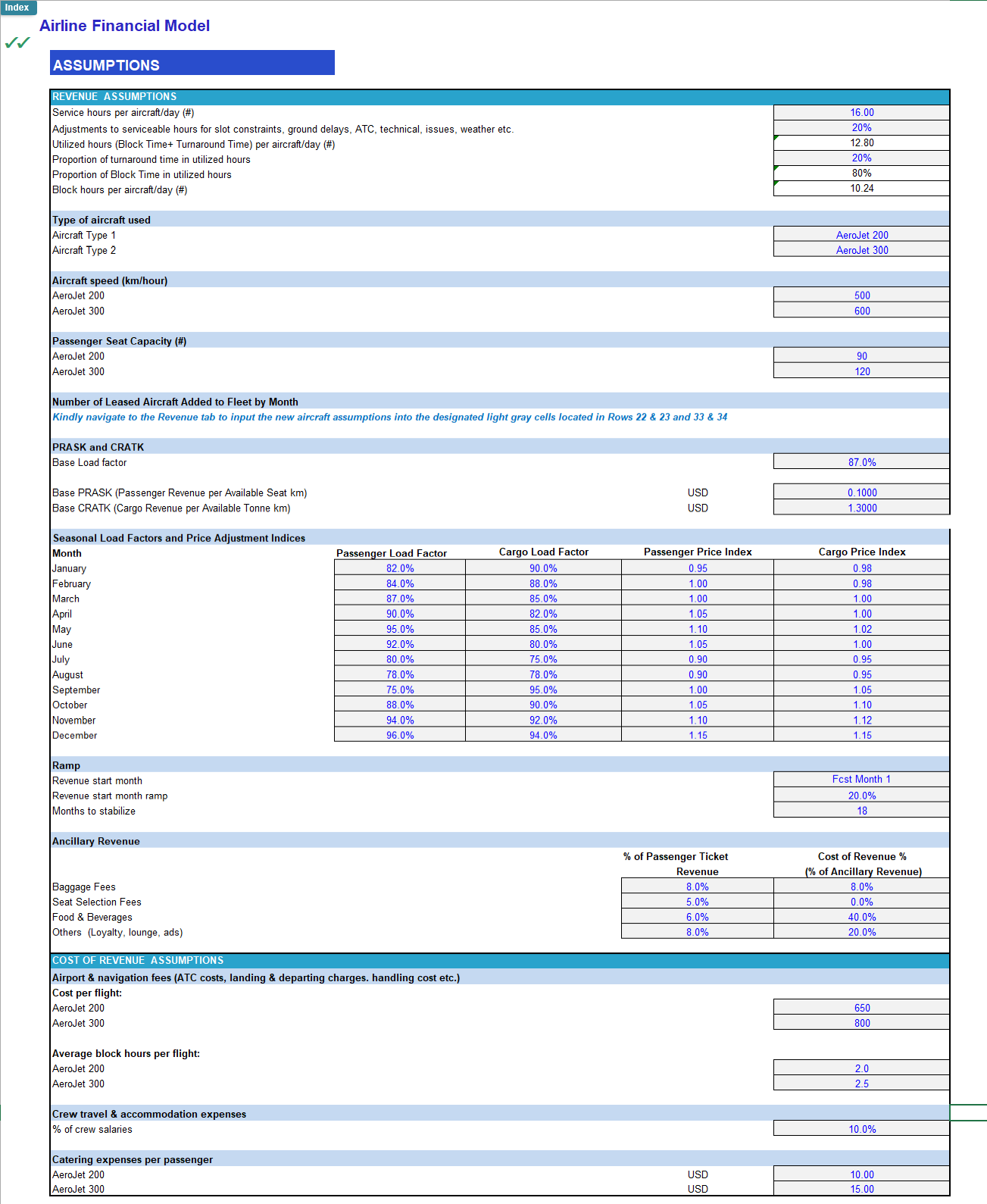
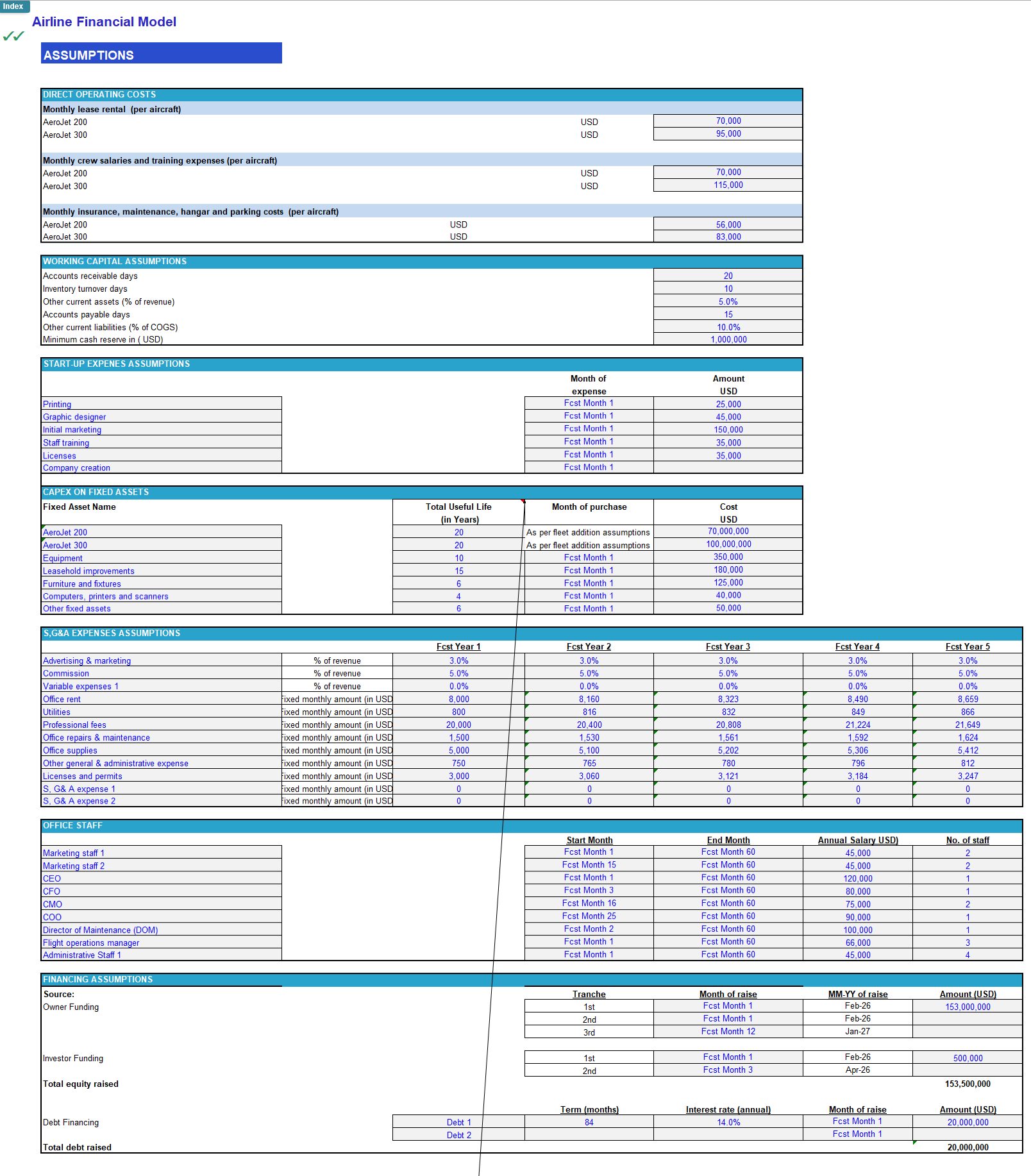
2. Input Section (Assumptions Tab) – All Inputs in Light Gray / Blue TextRevenue Assumptions

  • Passenger seat configuration by aircraft type

  • Base PRASK for passenger revenue (derives passenger yield)

  • Base CRATK (Cargo Revenue per Available Tonne-Kilometre)

  • Monthly load factor schedule + ramp-up curve

  • Passenger & cargo price seasonality indices

  • Cargo capacity per aircraft

  • Ancillary revenue inputs

Operational / Fleet Assumptions

  • Fleet size by aircraft type (leased & purchased)

  • Block hours, turnaround time, utilization

General Assumptions

  • Airline name, start date, reporting currency

  • Inflation, indexation factors, corporate tax

Cost of Revenue

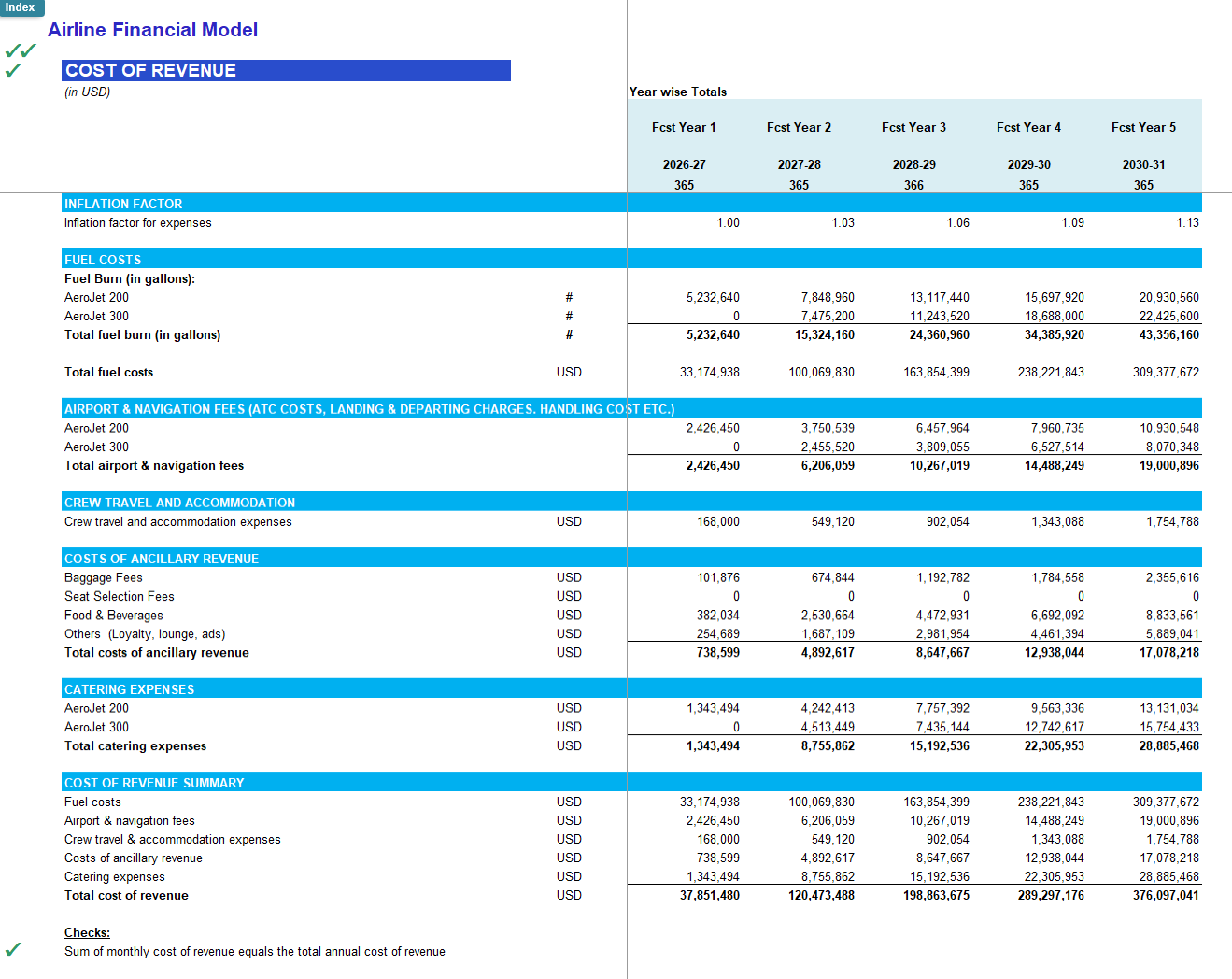
  • Fuel burn per block hour & ATF pricing

  • ATC, navigation, landing & departure fees

  • Catering & operating cost ratios

Direct Operating Expenses (DOE)

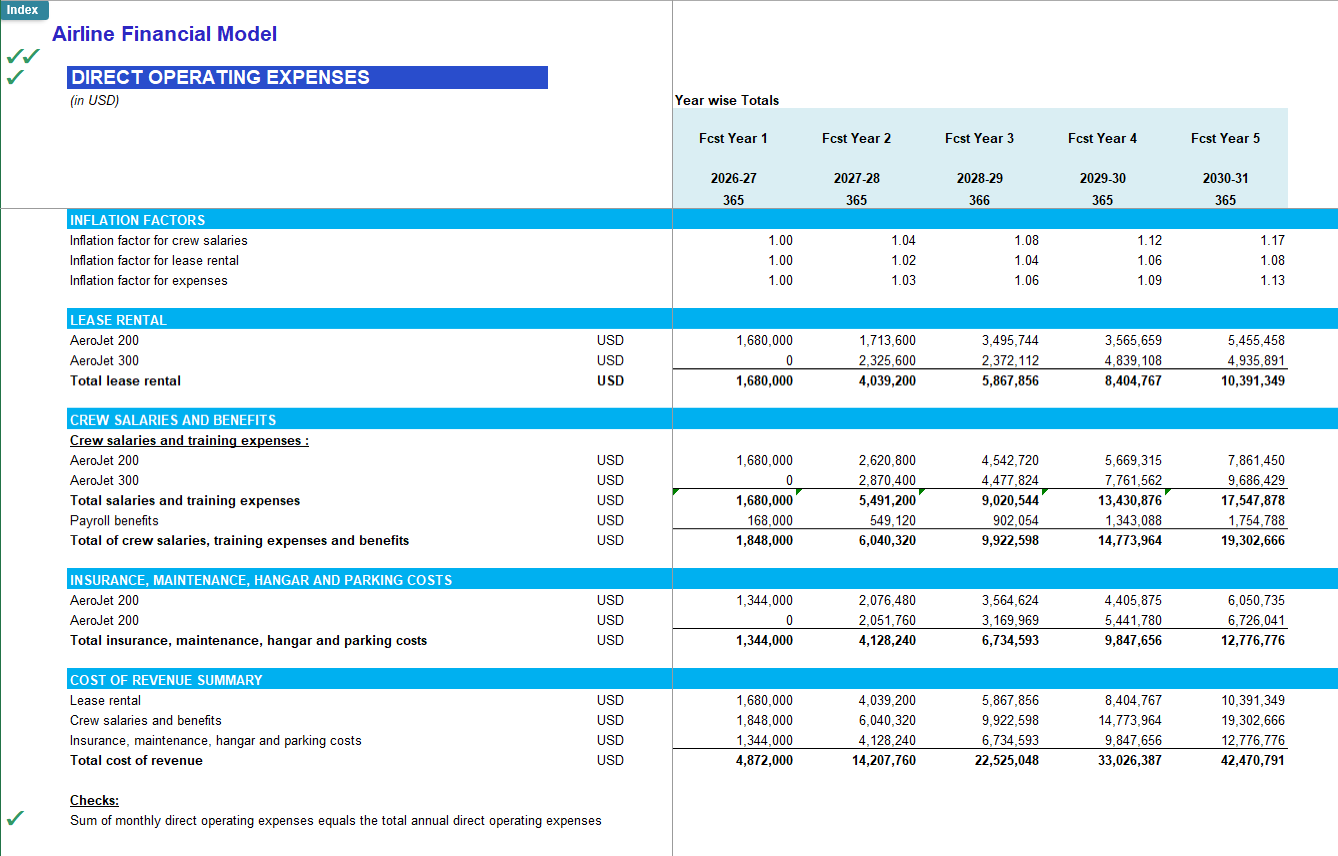
  • Lease rentals

  • Crew salaries & benefits

  • Maintenance & insurance

  • Hangar & parking fees

S,G&A Expenses

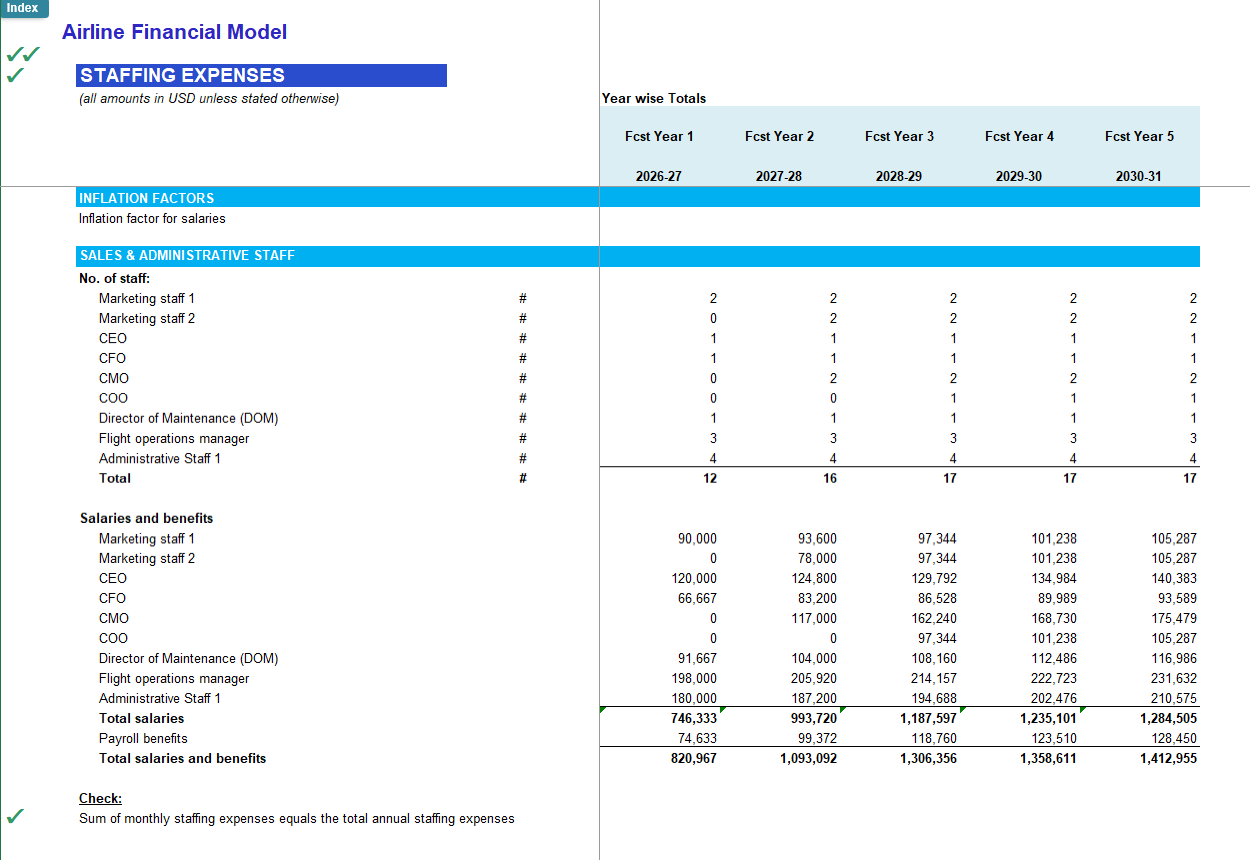
  • Administrative payroll

  • Sales & distribution

  • Utilities, IT systems, reservation platforms

  • Marketing & overheads

Working Capital

  • Receivable & payable days

  • Minimum cash balance

Financing & One-Time Costs

  • Equity & debt funding for aircraft purchases

  • Pre-operational licensing, certification, branding

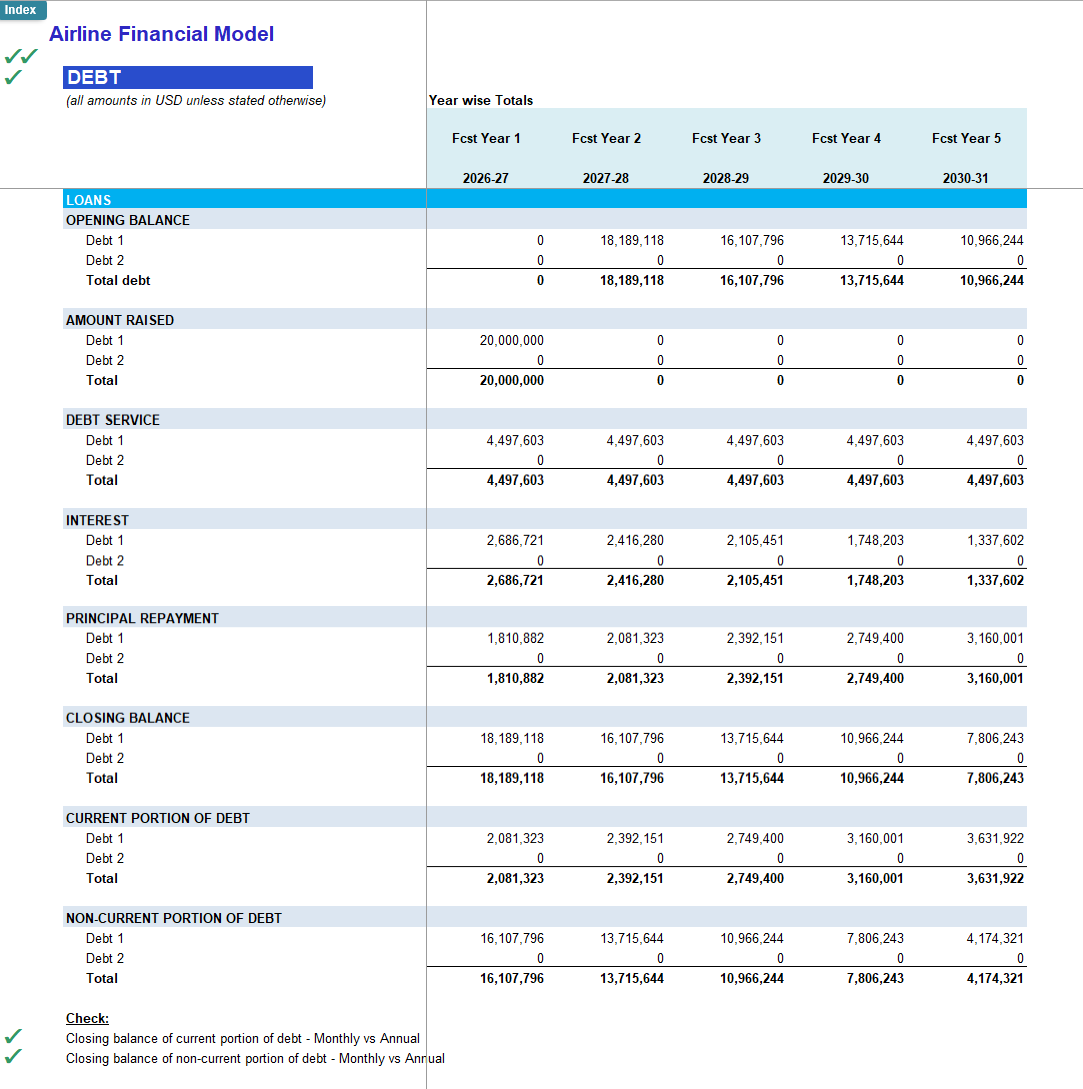
  • Loan amortization schedules

3. Output Tabs Section

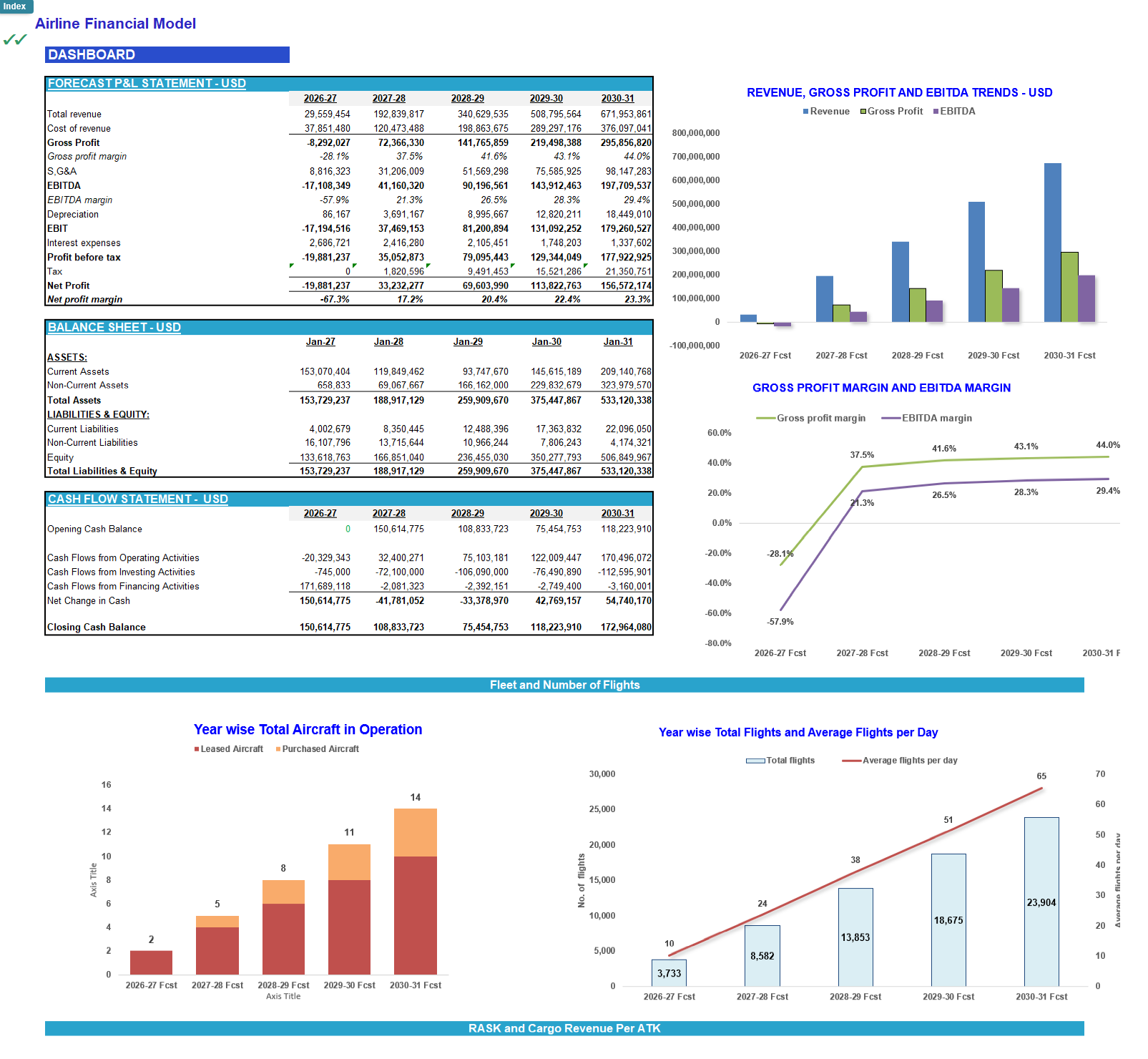
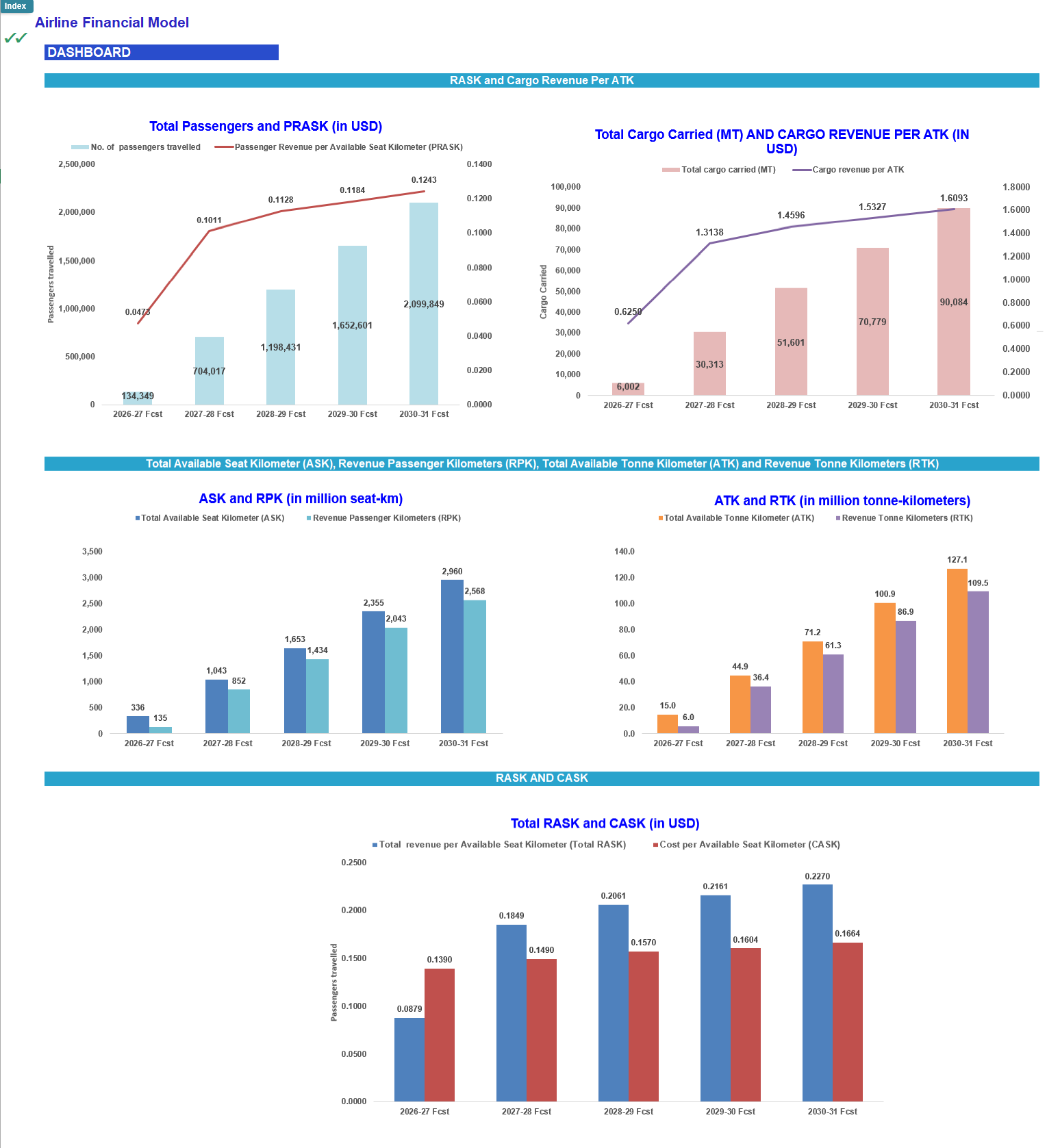
  • Dashboard with KPIs: revenue, margins, utilization, ASK/ACTK/RPK/RTK, PRASK, CRATK, CASK

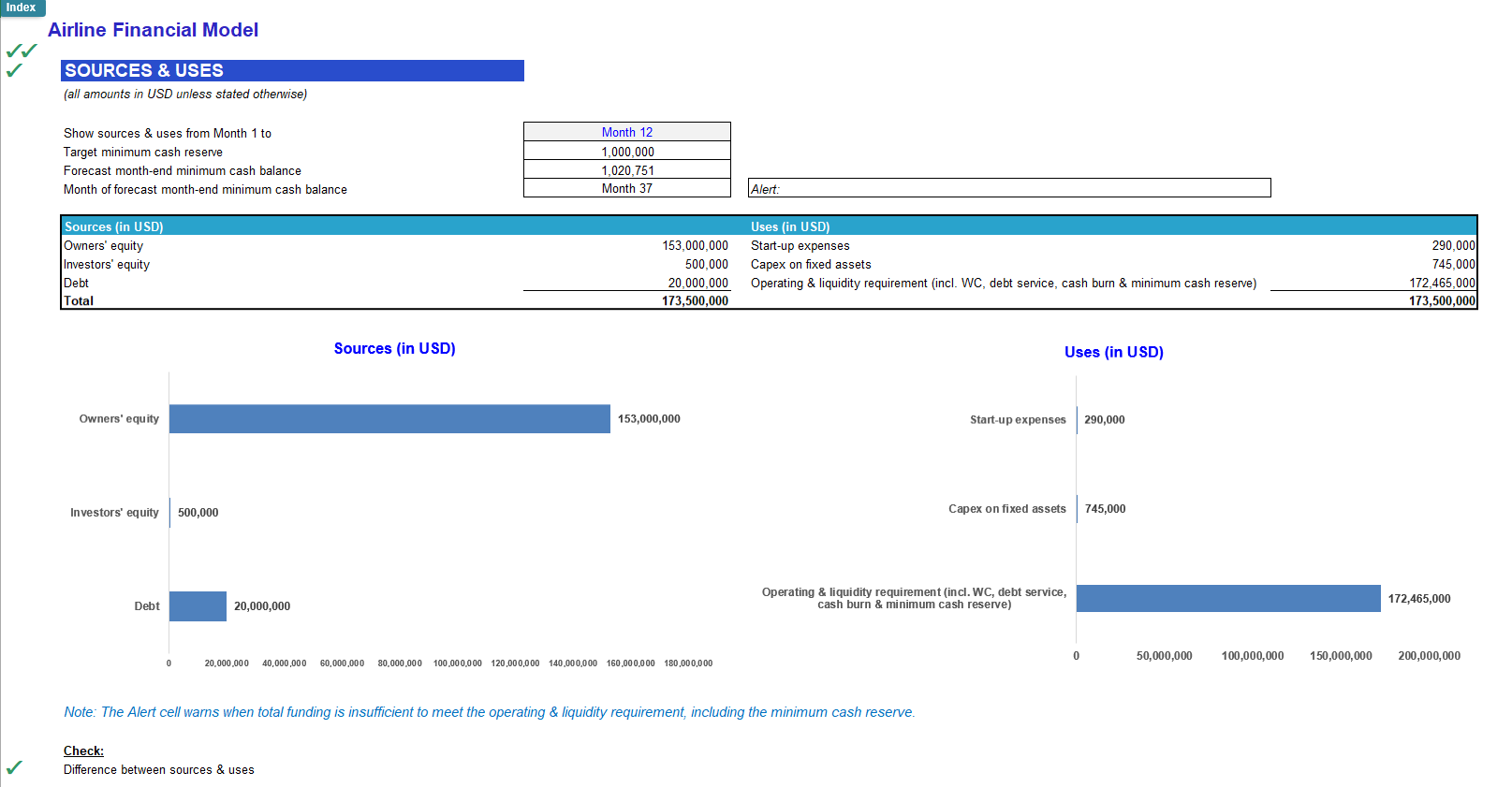
  • Sources & Uses

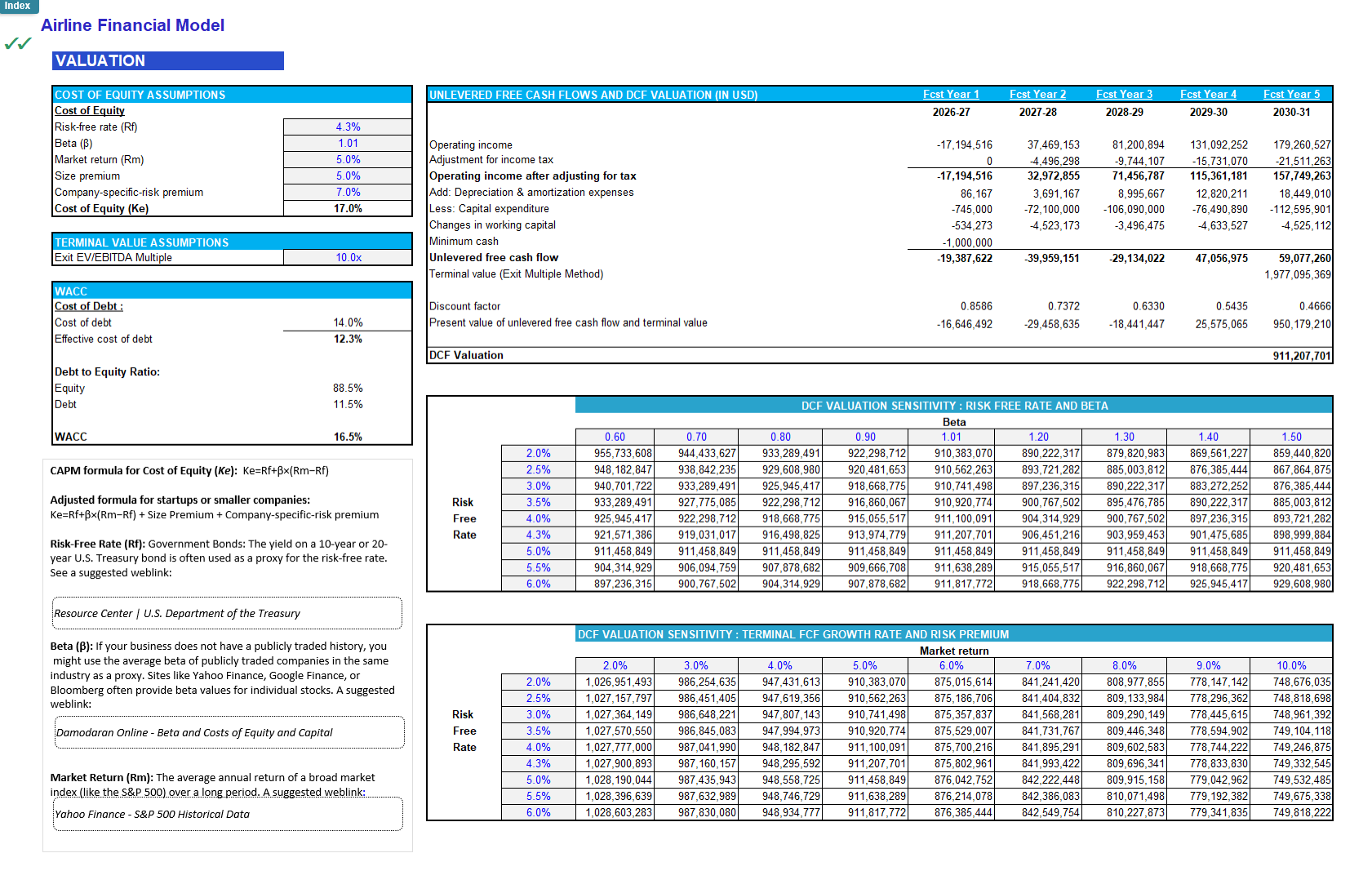
  • Valuation (DCF model + sensitivity)

4. Financial Statements Section

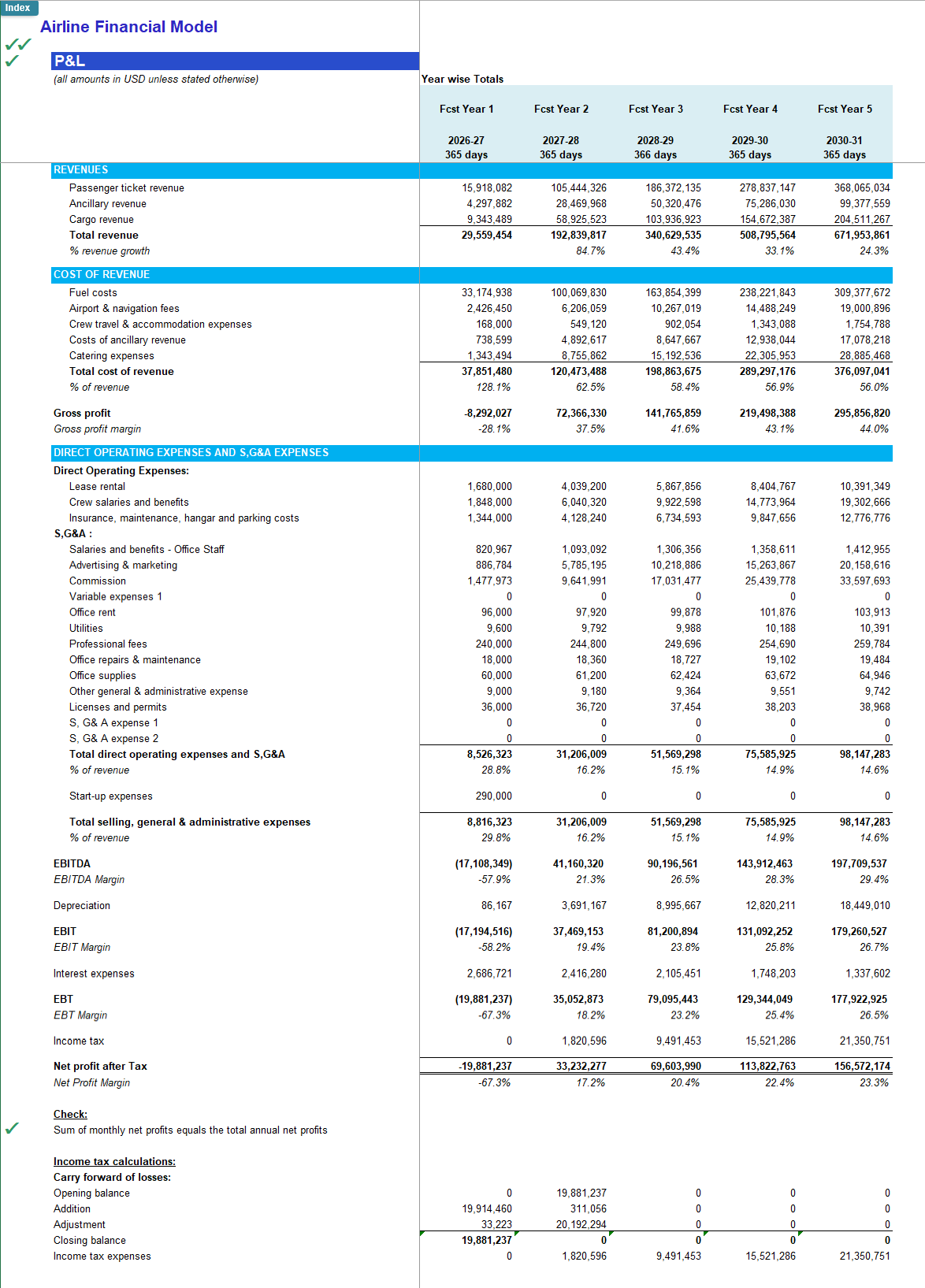
  • Profit & Loss Statement

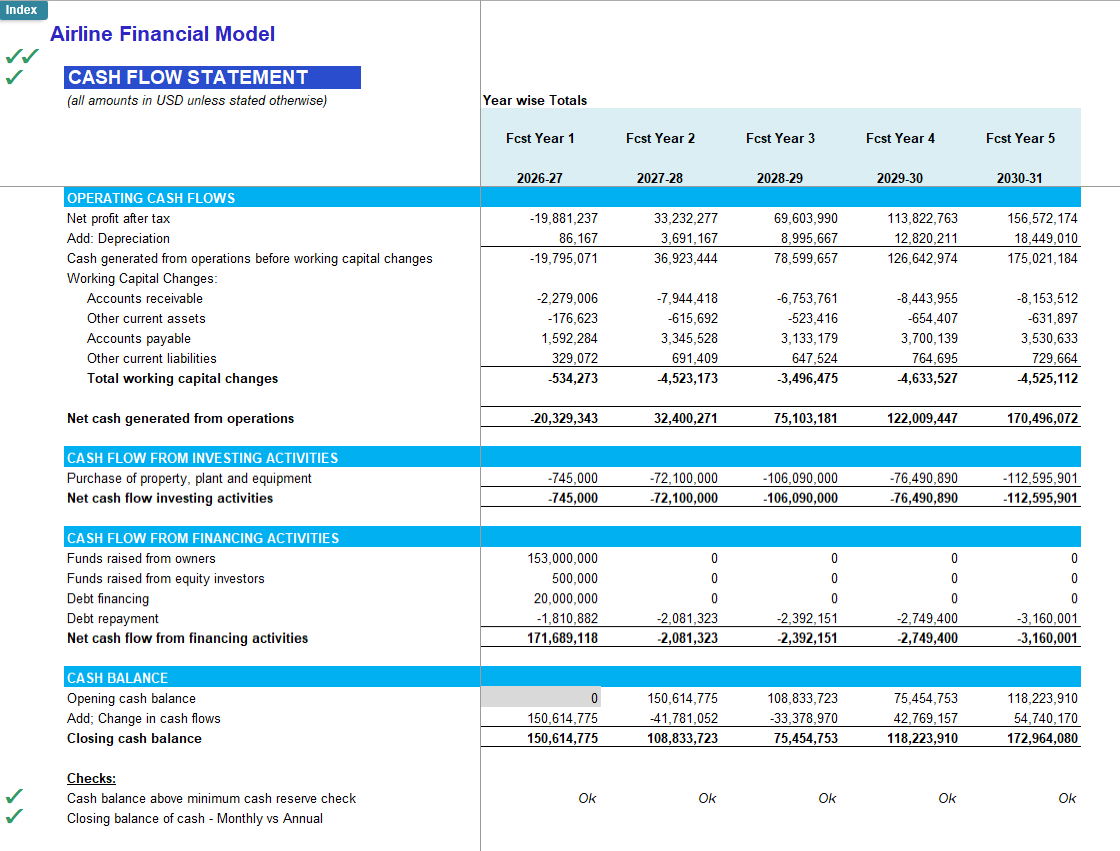
  • Cash Flow Statement

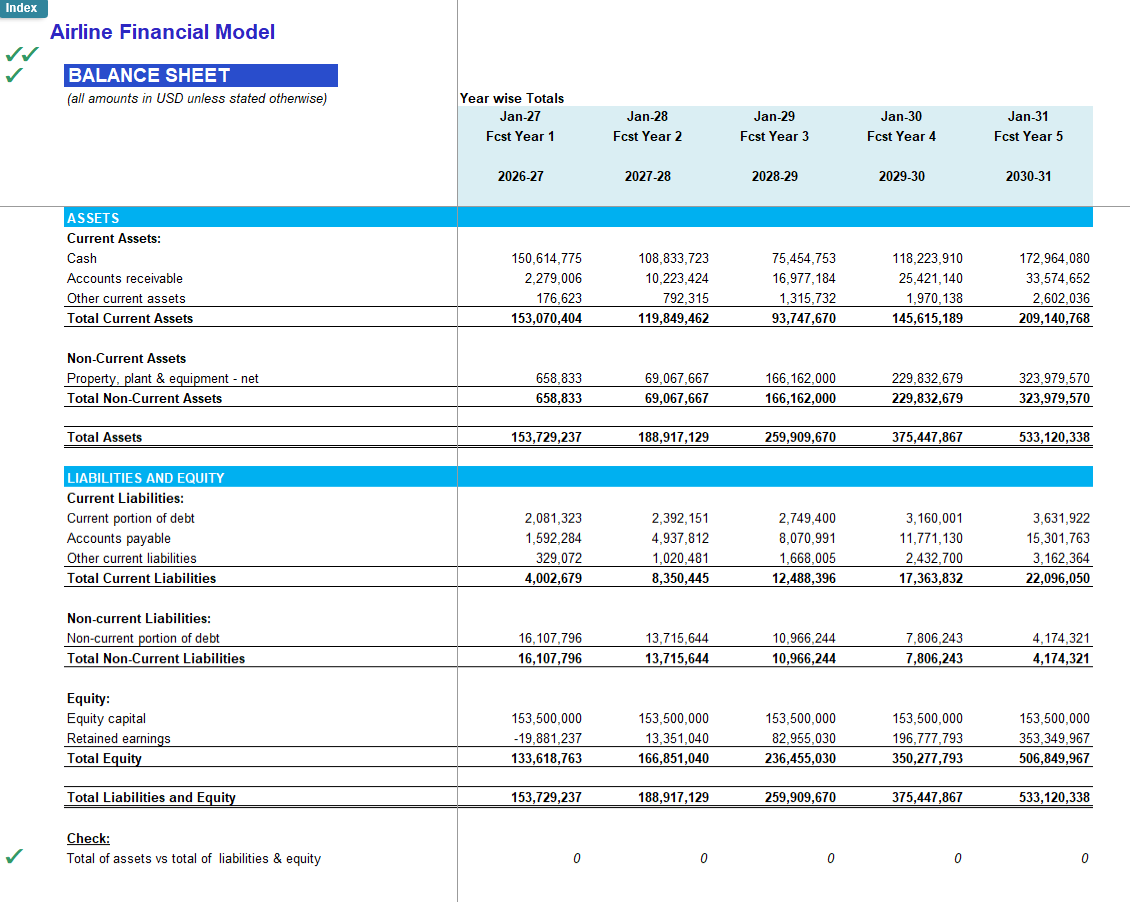
  • Balance Sheet

5. Calculations Section

  • ASK and ACTK build-up

  • Passenger, cargo, and ancillary revenue calculations

  • Block-hour and aircraft utilization logic

  • Fuel, ATC, handling, and catering cost computations

  • Direct operating cost calculations (lease, depreciation, crew, maintenance, insurance)

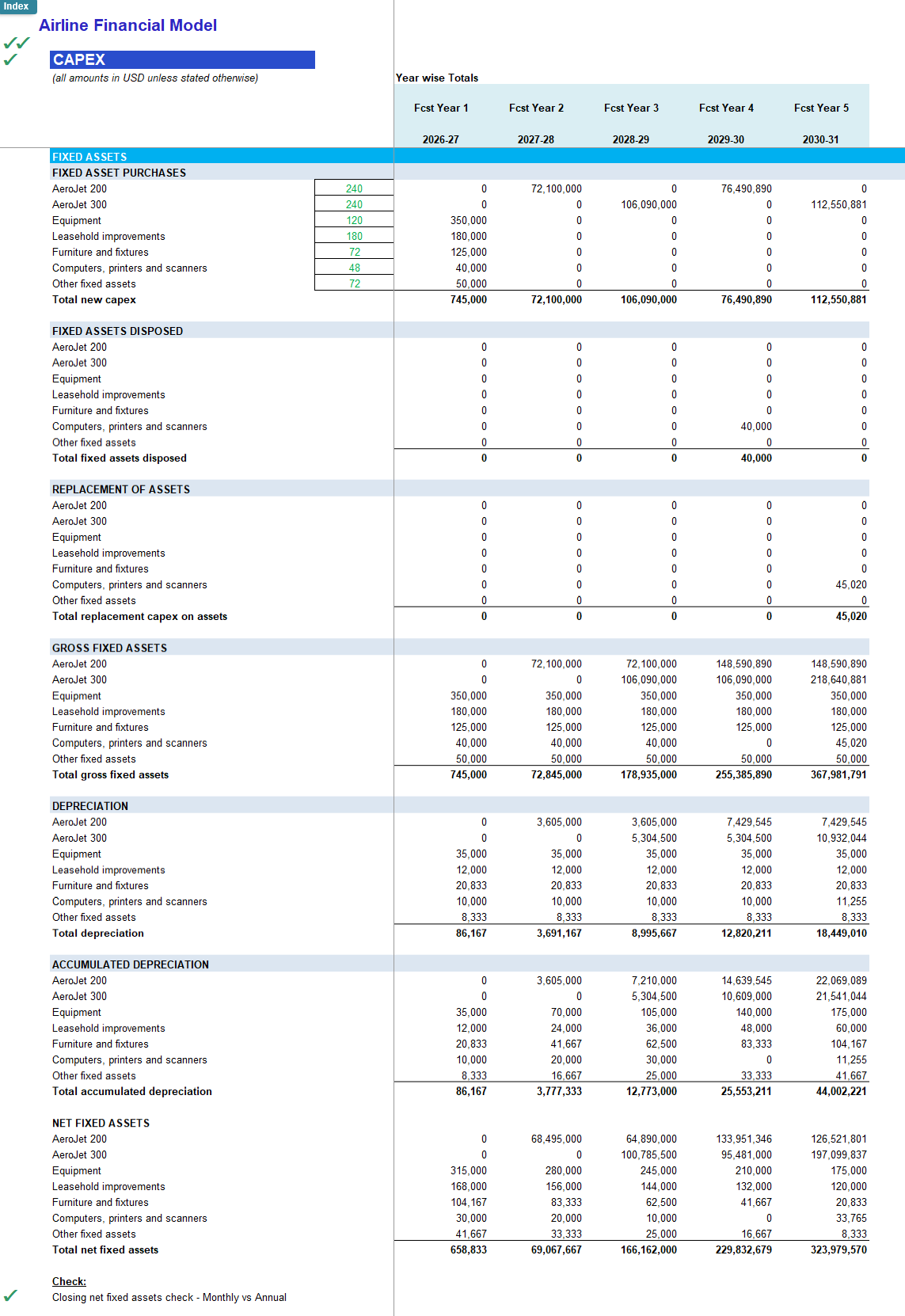
  • CapEx & loan schedules


Technical Specifications

  • No Macros / No VBA

  • Fully transparent, auditable calculation flow

  • Circular-reference-free

  • Excel 2010+ compatible


Why Choose This Model? This financial model is purpose-built for airlines seeking a scalable, RASK-driven revenue forecasting structure without the complexity of sector/route-level inputs. The revenue build-up is transparent: Passenger Revenue is forecast via PRASK, Cargo Revenue via CRATK, and Ancillary Revenue as a percentage of Passenger Revenue.


For users seeking maximum simplification, the model can be operated using a single blended RASK input, replacing both PRASK and CRATK with one aggregate unit revenue target.


By using unit metrics instead of route-level distance data, the model remains simple, flexible, and highly scalable across any fleet mix or network strategy. Ideal for airline startups, financial analysts, aviation consultants, and operators transitioning between leased and purchased aircraft, the model provides a robust, investor-ready framework for performance tracking, budgeting, valuation, and strategic planning. For enhanced customization, we can tailor the model to your specific fleet mix, ownership strategy, or financial structure.


Ideal for startup airlines, expanding carriers, aviation consultants, and financial analysts, the model provides a robust, investor-ready framework for budgeting, performance tracking, fleet planning, and valuation.

Customisation support is available for specific fleet mixes, revenue strategies, or financing structures.

This Best Practice includes
1 Excel Sheet

Acquire business license for $99.00

Add to cart

Add to bookmarks

Discuss

Further information

Provide a scalable, sector-agnostic financial forecast for airlines using RASK-based revenue modeling[; enable users to build investor-ready pro forma financial statements with reliable cost projections and revenue forecasts and offers a ready-to-use planning tool for startup airlines and growing carriers to evaluate operations, budgeting, funding needs, and profitability.

This model is ideal for airlines, startups, and consultants seeking high-level financial forecasting without the complexity of route-level inputs. It works best when revenue can be reliably modeled using ASK/ATK-based metrics such as PRASK and CRATK, rather than detailed sector schedules. It is particularly suitable for early-stage planning, budgeting, valuation, and fleet strategy assessments where scalability and simplicity are essential.


0.0 / 5 (0 votes)

please wait...