Originally published: 05/09/2026 11:50
Publication number: ELQ-67948-1
View all versions & Certificate
Publication number: ELQ-67948-1
View all versions & Certificate

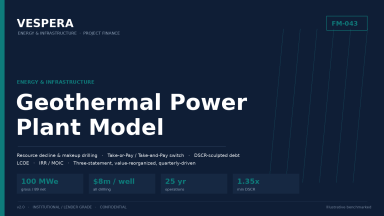
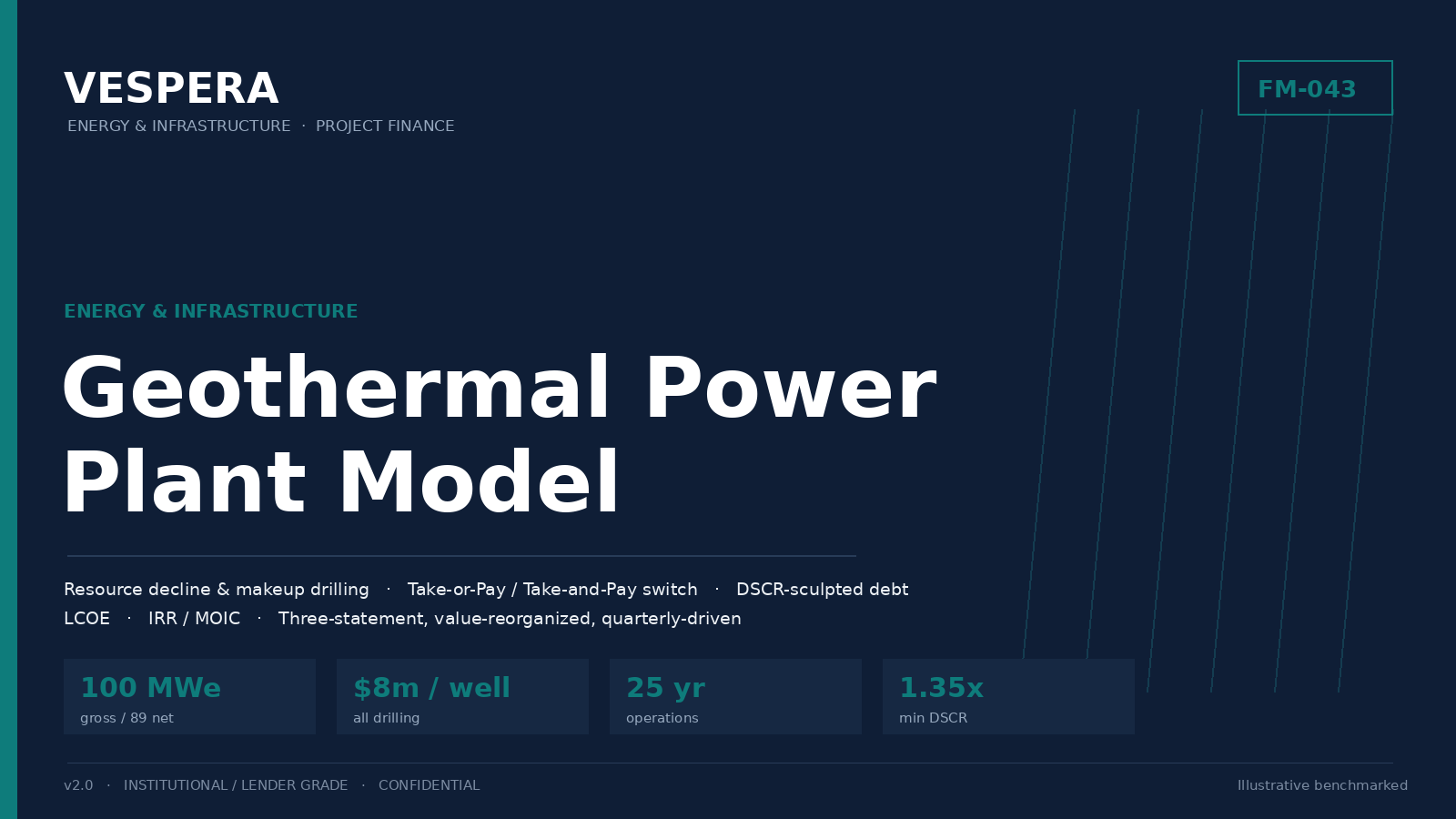
Geothermal Power Plant Financial Model - PPA, Take-or-Pay / Take-and-Pay, DSCR Debt & LCOE (Excel + Guide)
Institutional geothermal IPP model: resource decline, makeup drilling, a Take-or-Pay / Take-and-Pay tariff switch, DSCR debt, LCOE and returns. 28-page guide.
geothermalpower plantproject financeppatake or paytake and paydscrlcoerenewable energyindependent power producer
Description
The Geothermal Power Plant Financial Model is an institutional, lender-grade Excel model for a geothermal independent power producer, built on the same rigour as a full project-finance underwriting. It takes a steam resource and a power purchase agreement and turns them into a defensible investment case: revenue, coverage, returns and the levelized cost of energy, over the full 25-year operating life.
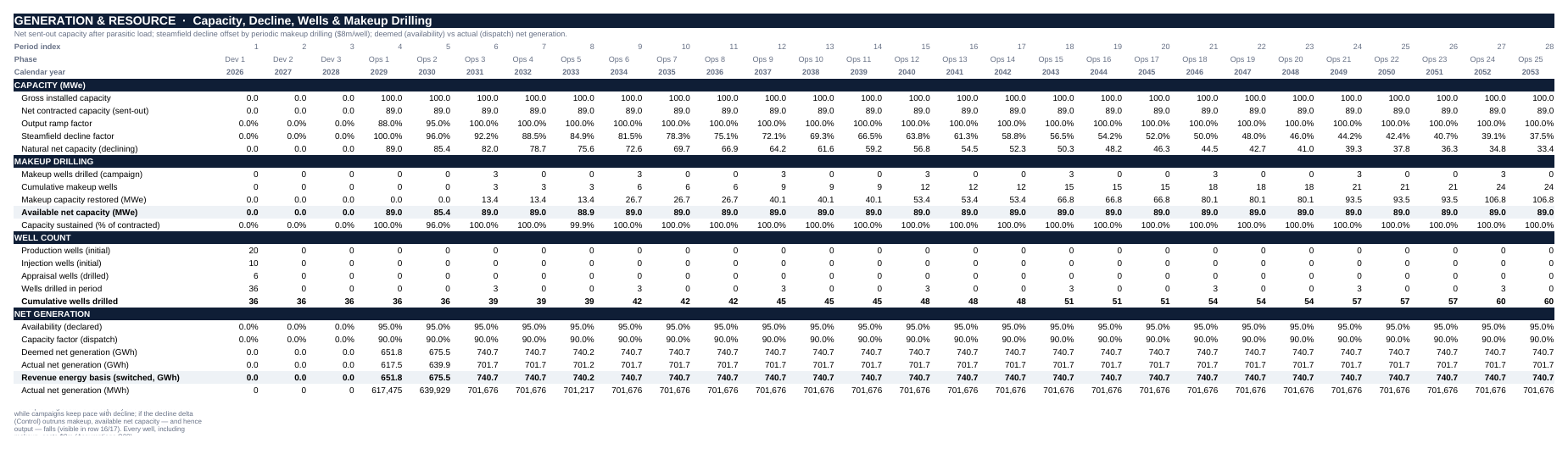
Geothermal is unusual among renewables. It runs as baseload at a high capacity factor, but its output gently declines as the reservoir is drawn down, and it is held up over decades by drilling fresh makeup wells. This model is built around that reality. It sizes the wellfield from plant capacity and well productivity, costs every well at a benchmark all-in figure, and schedules makeup drilling to sustain net capacity to the contracted level across the life of the plant.
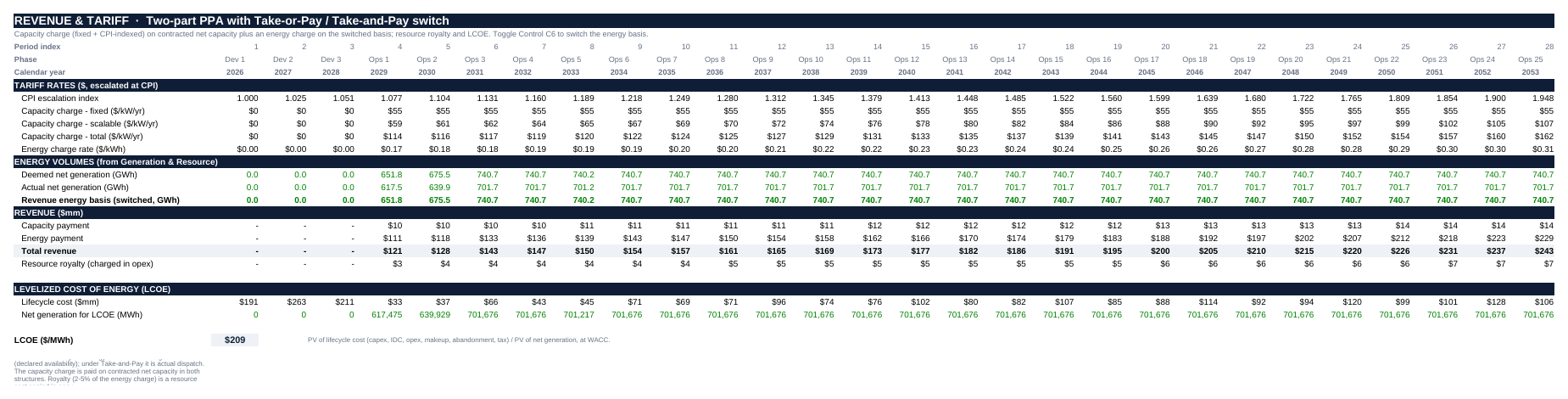
Revenue is built from a two-part PPA tariff, a capacity charge on available capacity plus a CPI-indexed energy charge net of a resource royalty, with a single switch that toggles the contract between Take-or-Pay, where the offtaker pays for deemed available energy, and Take-and-Pay, where the offtaker pays only for energy actually dispatched. The switch flows through revenue, debt capacity and returns, so you can see instantly how much the allocation of volume risk is worth.
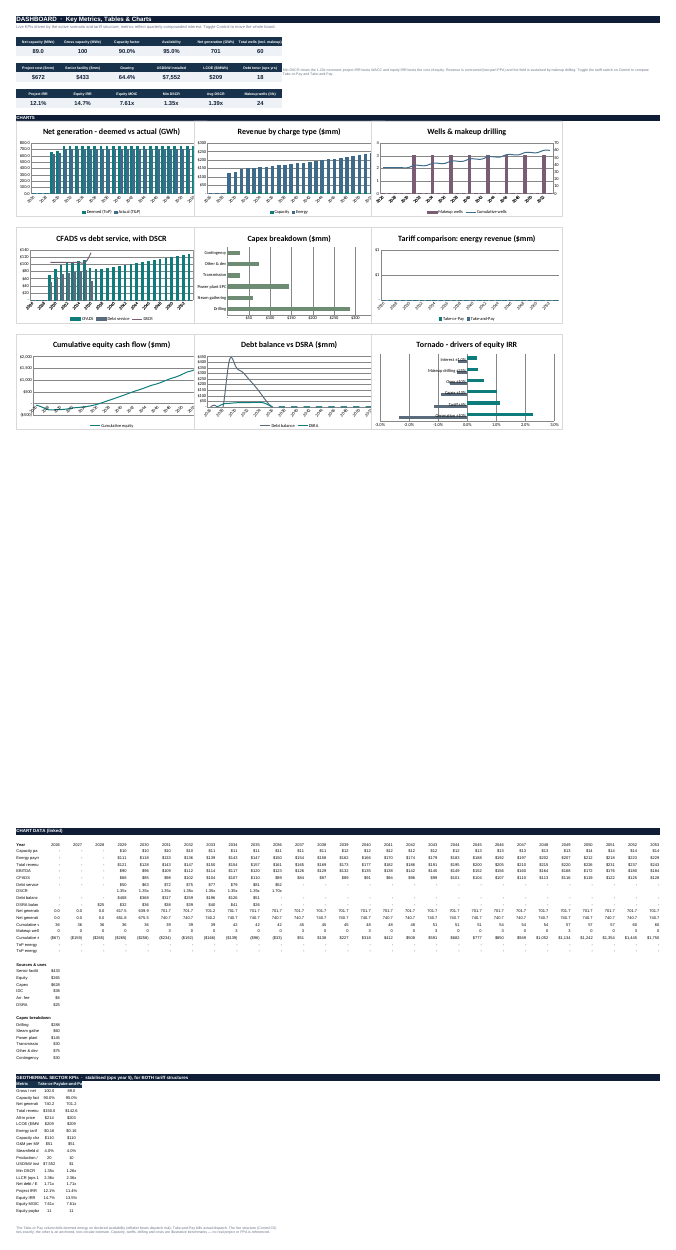
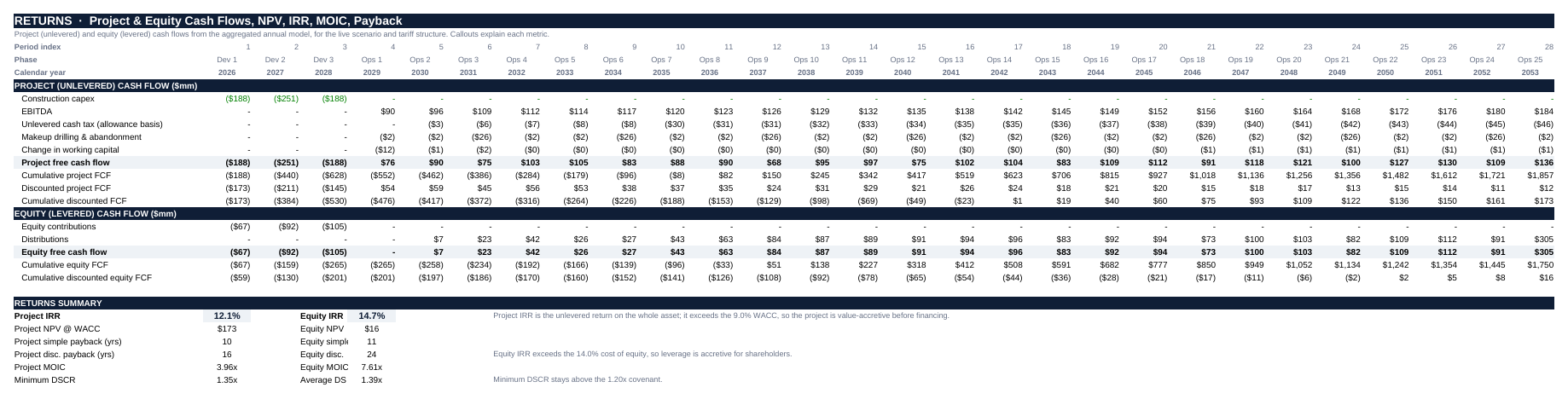
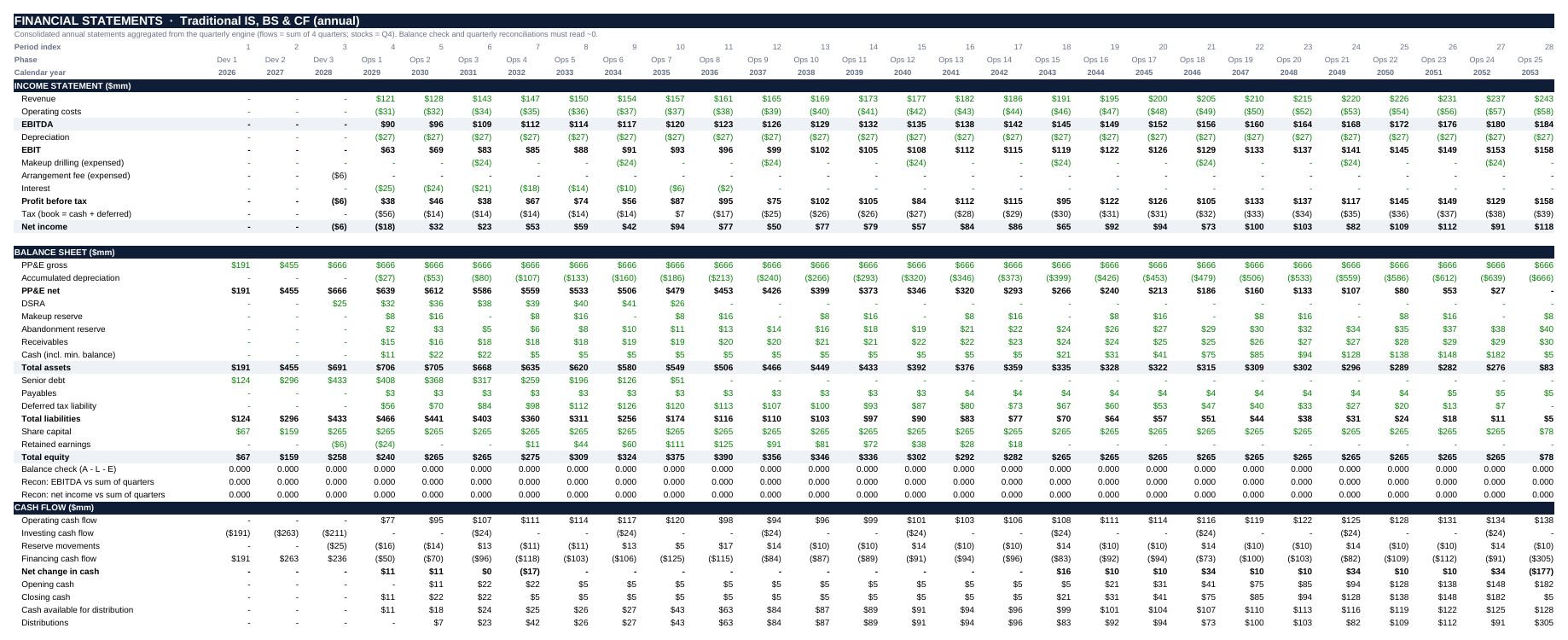
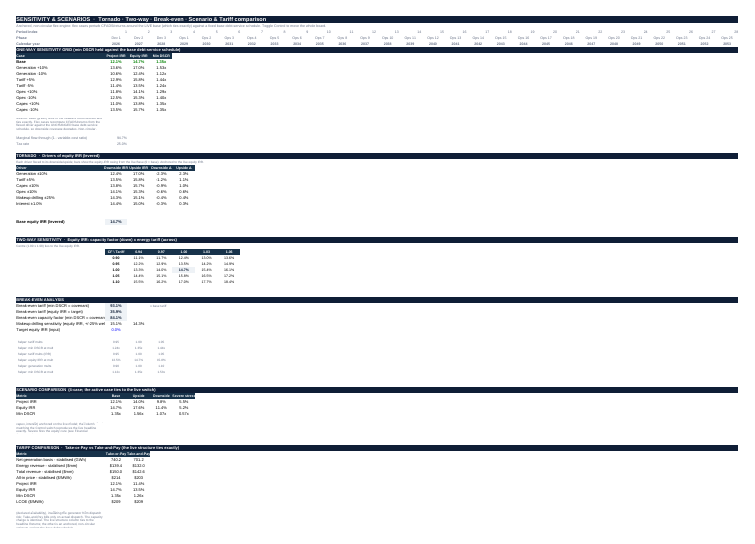
Inside the model you will find a generation and resource engine covering gross and net capacity, parasitic load, availability, capacity factor, net sent-out generation, reservoir decline and a makeup-drilling schedule; a two-part PPA revenue build with the tariff switch, CPI indexation and a resource royalty; a full construction and funding schedule spanning exploration and appraisal, production and injection drilling, steam gathering, power plant EPC, transmission, development costs, contingency and interest during construction; DSCR-sculpted senior debt with a debt service reserve, LLCR and PLCR, and covenant headroom; traditional financial statements alongside reorganized statements covering NOPLAT, invested capital, ROIC and economic profit, reconciled by three bridges that equal zero in every period; capital allowances and deferred tax that fully reverses, a minimum operating cash balance, a distribution policy limited to distributable reserves, and an abandonment reserve; returns and value metrics including project and equity IRR, equity multiple, payback, minimum and average DSCR, LLCR, PLCR and LCOE for both tariff structures; and a four-case scenario manager, a tornado, a two-way sensitivity grid, break-even analysis and a sponsor equity cure, all feeding a live dashboard and an internal checks tab.
Every calculation is formula-driven and transparent, with no macros. All inputs are illustrative and benchmarked to public industry ranges and are clearly flagged; there is no reference to any specific project, company, country or private contract. The model has been independently checked and carries zero formula errors, with the balance sheet balancing and the three reconciliation bridges tying to zero under both tariff structures and all four scenarios.
The model ships with a 28-page development and modelling guide that walks the entire project journey, from surface and subsurface studies, site acquisition and approvals, through production and injection drilling, the steam gathering system, the power plant and transmission, to commissioning, commercial operation and 25 years of resource management, and then maps every stage to the model. The guide includes original diagrams, a worked example and a glossary.
Who it is for: geothermal developers, independent power producers, sponsors, and infrastructure lenders sizing debt against a steam resource.
The Geothermal Power Plant Financial Model is an institutional, lender-grade Excel model for a geothermal independent power producer, built on the same rigour as a full project-finance underwriting. It takes a steam resource and a power purchase agreement and turns them into a defensible investment case: revenue, coverage, returns and the levelized cost of energy, over the full 25-year operating life.
Geothermal is unusual among renewables. It runs as baseload at a high capacity factor, but its output gently declines as the reservoir is drawn down, and it is held up over decades by drilling fresh makeup wells. This model is built around that reality. It sizes the wellfield from plant capacity and well productivity, costs every well at a benchmark all-in figure, and schedules makeup drilling to sustain net capacity to the contracted level across the life of the plant.
Revenue is built from a two-part PPA tariff, a capacity charge on available capacity plus a CPI-indexed energy charge net of a resource royalty, with a single switch that toggles the contract between Take-or-Pay, where the offtaker pays for deemed available energy, and Take-and-Pay, where the offtaker pays only for energy actually dispatched. The switch flows through revenue, debt capacity and returns, so you can see instantly how much the allocation of volume risk is worth.
Inside the model you will find a generation and resource engine covering gross and net capacity, parasitic load, availability, capacity factor, net sent-out generation, reservoir decline and a makeup-drilling schedule; a two-part PPA revenue build with the tariff switch, CPI indexation and a resource royalty; a full construction and funding schedule spanning exploration and appraisal, production and injection drilling, steam gathering, power plant EPC, transmission, development costs, contingency and interest during construction; DSCR-sculpted senior debt with a debt service reserve, LLCR and PLCR, and covenant headroom; traditional financial statements alongside reorganized statements covering NOPLAT, invested capital, ROIC and economic profit, reconciled by three bridges that equal zero in every period; capital allowances and deferred tax that fully reverses, a minimum operating cash balance, a distribution policy limited to distributable reserves, and an abandonment reserve; returns and value metrics including project and equity IRR, equity multiple, payback, minimum and average DSCR, LLCR, PLCR and LCOE for both tariff structures; and a four-case scenario manager, a tornado, a two-way sensitivity grid, break-even analysis and a sponsor equity cure, all feeding a live dashboard and an internal checks tab.
Every calculation is formula-driven and transparent, with no macros. All inputs are illustrative and benchmarked to public industry ranges and are clearly flagged; there is no reference to any specific project, company, country or private contract. The model has been independently checked and carries zero formula errors, with the balance sheet balancing and the three reconciliation bridges tying to zero under both tariff structures and all four scenarios.
The model ships with a 28-page development and modelling guide that walks the entire project journey, from surface and subsurface studies, site acquisition and approvals, through production and injection drilling, the steam gathering system, the power plant and transmission, to commissioning, commercial operation and 25 years of resource management, and then maps every stage to the model. The guide includes original diagrams, a worked example and a glossary.
Who it is for: geothermal developers, independent power producers, sponsors, and infrastructure lenders sizing debt against a steam resource.
This Best Practice includes
1 Excel model (.xlsx, protected, formula-driven, no macros) and 1 development and modelling guide (28-page PDF).