ISO 19011:2018 — Auditing ISO 9001 QMS — Complete Training Package
Originally published: 31/03/2026 20:32
Publication number: ELQ-40014-1
View all versions & Certificate
certified

ISO 19011:2018 — Auditing ISO 9001 QMS — Complete Training Package

Master ISO 19011:2018 auditing principles for ISO 9001 QMS. 55 slides + 7 practical exercises PPTX export-ready. + Final Assessment Word

Description

Transform Your Auditing Skills with ISO 19011:2018 Professional Training

This comprehensive training course provides everything you need to master ISO 19011:2018 guidelines for auditing ISO 9001:2015 Quality Management Systems. Designed for quality professionals, internal auditors, lead auditors, and certification body auditors.

📋 What's Included:

  • 55 Professional Slides — Modern, elegant design with varied layouts (NO repetitive templates)
  • 7 Practical Exercises — Real-world scenarios with detailed answer keys
  • 100% PPTX Export Compatible — Ready for PowerPoint, PDF, and training room projection
  • 4 Industry Sectors Covered — Manufacturing, Healthcare, Construction, Service
  • Interactive HTML Format — 1280×720px (16:9) optimized for digital delivery

🎓 Training Modules Covered:

Module 10: Introduction to ISO 19011

  • What is ISO 19011? Purpose & 2018 Edition updates
  • Key definitions (Audit, Audit Programme, Audit Criteria, etc.)
  • Types of audits (1st, 2nd, 3rd party)

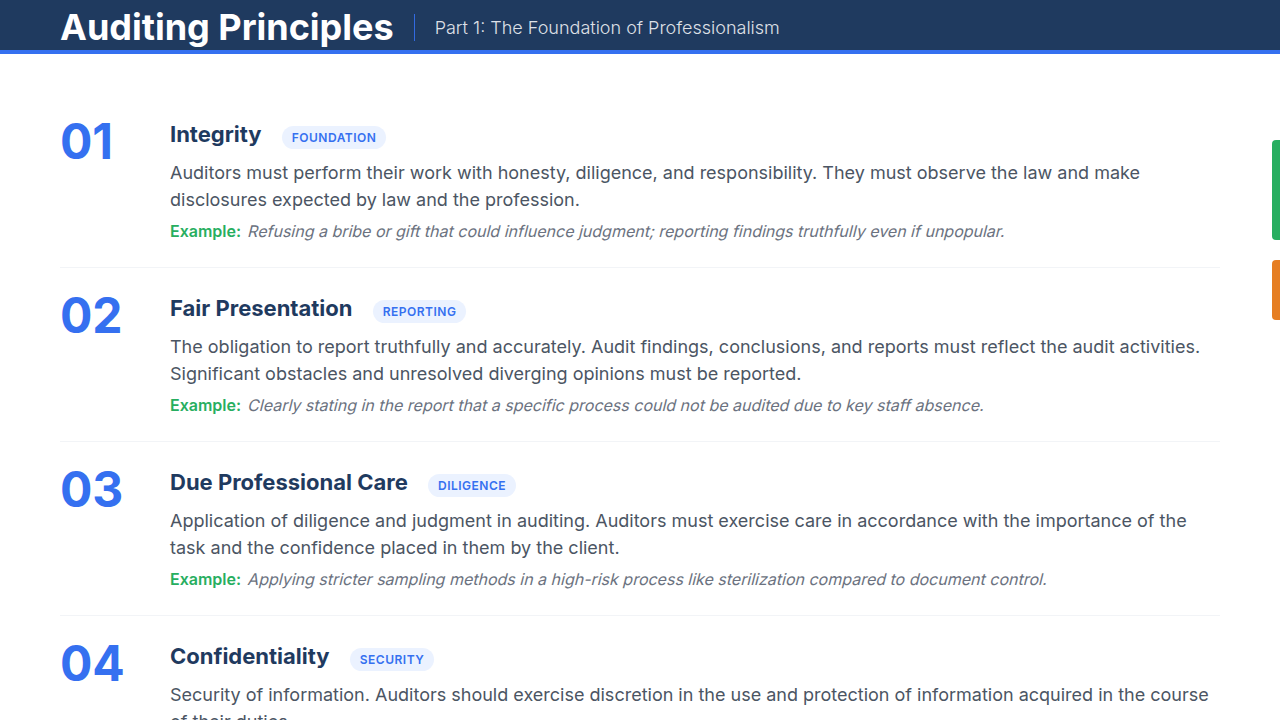
Module 11: The 7 Principles of Auditing

  • Integrity, Fair Presentation, Due Professional Care
  • Confidentiality, Independence, Evidence-based Approach
  • Risk-based Approach (2018 key update)
  • Exercise 1: Principles in Action

Module 12: Audit Programme Management (Clause 5)

  • Establishing audit programmes and objectives
  • Managing risks and opportunities
  • Implementing, monitoring, and reviewing programmes
  • Exercise 2: Design a 12-month audit programme

Module 13: Conducting an Audit (Clause 6)

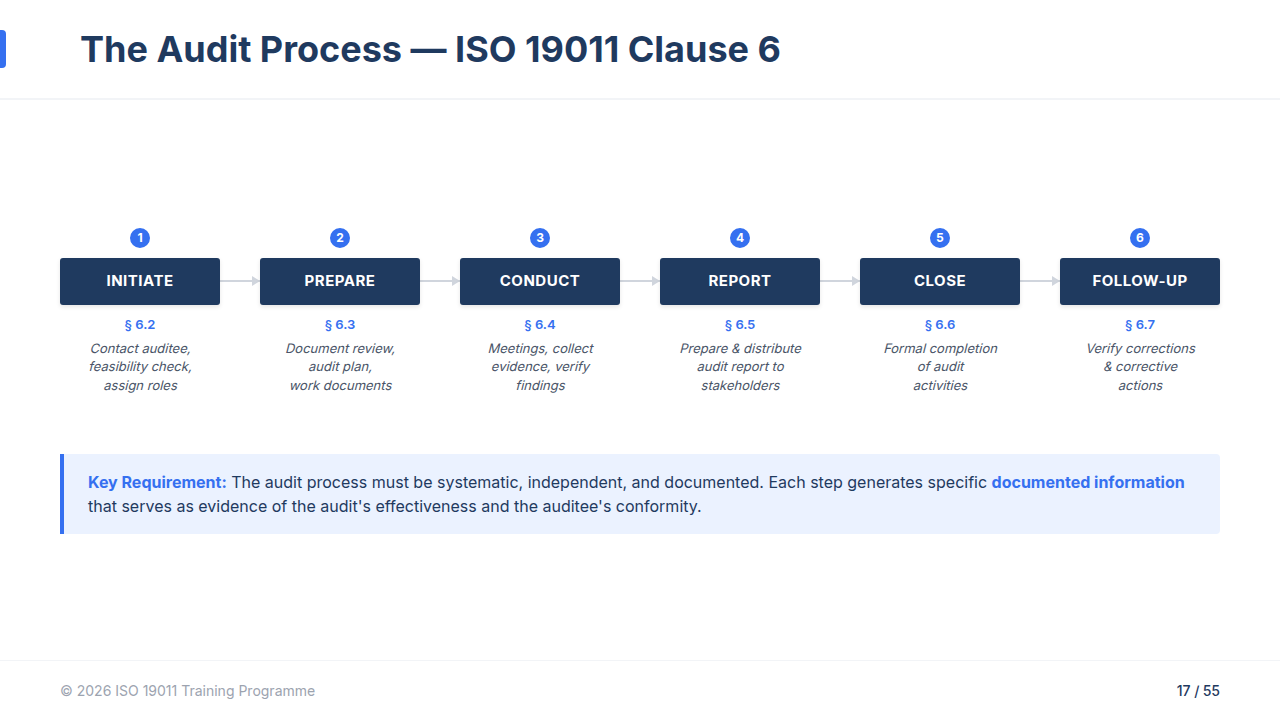
  • Complete audit process: Initiate → Prepare → Conduct → Report → Follow-up
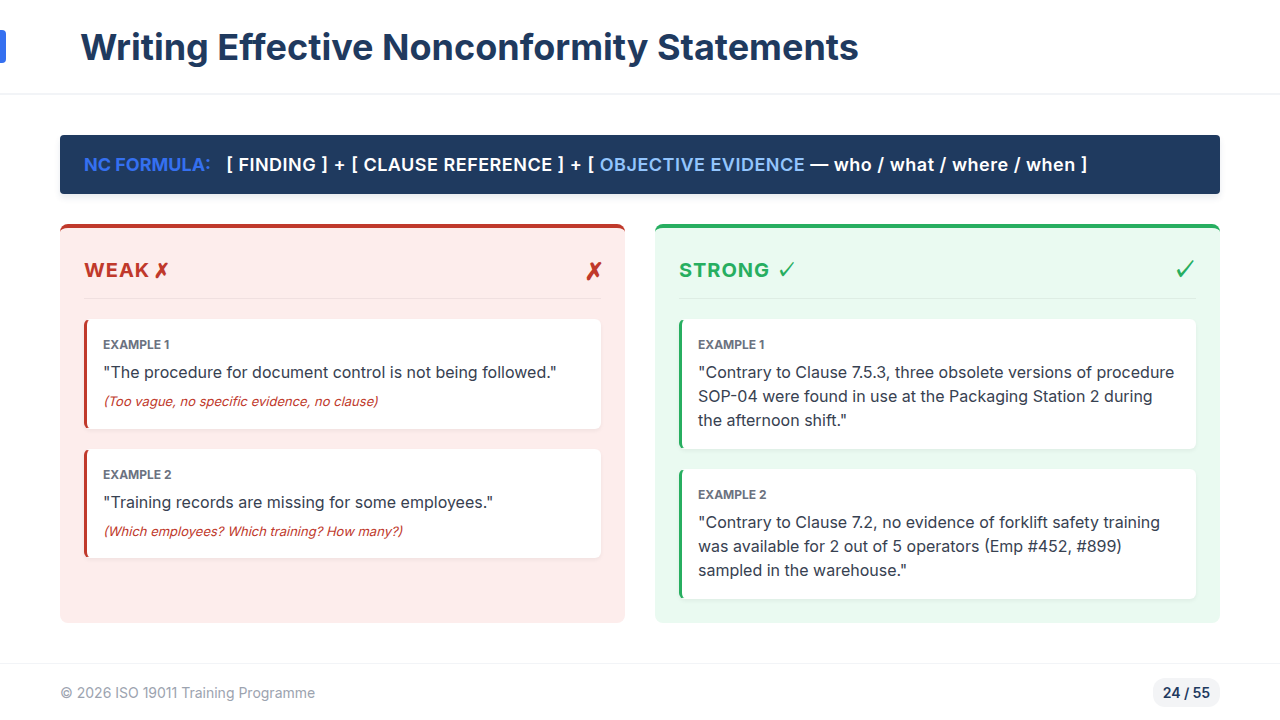
  • Writing effective nonconformity statements
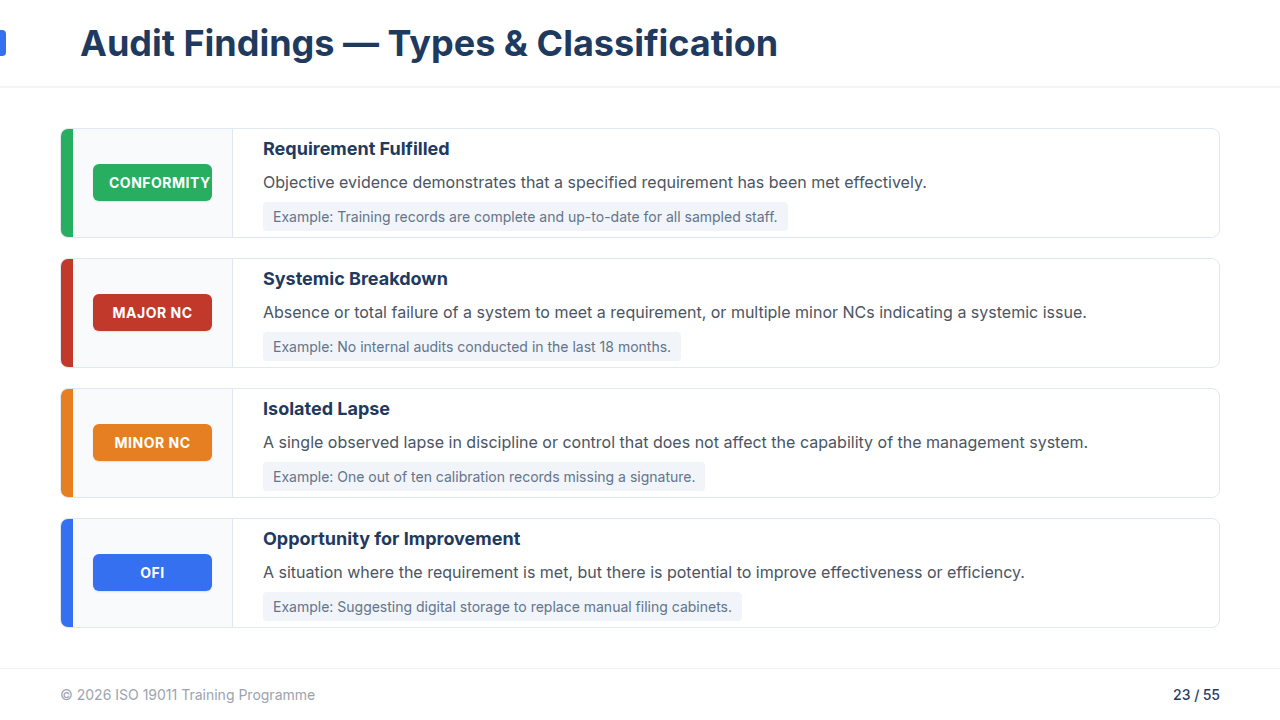
  • Audit findings classification (Conformity, Major NC, Minor NC, OFI)
  • Opening and closing meetings
  • Exercise 3: Writing NCs for construction company
  • Exercise 4: Drafting audit report sections

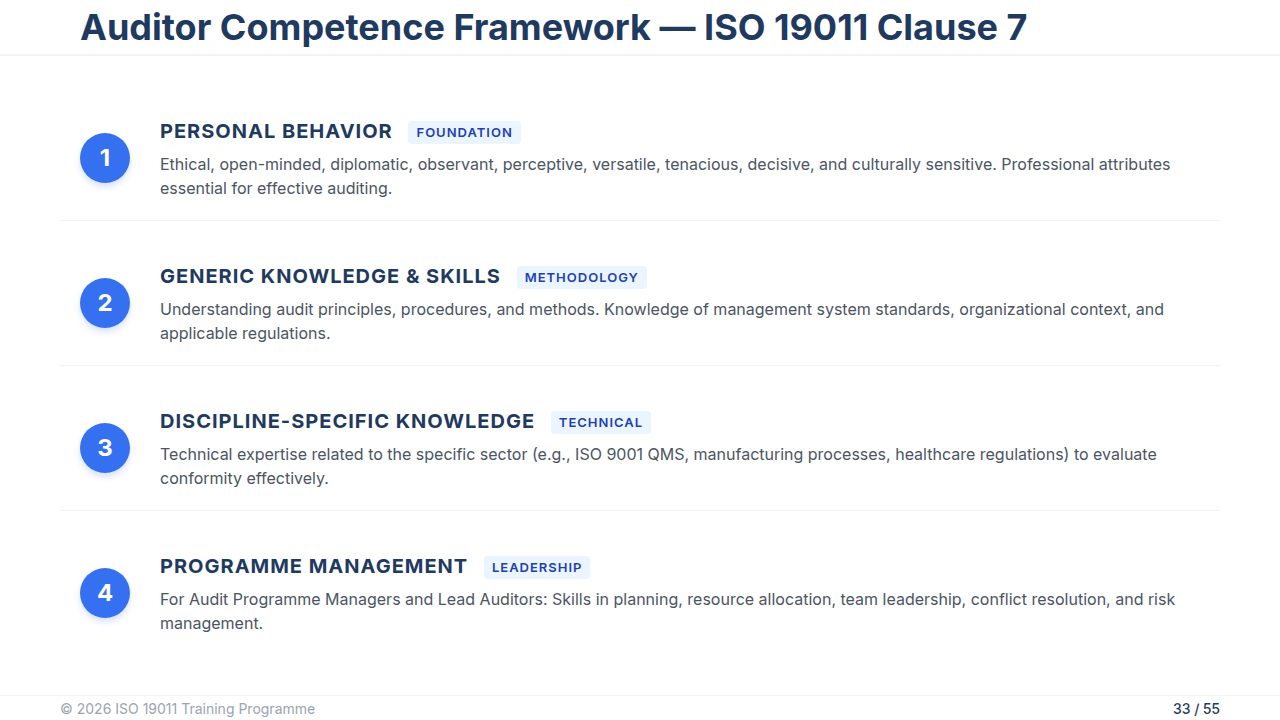
Module 14: Auditor Competence (Clause 7)

  • 4-pillar competence framework
  • Personal behavior and attributes (11 key traits)
  • Knowledge & skills requirements
  • Evaluating and maintaining competence
  • Exercise 5: Auditor selection for pharma audit
  • Exercise 6: Full audit simulation (MediBuild GmbH)

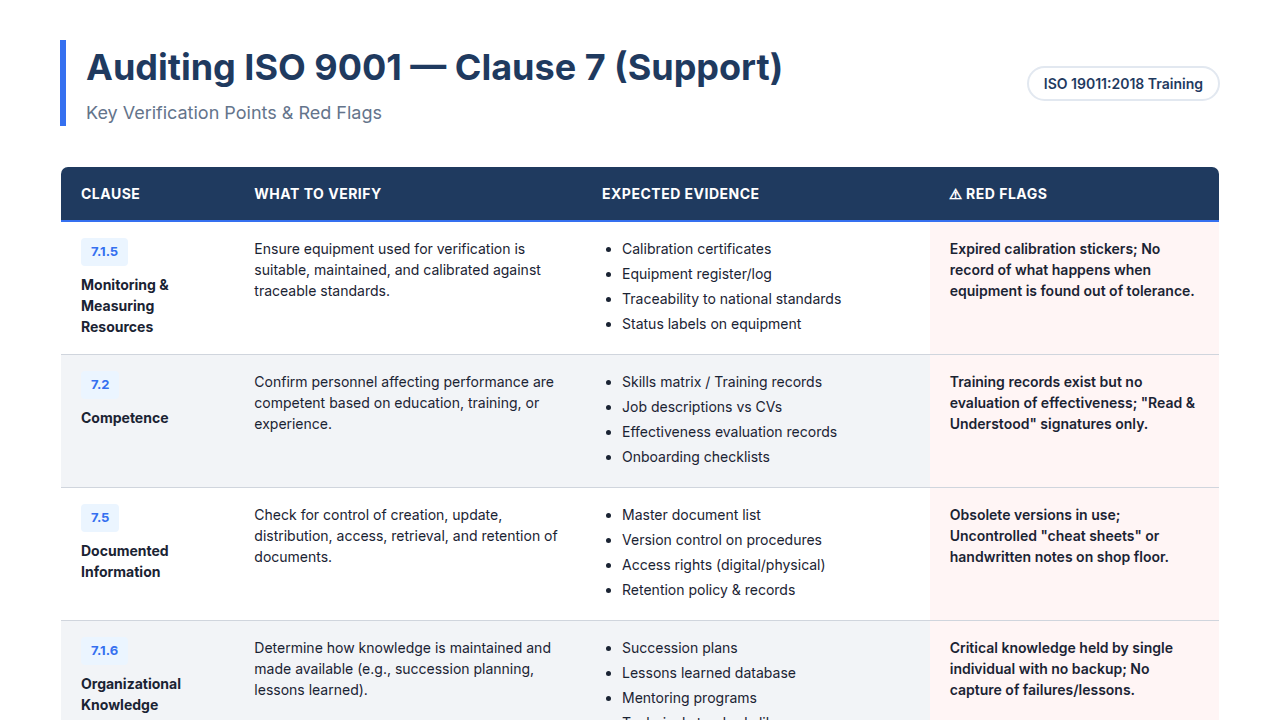
Module 15: Auditing ISO 9001 in Practice

  • Clause-by-clause audit guidance (Clauses 4, 5, 6, 7, 8, 9, 10)
  • Red flags and common audit traps
  • Good audit practice checklist
  • Sector-specific focus areas
  • Exercise 7: Process audit simulation (Purchasing)

Module 16: Closing & Key Takeaways

  • ISO 19011 vs ISO 9001 relationship
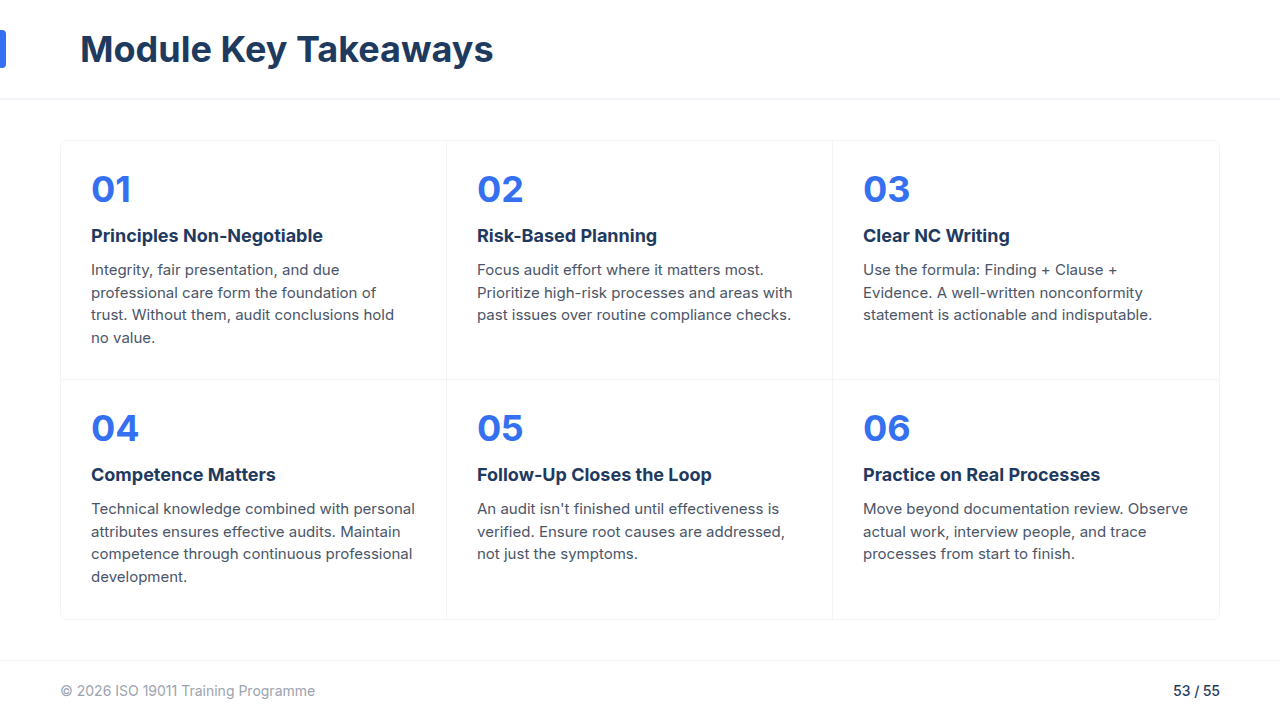
  • 6 key takeaways for effective auditing
  • Complete module summary table

Learning Outcomes:

By completing this training, you will be able to:

  • ✓ Apply the 7 principles of auditing in real audit situations
  • ✓ Plan and manage an effective audit programme (Clause 5)
  • ✓ Conduct audits systematically from initiation to follow-up (Clause 6)
  • ✓ Write clear, objective nonconformity statements with proper evidence
  • ✓ Evaluate auditor competence against ISO 19011 requirements (Clause 7)
  • ✓ Audit all ISO 9001:2015 clauses with confidence
  • ✓ Identify red flags and avoid common audit traps
  • ✓ Adapt auditing techniques to different industry sectors

Who Should Use This Training:

  • Internal Auditors — Building or refreshing ISO 9001 audit skills
  • Lead Auditors — Training audit teams on ISO 19011 methodology
  • Quality Managers — Managing internal audit programmes
  • Certification Body Auditors — Professional development & CPD
  • Consultants — Delivering auditor training to clients
  • Operations Managers — Understanding the audit process as auditees

Design Features:

Modern Varied Layouts — 40 unique templates (NO repetitive card designs)

  • Two-tone split layouts with navy accent panels
  • Horizontal process flows (4-step and 6-step)
  • Side-by-side contrast panels (red/green for risks/opportunities)
  • Audit trail diagrams with vertical flow visualization
  • KPI bars with CSS progress indicators
  • Horizontal timelines with numbered milestones
  • Formula bars with good/bad comparison layouts
  • Profile cards for candidate evaluation
  • Warning strips with color-coded alerts
  • 4-column phase-based checklists

✅ 100% PPTX Export Compatible

  • NO gradients, NO box-shadow, NO backdrop-filter
  • NO SVG icons — Unicode symbols only (●, ▶, ✓, ✗, ★)
  • Strict overflow control (no scroll issues on export)
  • System fonts (Inter, Arial, Helvetica)
  • Minimum 20px body text for training room projection

Professional Color Palette

  • Navy #1F3A5F (primary)
  • Blue #3570F0 (accents)
  • Green #27AE60 (conformity/opportunities)
  • Red #C0392B (Major NCs/risks)
  • Orange #E67E22 (Minor NCs/warnings)
  • Light Grey #F2F4F7 (backgrounds)

 What You Get:

  1. 55-Slide Interactive HTML Presentation

    • Fully responsive 1280×720px format
    • Clickable navigation
    • Print-ready layout

  2. 7 Complete Exercises with Answer Keys

    • Real-world audit scenarios
    • Detailed solutions with clause references
    • Rationale linked to ISO 19011 requirements

  3. Ready-to-Use Training Materials

    • Logo placeholder on cover slides
    • Editable content via HTML/CSS
    • Export to PPTX/PDF for offline use

  4. Sector-Specific Examples

    • Manufacturing (traceability, production control)
    • Healthcare (competence, safety, sterilization)
    • Construction (subcontractors, ITP, site safety)
    • Service (SLA monitoring, knowledge management)

  5.  Final Assessment ( INCLUDED):
  • A separate 30-question final assessment is available upon request:

    • Multiple choice questions (MCQ)
    • True/False questions
    • Short scenario-based questions
    • Passing score: 70% (21/30)
    • Covers all modules (Clauses 1-7 + Annex A)

Commercial Use Rights:

 - Use for internal training within your organization
- Deliver training to clients (consultants) 

- Customize content for your specific needs 

- Export to PPTX/PDF for distribution


 Technical Specifications:

  • Format: Interactive HTML5 (1280×720px, 16:9 aspect ratio)
  • Compatibility: All modern browsers, PPTX export via platform
  • File Size: Optimized for fast loading
  • Fonts: Google Fonts (Inter) + system fallbacks
  • Language: English
  • Accessibility: High-contrast design, readable fonts (18px minimum)

 Complementary Resources:

This training is designed to complement:

  • ISO 9001:2015 QMS training modules
  • ISO 19011:2018 standard (not included — purchase separately)
  • Internal auditor certification programmes
  • Lead auditor training courses 

This Best Practice includes
• 55 Interactive HTML Slides (1280×720px, 16:9 format) • 7 Practical Exercises with detailed answer keys • 30-Question

Acquire business license for $20.00

Add to cart

Add to bookmarks

Discuss

Further information

Learning Objectives: • Master the 7 principles of auditing according to ISO 19011:2018 (Integrity, Fair Presentation, Due Professional Care, Confidentiality, Independence, Evidence-based Approach, Risk-based Approach) • Plan and manage effective audit programmes (Clause 5: objectives, risks/opportunities, implementation, monitoring) • Conduct systematic audits from initiation to follow-up (Clause 6: complete audit process) • Write clear, objective nonconformity statements with proper evidence (Finding + Clause + Evidence formula) • Evaluate and maintain auditor competence against ISO 19011 requirements (Clause 7: 4-pillar framework) • Audit all ISO 9001:2015 clauses with confidence (Clauses 4-10: Context, Leadership, Planning, Support, Operation, Performance, Improvement) • Identify audit red flags and avoid common audit traps • Adapt auditing techniques to different industry sectors (Manufacturing, Healthcare, Construction, Service)

Training Outcomes: • Apply ISO 19011:2018 guidelines to real audit situations • Classify audit findings correctly (Conformity, Major NC, Minor NC, OFI) • Conduct opening and closing meetings professionally • Draft comprehensive audit reports with mandatory content (Clause 6.5) • Verify corrective action effectiveness through structured follow-up • Use audit methods effectively (on-site, remote, observation, sampling, document review) • Recognize when auditor independence is compromised

Professional Development: • Build CPD hours for ISO 9001 Lead Auditor certification • Strengthen internal audit programme management skills • Enhance root cause analysis capabilities for nonconformities • Develop sector-specific auditing competence

Ideal Use Cases: • Organizations implementing ISO 9001:2015 QMS and establishing internal audit programmes • Internal auditors requiring structured training on ISO 19011:2018 methodology • Lead auditors training audit teams on standardized auditing principles • Quality managers responsible for managing and monitoring audit programmes • Certification body auditors seeking professional development and CPD hours • Consultants delivering auditor training to multiple client organizations • Companies preparing for ISO 9001 certification or recertification audits • Operations managers wanting to understand the audit process as auditees • Organizations transitioning from ISO 19011:2011 to the 2018 edition (risk-based approach)

Best Applied When: • Training groups of 5-20 participants in classroom or virtual training rooms • Conducting multi-session training programmes (Module 10-16 delivered over 2-3 days) • Combining with practical audit simulations and role-playing exercises • Following up ISO 9001:2015 foundational training with auditing skills • Preparing audit teams before internal audit campaigns • Onboarding new auditors into quality departments • Refreshing auditor competence annually (CPD requirement)

Sector Suitability: • Manufacturing (production control, traceability, supplier management) • Healthcare (competence, safety, sterilization, patient care) • Construction (subcontractors, inspection test plans, site safety) • Service industries (SLA monitoring, knowledge management, customer satisfaction)

Delivery Formats: • Projected in training rooms (1280×720px optimized for standard projectors) • Exported to PPTX for offline delivery in client locations • Converted to PDF for self-paced learning and documentation • Shared digitally via LMS platforms for remote learning

NA


0.0 / 5 (0 votes)

please wait...