


Publication number: ELQ-14685-1
View all versions & Certificate

Private Medical Practice Financial Model — Excel + PDF
Financial clarity for clinics & practices: 9-tab Excel model for revenue, staffing, break-even, and 5-year scenarios. Print-ready dashboard.
 by Sankar Srinivasan
Stock Market Consultant | Options Strategies | Portfolio Risk Management & Professional Trading SystemsFollow
Further information
This financial model is designed to give private medical practice owners and healthcare entrepreneurs the tools to understand, manage, and grow their business with confidence.
By downloading this best practice, you will be able to:
Know your break-even point — understand exactly how many patient appointments you need each month to cover all costs and start generating profit.
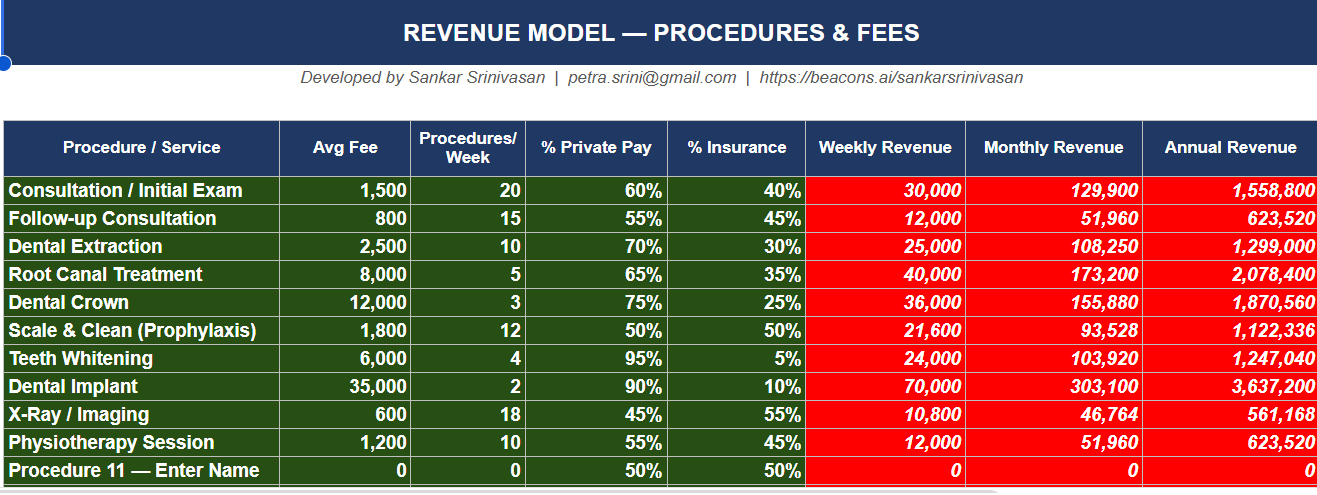
Model your revenue accurately — map every procedure or service you offer against real fees and volumes to see where your income actually comes from.
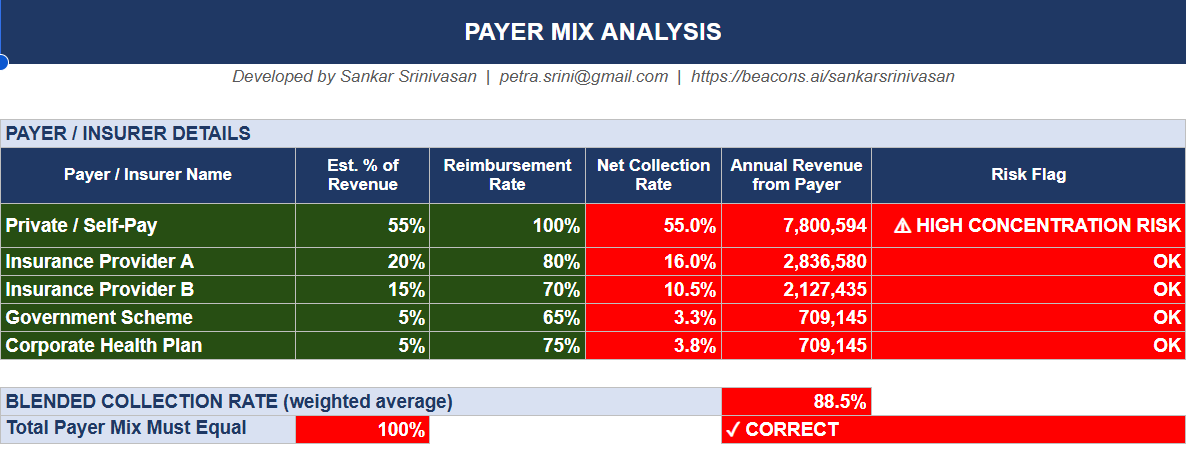
Understand your payer risk — identify dangerous over-reliance on a single insurer or scheme before it becomes a cash flow crisis.
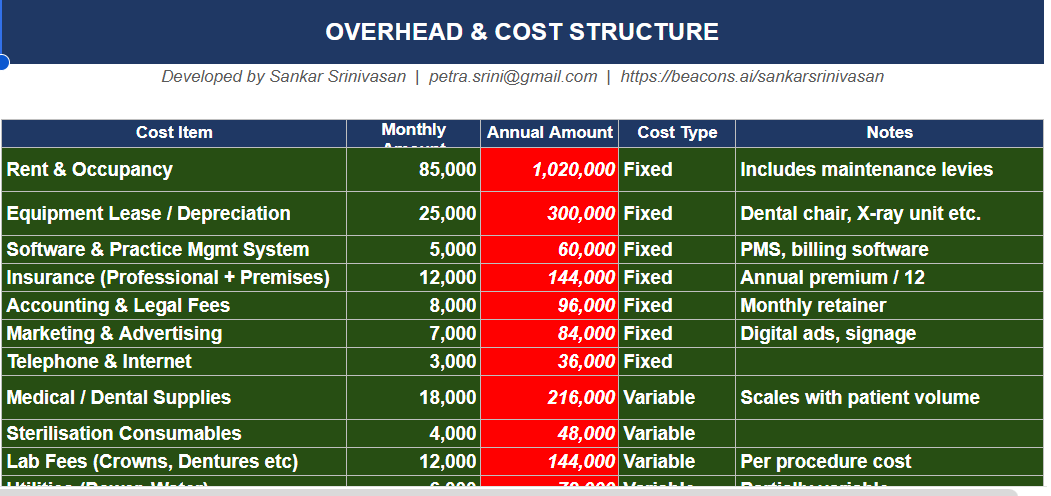
Control your largest cost: your team — calculate true staffing cost, revenue per staff member, and whether your consulting rooms are being used to their full potential.
Plan for growth with evidence — run Conservative, Base, and Optimistic 5-year scenarios to support expansion decisions, bank loan applications, or partnership discussions.
Present with credibility — use the one-page Executive Summary Dashboard in board meetings, bank meetings, or partner conversations without needing an accountant in the room.
This tool replaces guesswork with clarity, and expensive consultants with a one-time affordable investment.
This tool is ideal for private healthcare professionals who own or manage a fee-generating clinical practice and need financial visibility without relying on an accountant for every decision.
It applies best when you are setting up a new private practice and need to model viability before committing to premises and staff. It is equally valuable for an established clinic that has never had a structured financial model and is running on instinct rather than numbers.
The model is particularly relevant if you are planning to hire an associate doctor or expand your service menu and need to understand the cost and revenue impact before acting. It suits practitioners preparing a business case for a bank loan or investor, or those entering a partnership arrangement who need a shared financial reference point.
It also fits well when your practice feels busy but profitability is unclear — a situation far more common in healthcare than any other industry. If you suspect certain procedures are loss-making, your insurance payer mix is too concentrated, or your break-even point is unknown, this model resolves all three immediately.
Practice types it covers best: private GP and family medicine clinics, dental and orthodontic practices, physiotherapy and rehabilitation centers, dermatology and aesthetic clinics, specialist consulting rooms, and small multi-specialty health centers.
This financial model is designed for privately-owned, fee-for-service medical practices and may not be suitable in the following situations:
This tool is not intended for large hospital groups, NHS or public health systems, or government-funded healthcare institutions where funding structures, budget cycles, and reporting frameworks differ fundamentally from private practice economics.
It is not a substitute for professional accounting, tax advice, or statutory financial reporting. The model does not calculate GST, VAT, income tax, or jurisdiction-specific payroll levies — users should consult a qualified accountant for compliance purposes.
The model assumes a single-location practice. While it can be adapted, it is not purpose-built for multi-site clinic networks or franchise health businesses requiring consolidated group reporting.
It does not apply to pharmaceutical companies, medical device businesses, health insurance providers, or healthcare staffing agencies, as their revenue models and cost structures are structurally different.
Finally, this tool is not suitable for academic or research institutions, nonprofit health organizations, or practices operating purely under fixed government capitation contracts where fee-for-service revenue modeling is not relevant.