Originally published: 06/02/2026 16:32
Publication number: ELQ-44222-1
View all versions & Certificate
Publication number: ELQ-44222-1
View all versions & Certificate

Solar Photovoltaic (PV) EPC (Engineering, Procurement & Construction) – Financial Forecast Model
Financial forecast model for Solar PV EPC businesses, covering project-based revenue, costs, cash flows, working capital, and integrated financial statements.
Seasoned Financial Analyst: Excel Modeling, Data Analysis and Data VisualizationFollow 116
renewable energy valuationsolar pv epc financial modelphotovoltaic project forecastingsolar epc revenue & cost analysiyear cash flow projectionmilestone-based billing modelworking capital managementbalance-of-system cost breakdownebitda margin optimization
Description
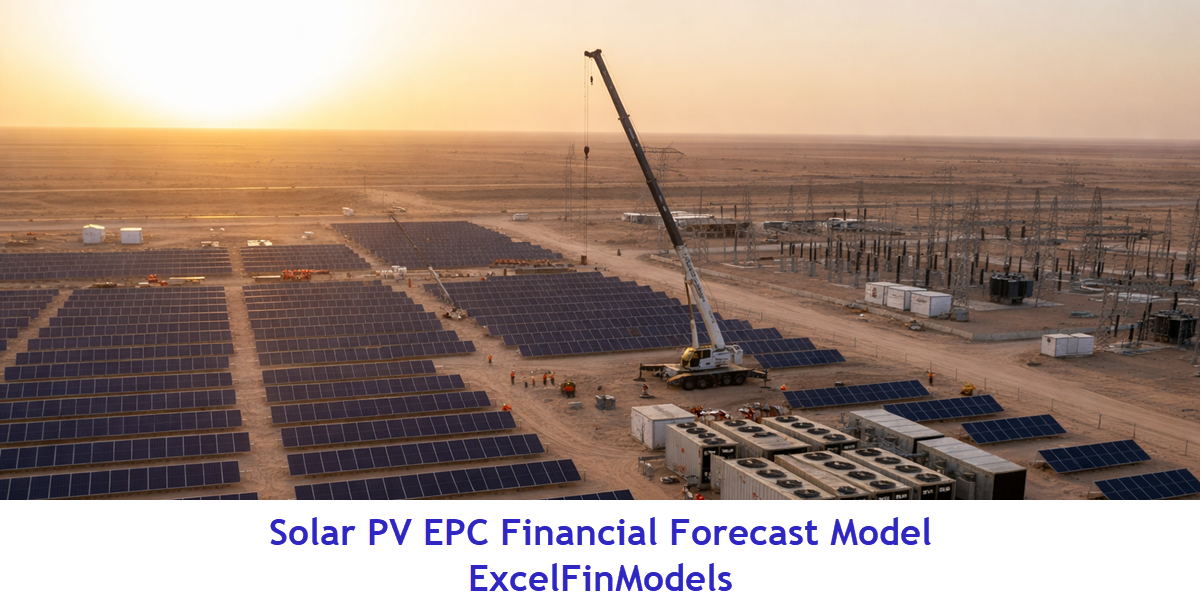
This financial model is designed to evaluate and forecast the operating and financial performance of a Solar Photovoltaic (PV) Engineering, Procurement, and Construction (EPC) business. The business scope includes the design, procurement, installation, and commissioning of turnkey solar PV projects across residential, commercial & industrial (C&I), and community or utility / distribution-scale applications.
The model captures project-driven revenue, solar module and balance-of-system procurement economics, civil and electrical installation costs, and monthly operating dynamics across configurable Solar PV market segments. It delivers a 5-year (60-month), forward-looking forecast, enabling decision-makers to assess scalability, revenue and cost trajectories, project-level margins, working capital requirements, and overall profitability.
Model Structure – Five Core Sections
1. Cover & Navigation
2. Input Assumptions
Key business drivers are consolidated into a centralized assumptions interface.
To support granular monthly forecasting, assumptions related to the number of new Solar PV EPC contracts signed are embedded within the Revenue & Cost of Revenue tab.
Revenue Assumptions
The model supports industry-standard Solar PV EPC revenue frameworks, including:
Dashboard
Built-in validation controls ensure model integrity:
This model supports institutional-gradefinancial planning for Solar PV EPC contractors. It is purpose-built to addressthe project-based revenue profile, procurement-driven cost structure,milestone-based billing, and working-capital intensity inherent in Solar EPCbusinesses, while maintaining transparency across execution risk, cash-flowtiming, and profitability drivers.
This financial model is designed to evaluate and forecast the operating and financial performance of a Solar Photovoltaic (PV) Engineering, Procurement, and Construction (EPC) business. The business scope includes the design, procurement, installation, and commissioning of turnkey solar PV projects across residential, commercial & industrial (C&I), and community or utility / distribution-scale applications.
The model captures project-driven revenue, solar module and balance-of-system procurement economics, civil and electrical installation costs, and monthly operating dynamics across configurable Solar PV market segments. It delivers a 5-year (60-month), forward-looking forecast, enabling decision-makers to assess scalability, revenue and cost trajectories, project-level margins, working capital requirements, and overall profitability.
Model Structure – Five Core Sections
1. Cover & Navigation
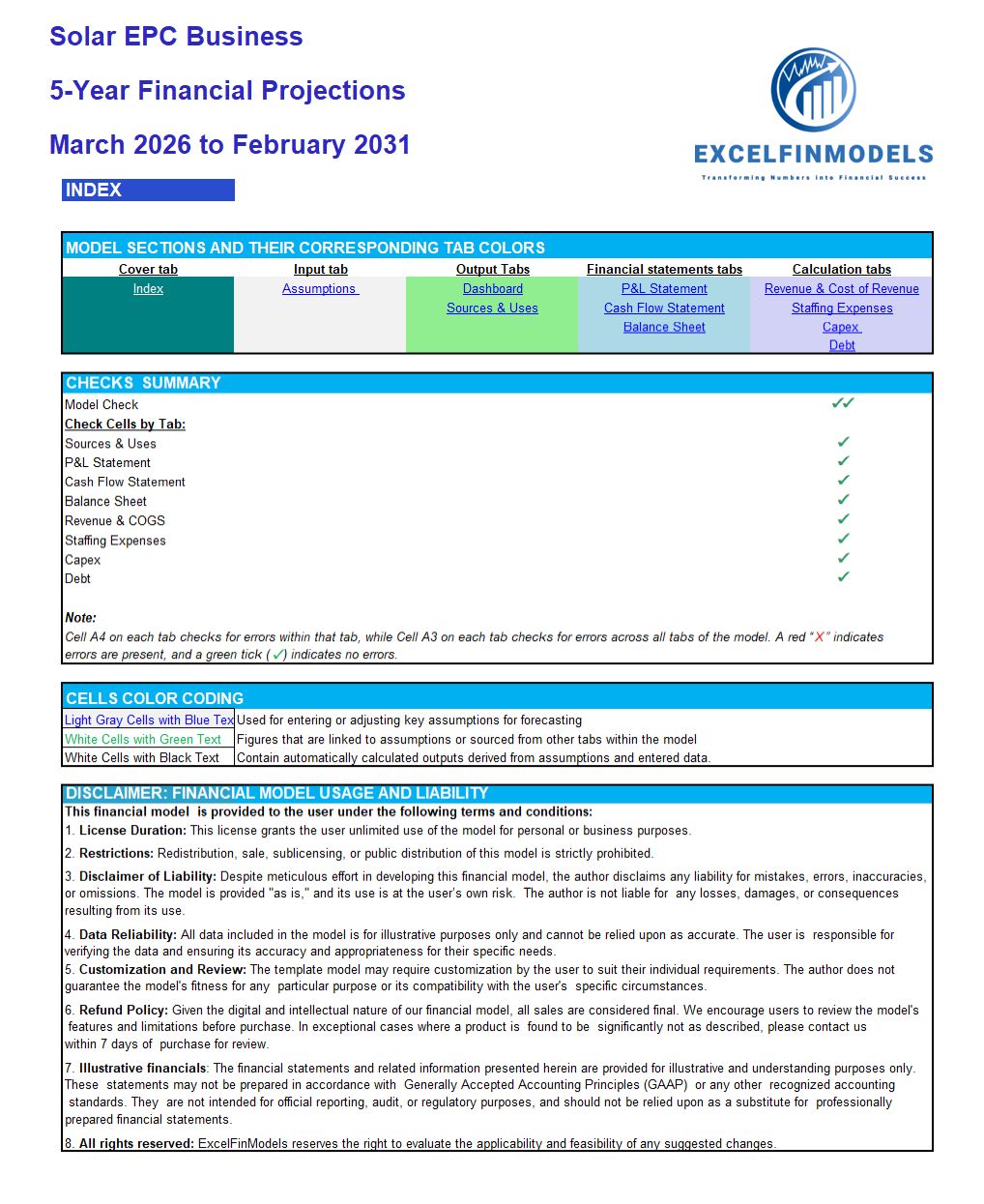
- Clear index with intuitive navigation across all schedules.
- Summary checks validating structural consistency and model integrity.
- Color coding for tabs and cells.
2. Input Assumptions
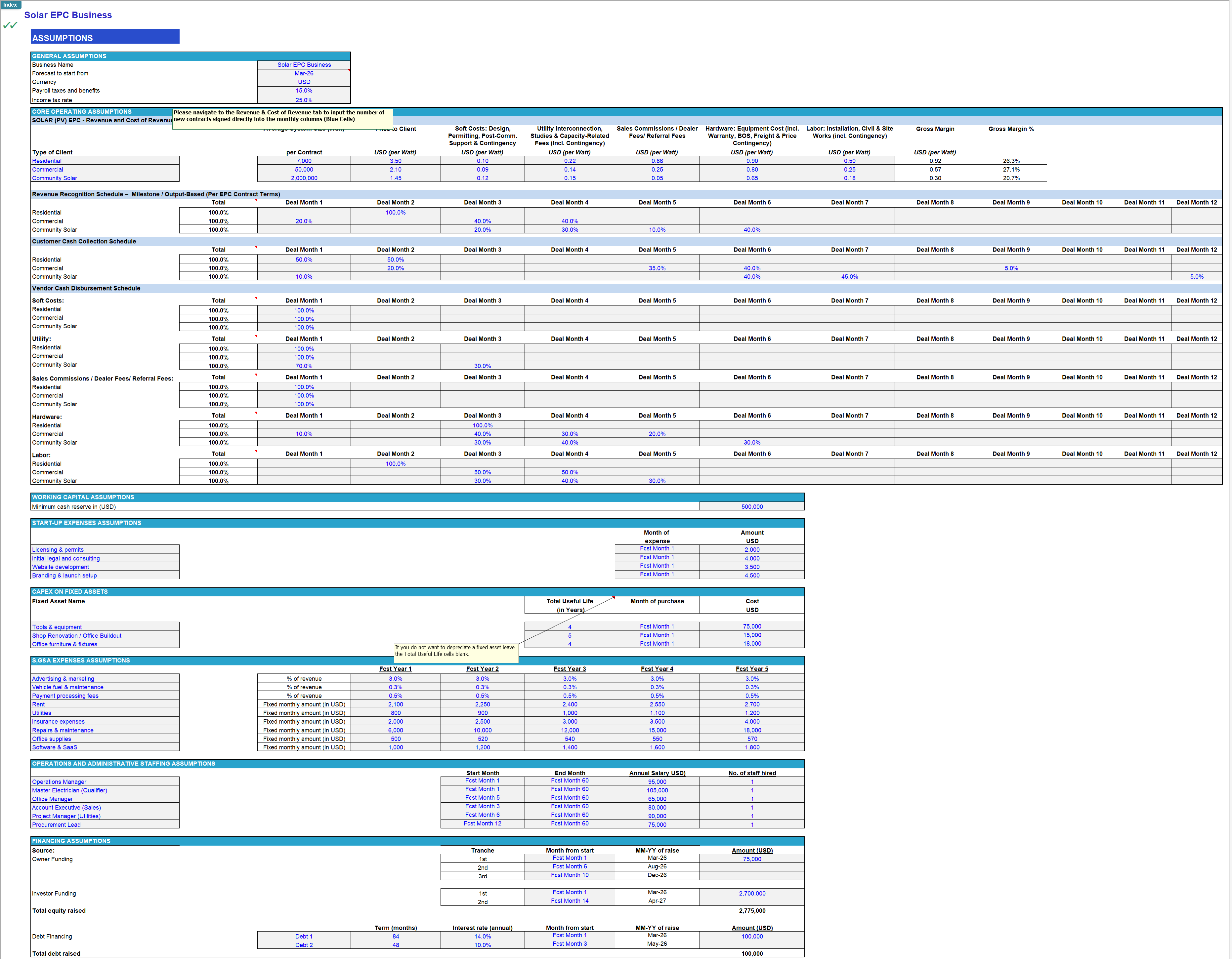
Key business drivers are consolidated into a centralized assumptions interface.
To support granular monthly forecasting, assumptions related to the number of new Solar PV EPC contracts signed are embedded within the Revenue & Cost of Revenue tab.
Revenue Assumptions
The model supports industry-standard Solar PV EPC revenue frameworks, including:
- Customer Segments: Fully customizable segments (e.g., Residential, Commercial Solar and Community).
- Project Specifications: Volume drivers based on installed solar capacity (kW DC) and pricing per unit of capacity ($/W).
- Revenue Timing:Milestone-based billing and revenue recognition aligned with Solar EPC execution stages.
- Hardware: Solar PV modules, inverters, mounting structures (fixed-tilt or trackers), combiner boxes, DC/AC cabling, transformers, and other balance-of-system (BOS) components.
- Execution Costs: Civil works, structural installation, electrical installation, testing, and commissioning.
- Soft Costs: Engineering and design, permitting, utility interconnection, grid studies, and contingency allowances.
- Variable Costs: Sales commissions, dealer or referral fees, marketing and business development expenses.
- Fixed Costs: Management and staff payroll, office rent, software and SaaS tools, fleet costs, and general insurance.
- CapEx: Tools and equipment, installation machinery, service vehicles, IT assets, and office infrastructure.
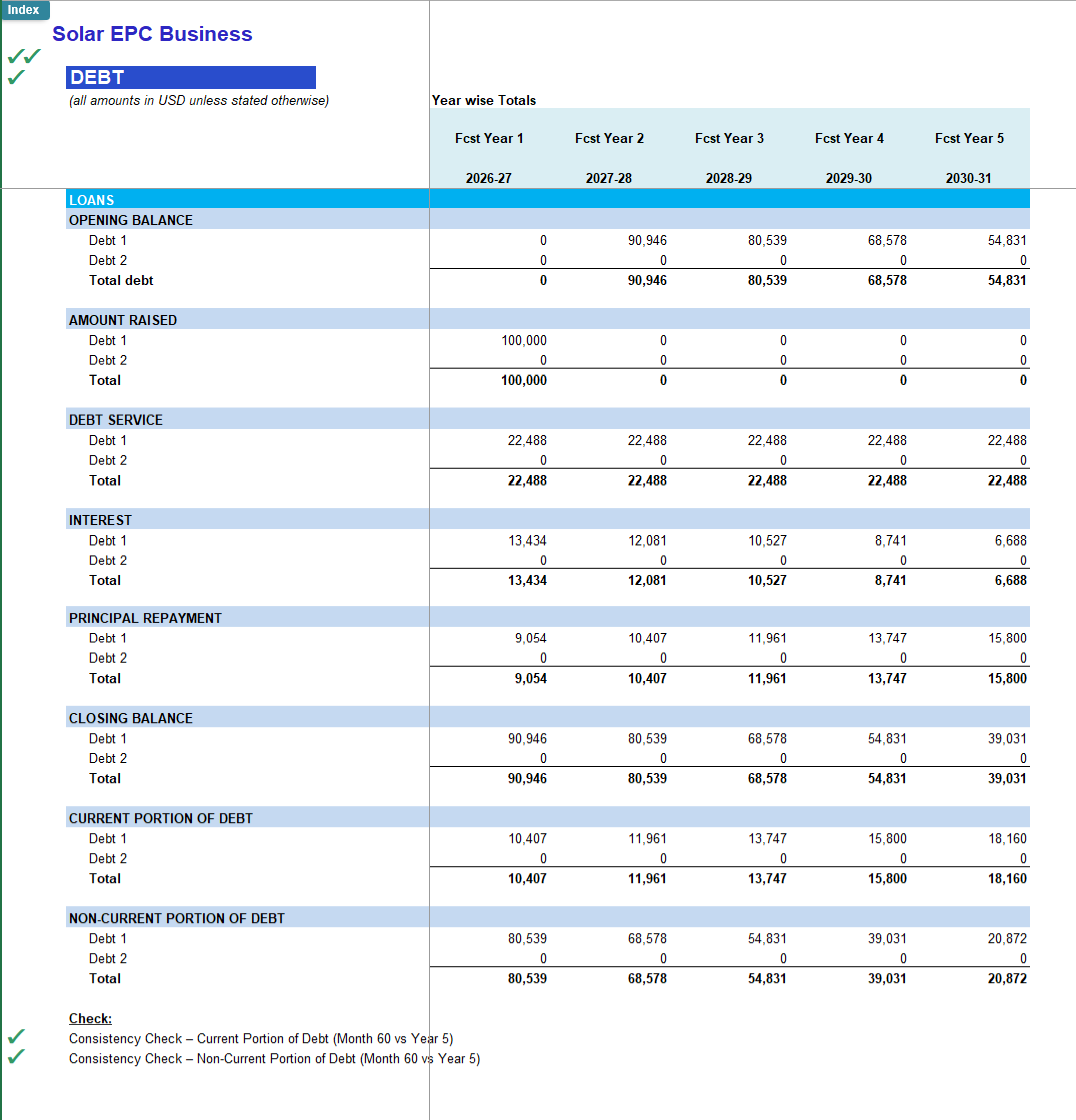
- Financing: Equity contributions, revolving working-capital facilities, and term-debt amortization schedules.
Dashboard
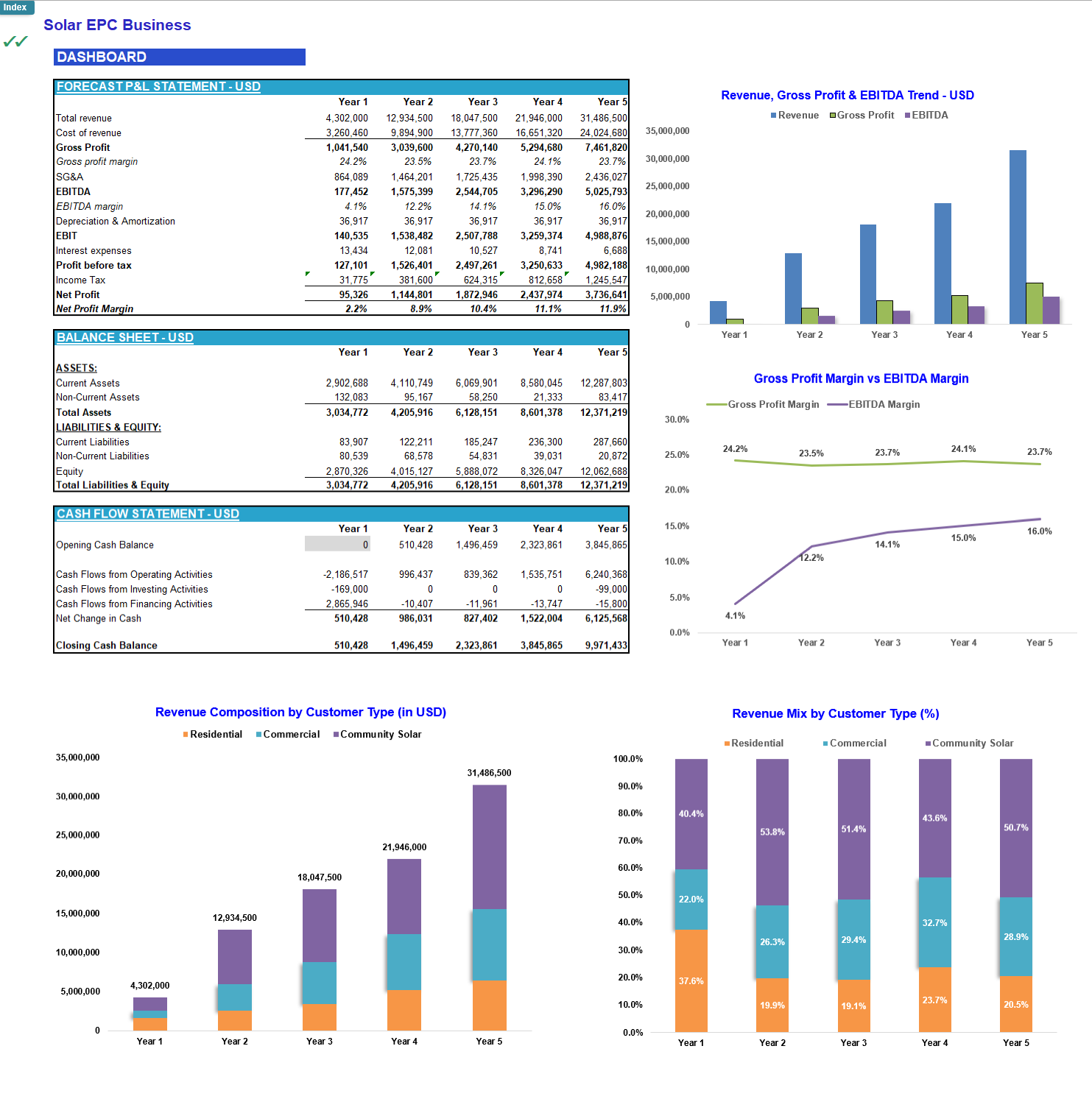
- Revenue trends segmented by Solar PV customer type.
- Gross profit, EBITDA, and net margin evolution.
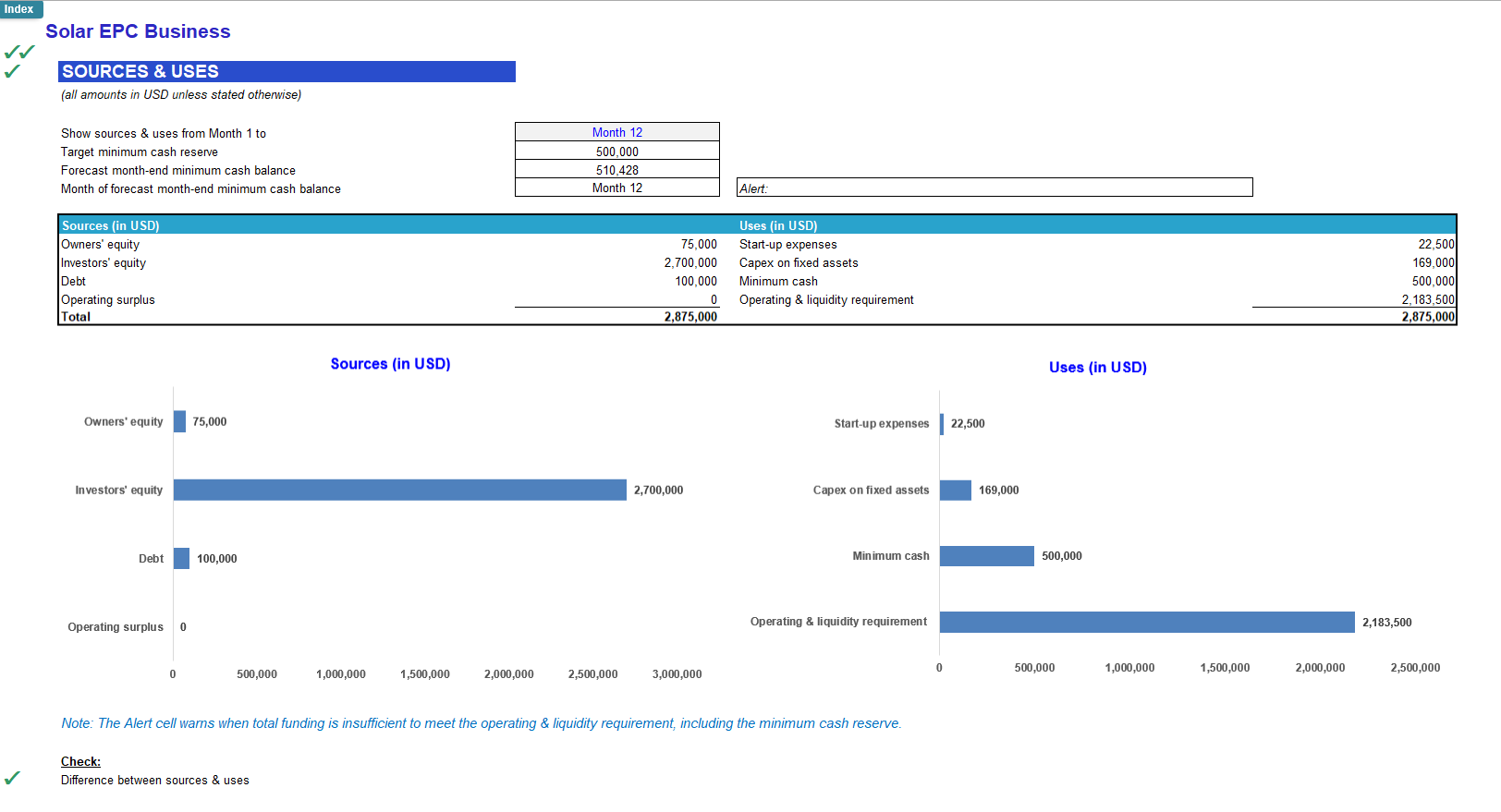
- Uses: Start-up costs, pre-development expenses, project working capital, and capital expenditures.
- Sources: Equity injections and debt financing.
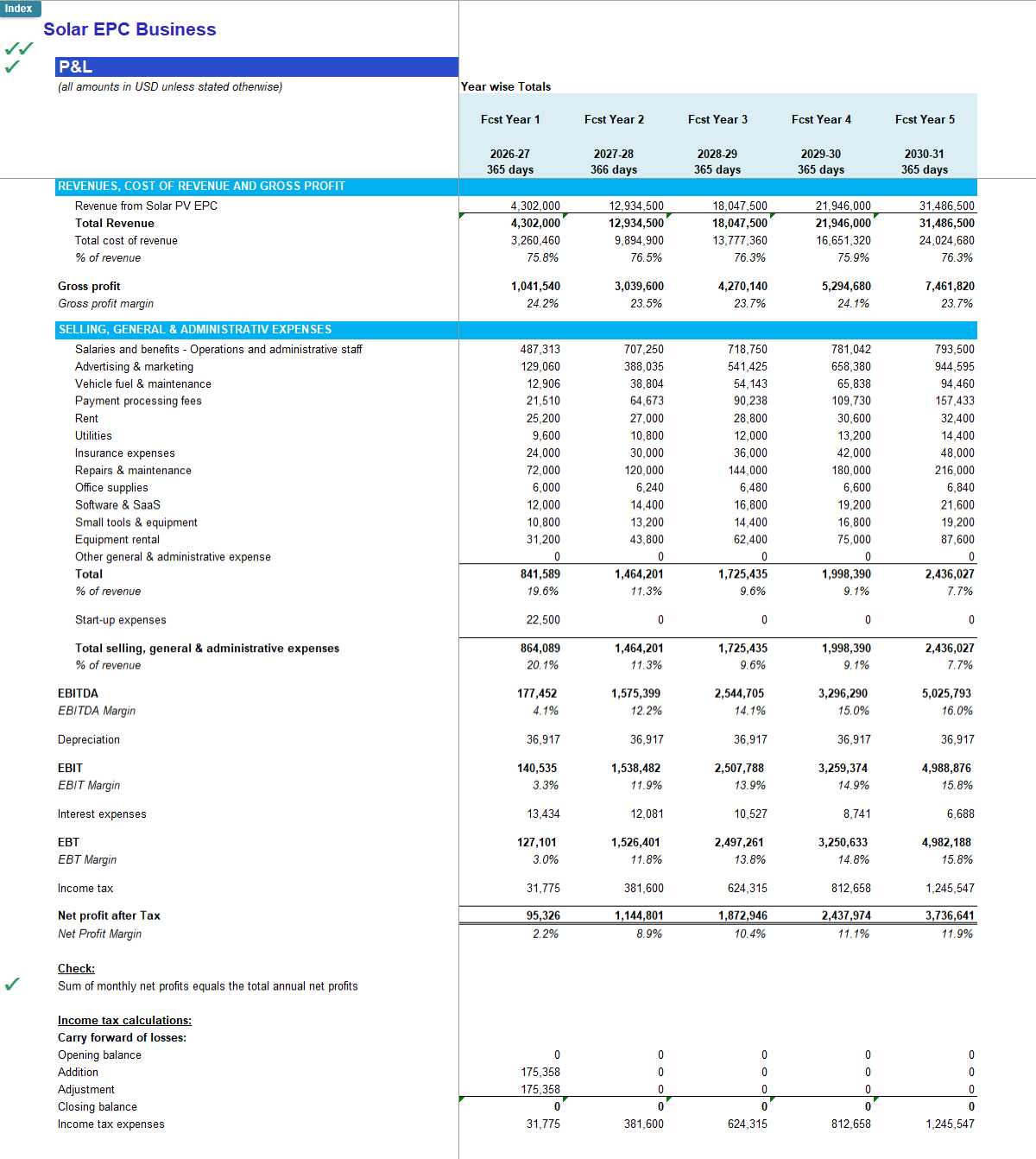
- Profit & Loss Statement
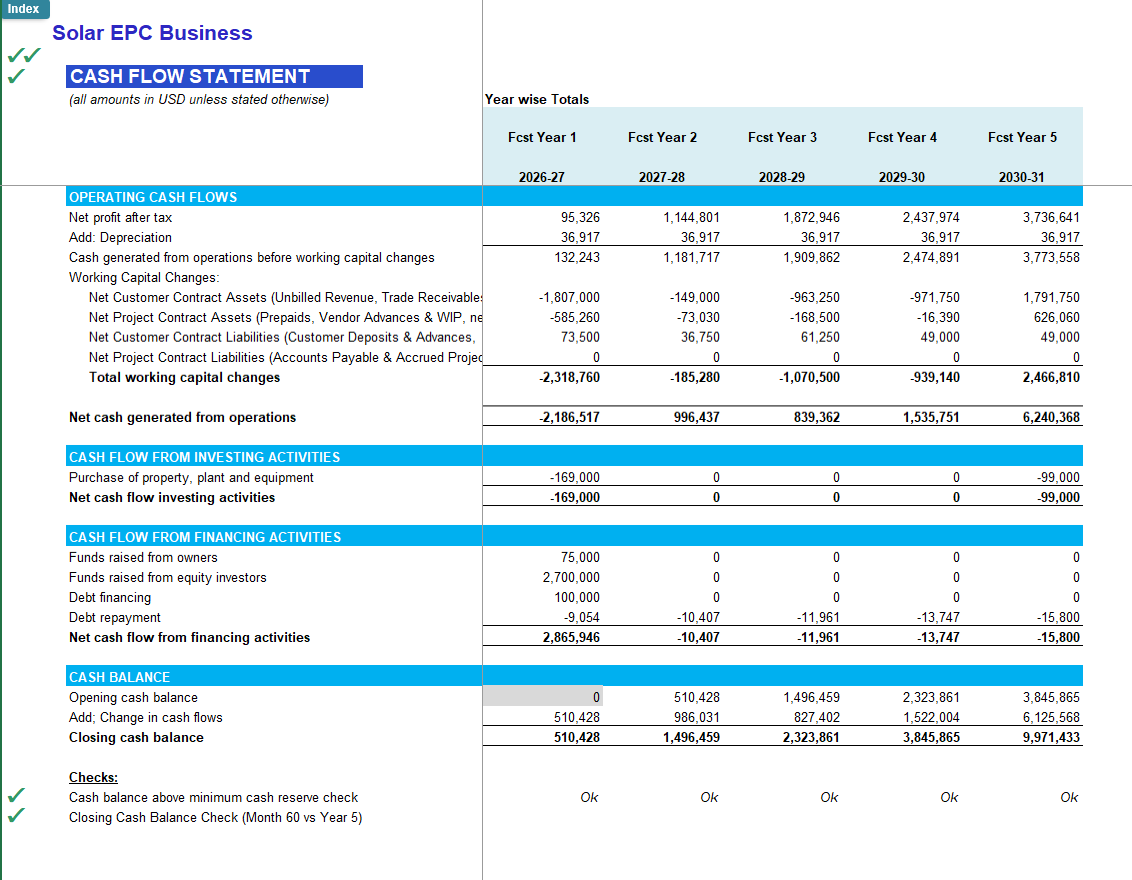
- Cash Flow Statement
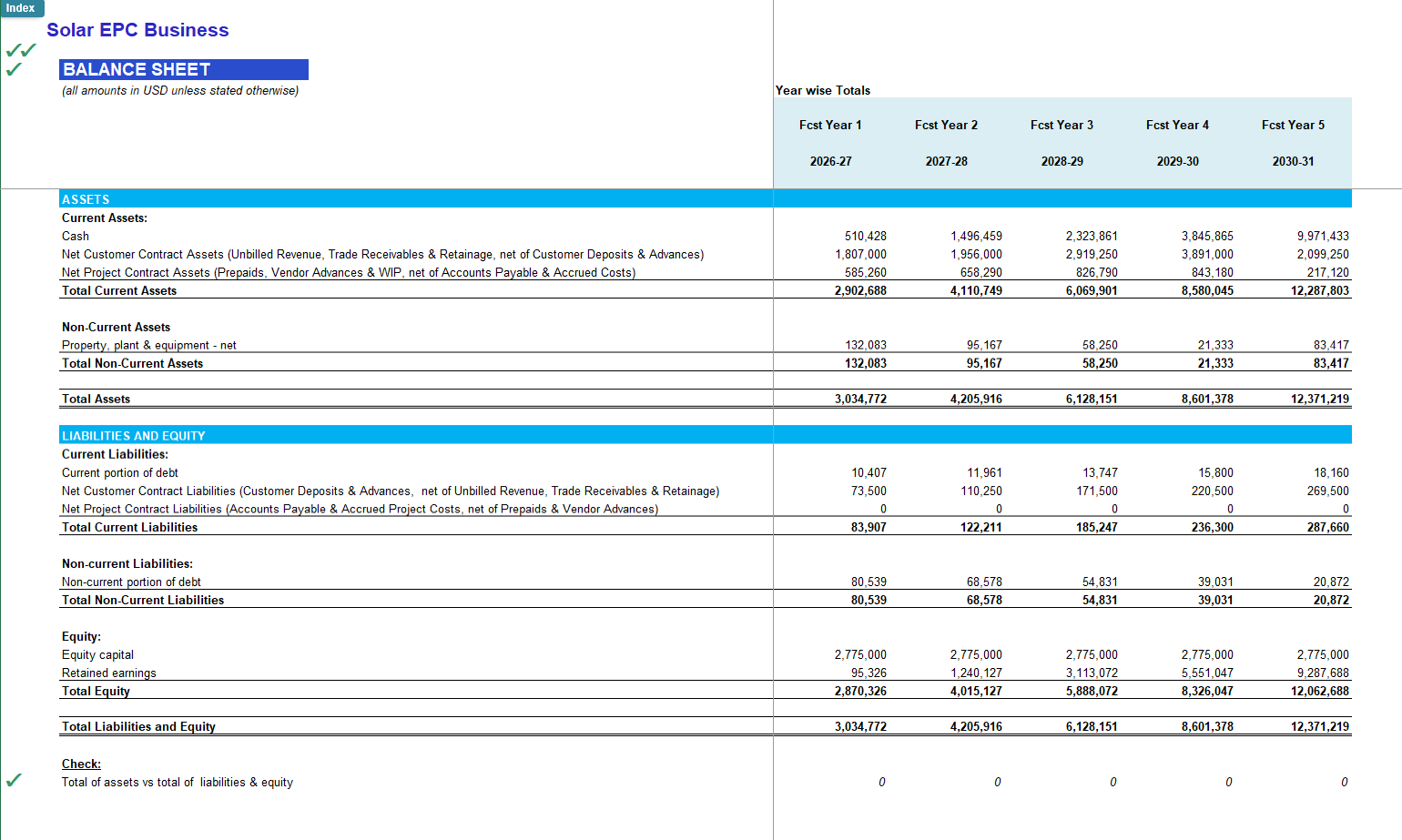
- Balance Sheet
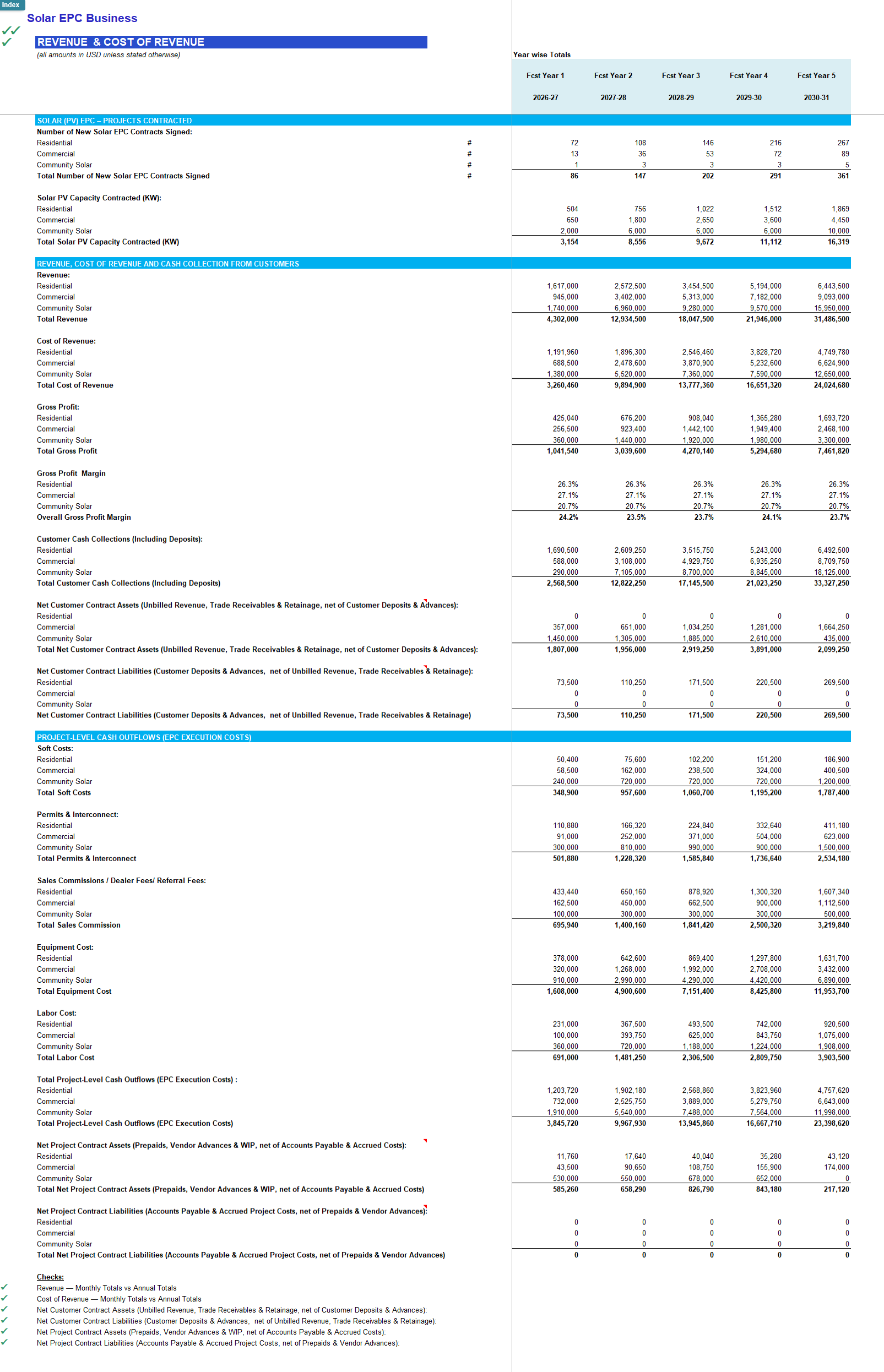
- Revenue and COGS recognition aligned with Solar PV EPC construction milestones.
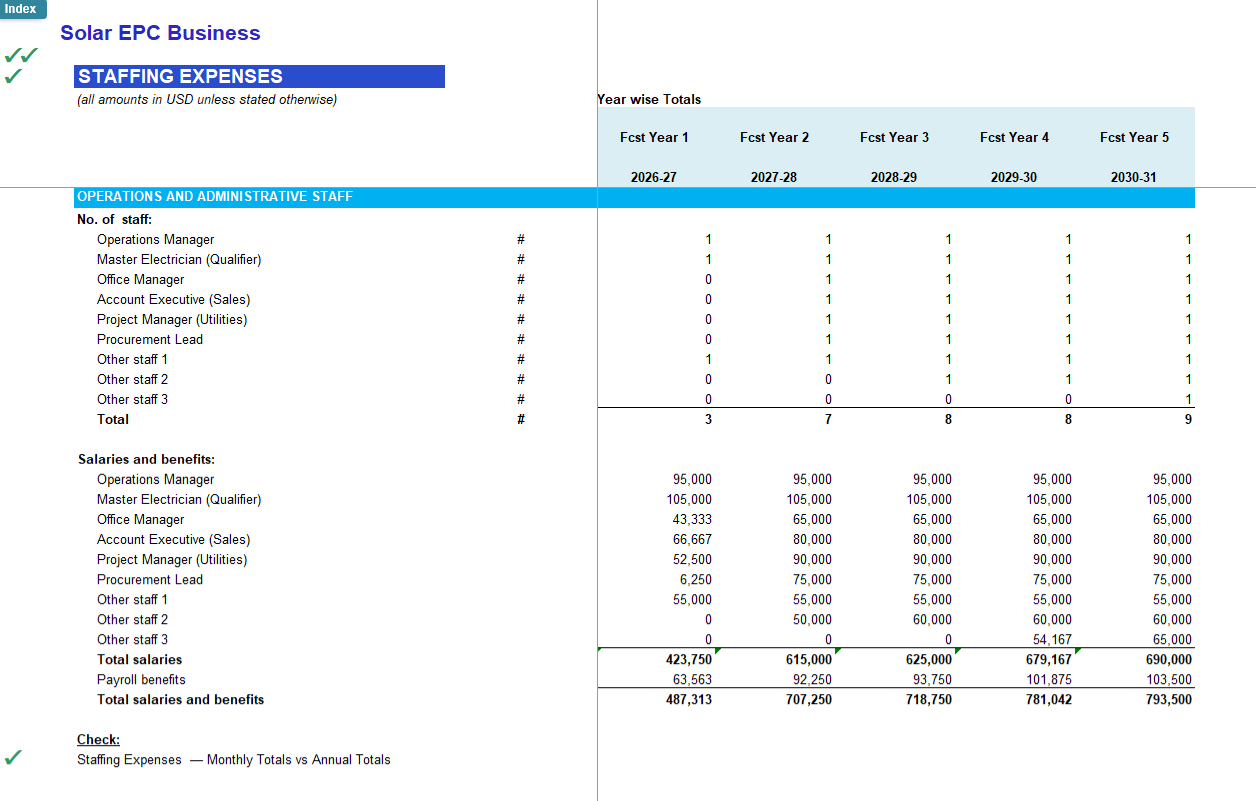
- Staffing and payroll expense calculations.
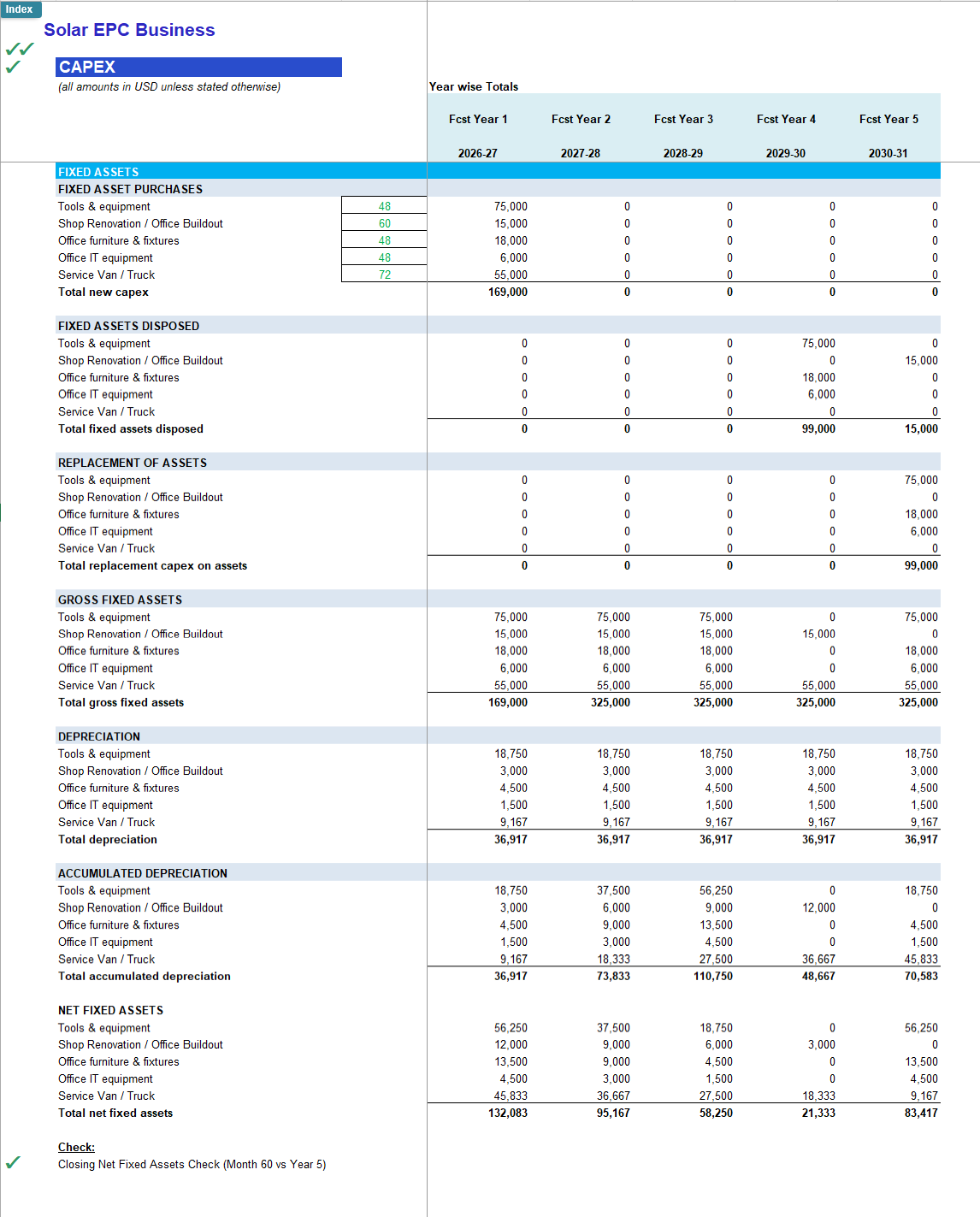
- Debt schedules and capital expenditure roll-forwards.
- Fully transparent structure (no VBA or macros).
- Circular reference–free.
- Compatible with Excel 2021 or newer. Excel 2010–2019 Users: Certain calculations rely on array formulas and may require Ctrl + Shift + Enter for correct execution.
Built-in validation controls ensure model integrity:
- Green checkmarks (✓): Logic and calculations are consistent.
- Red indicators (✗): Inputs or assumptions require review.
This model supports institutional-gradefinancial planning for Solar PV EPC contractors. It is purpose-built to addressthe project-based revenue profile, procurement-driven cost structure,milestone-based billing, and working-capital intensity inherent in Solar EPCbusinesses, while maintaining transparency across execution risk, cash-flowtiming, and profitability drivers.
This Best Practice includes
1 Excel Sheet
Further information
This downloadable best practice is designed to provide a structured, practical framework for building a robust Solar PV EPC financial forecast. It aims to help users accurately project revenue, costs, cash flows, and working capital while ensuring internal consistency across integrated financial statements.