Publication number: ELQ-59714-1
View all versions & Certificate

Mastering Capital Budgeting: Evaluating Investments with NPV, IRR and Payback
Assess investments using NPV, IRR and payback with confidence.
Further information
Capital budgeting evaluates whether a long-term investment is financially and strategically worthwhile. Its main objectives are to:
• Estimate the initial investment required for a project.
• Forecast the project’s incremental operating cash flows.
• Assess whether expected returns exceed the required rate of return.
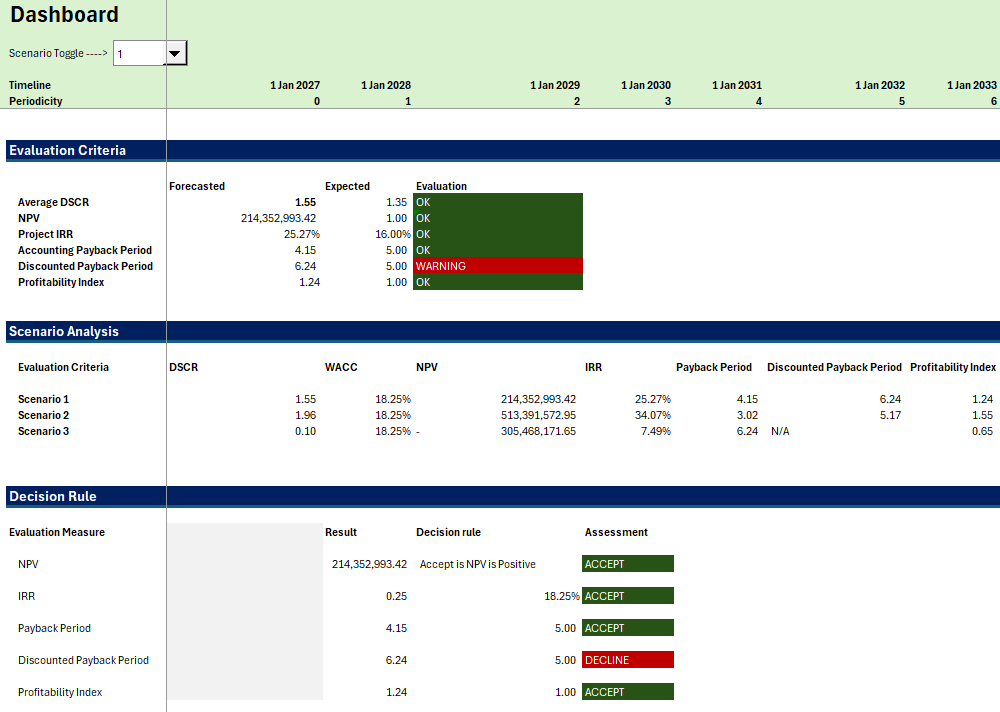
• Measure value creation using Net Present Value.
• Estimate the project’s percentage return using Internal Rate of Return.
• Determine how quickly the initial investment will be recovered.
• Compare competing investment opportunities.
• Allocate limited capital to the most attractive projects.
• Assess the effects of taxes, working capital, depreciation and terminal value.
• Identify the financial risks associated with uncertain cash flows.
• Support investment approval, financing and strategic planning decisions.
Capital-budgeting analysis works best when:
• The project’s incremental cash flows can be reasonably estimated.
• The initial capital expenditure and implementation costs are identifiable.
• The investment has a defined economic life.
• The timing of cash inflows and outflows can be forecast.
• A suitable discount rate or required return can be determined.
• The project can be evaluated separately from existing operations.
• Tax, depreciation, working-capital and terminal-value assumptions are available.
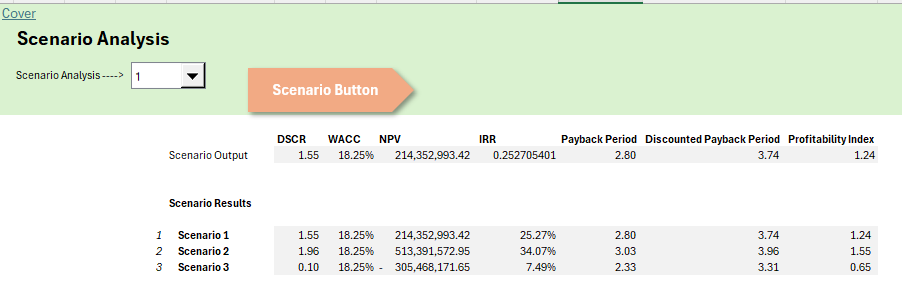
• Management can prepare realistic base-case, upside and downside scenarios.
• Competing projects can be compared using consistent assumptions.
• The investment is primarily intended to generate measurable financial benefits.
It is particularly useful for investments in machinery, factories, infrastructure, renewable energy, technology systems, acquisitions and business expansion.
Capital-budgeting analysis works best when:
• The project’s incremental cash flows can be reasonably estimated.
• The initial capital expenditure and implementation costs are identifiable.
• The investment has a defined economic life.
• The timing of cash inflows and outflows can be forecast.
• A suitable discount rate or required return can be determined.
• The project can be evaluated separately from existing operations.
• Tax, depreciation, working-capital and terminal-value assumptions are available.
• Management can prepare realistic base-case, upside and downside scenarios.
• Competing projects can be compared using consistent assumptions.
• The investment is primarily intended to generate measurable financial benefits.
It is particularly useful for investments in machinery, factories, infrastructure, renewable energy, technology systems, acquisitions and business expansion.