
Business Continuity, Disaster Recovery & Operational Resilience Management System

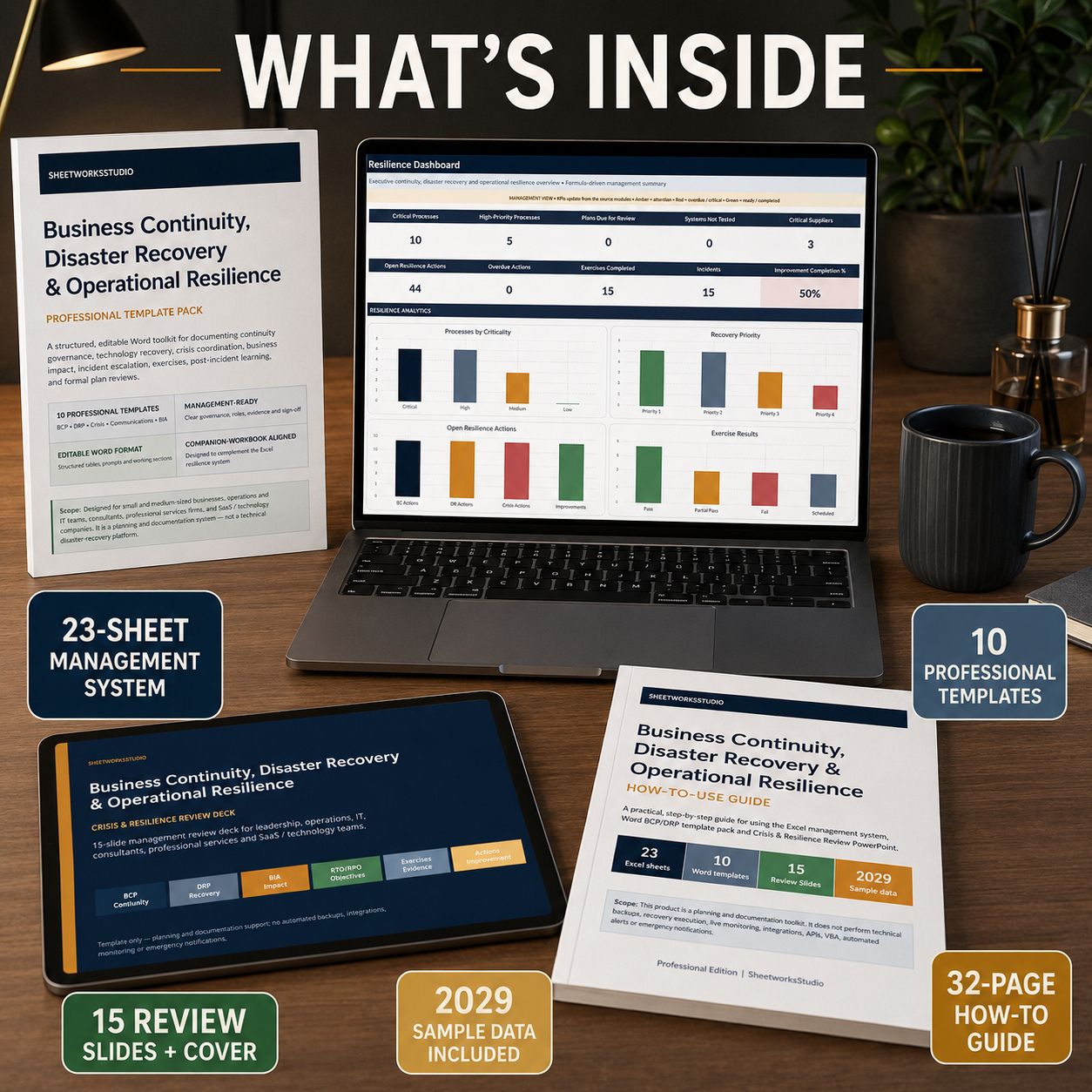
A comprehensive business continuity, disaster recovery & operational resilience toolkit combining a Excel sheet management system, 10 structured Word templates

Description
πŸ›‘οΈ BUSINESS CONTINUITY, DISASTER RECOVERY & OPERATIONAL RESILIENCE SYSTEM


Build a structured approach to business continuity, disaster recovery, crisis preparedness and operational resilience with one integrated management toolkit.


This professional system combines operational tracking, recovery planning, controlled documentation and executive reporting across Excel, Word, PowerPoint and PDF.


Rather than managing processes, recovery objectives, suppliers, systems, incidents, exercises and improvement activities across disconnected files, the toolkit brings the full resilience lifecycle into one coordinated framework.


πŸ“Š 23-SHEET RESILIENCE MANAGEMENT SYSTEM
The Excel workbook provides the operational foundation of the toolkit.


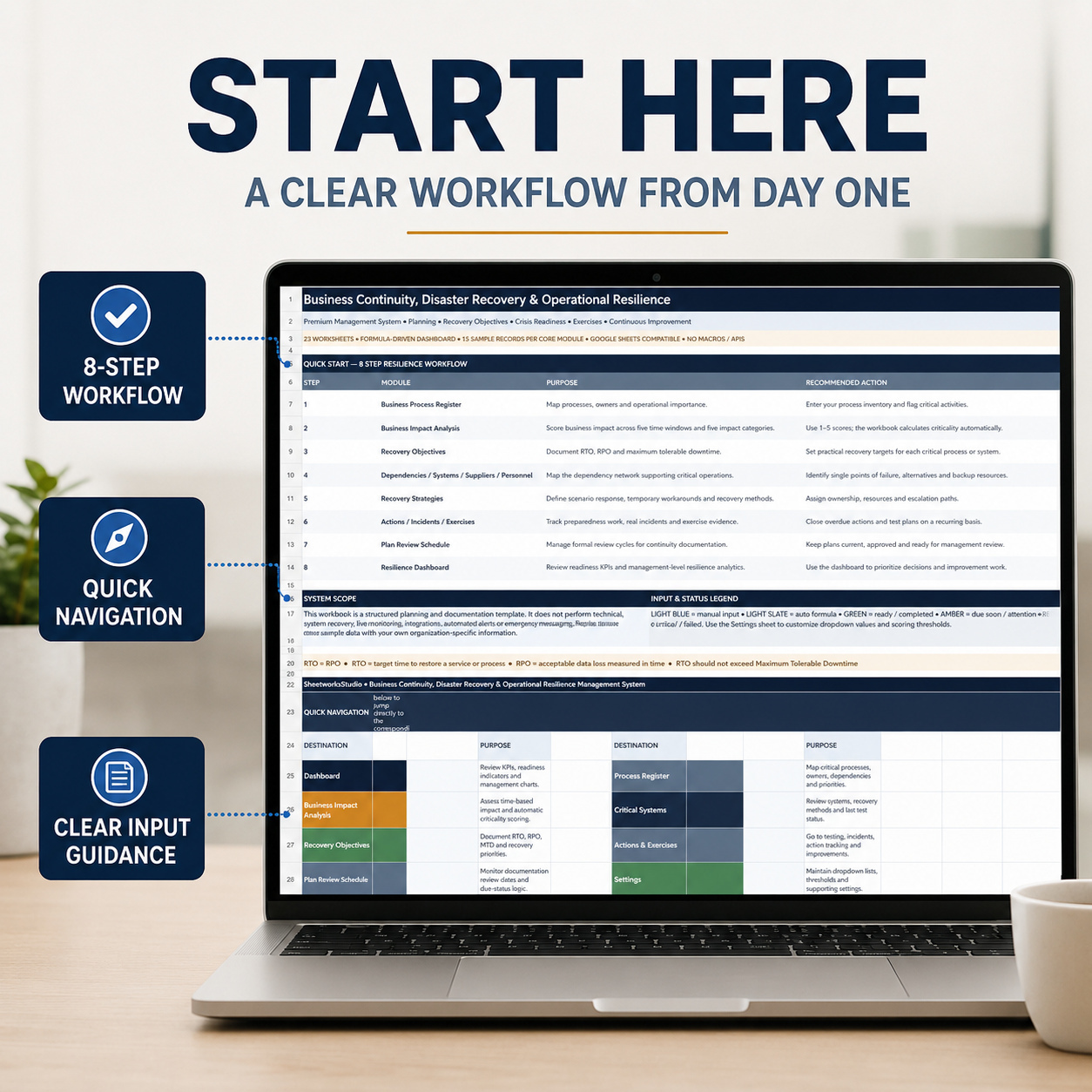
It supports the complete workflow from initial process identification and Business Impact Analysis through recovery planning, testing, incidents and recurring plan reviews.


Key management areas include:
βœ… Business Process Register
βœ… Business Impact Analysis
βœ… Criticality Assessment
βœ… Recovery Objectives
βœ… Dependencies
βœ… Critical Systems
βœ… Critical Suppliers
βœ… Key Personnel
βœ… Recovery Strategies
βœ… Business Continuity Actions
βœ… Disaster Recovery Actions
βœ… Incident Management
βœ… Crisis Actions
βœ… Communication Contacts
βœ… Exercises & Testing
βœ… Lessons Learned
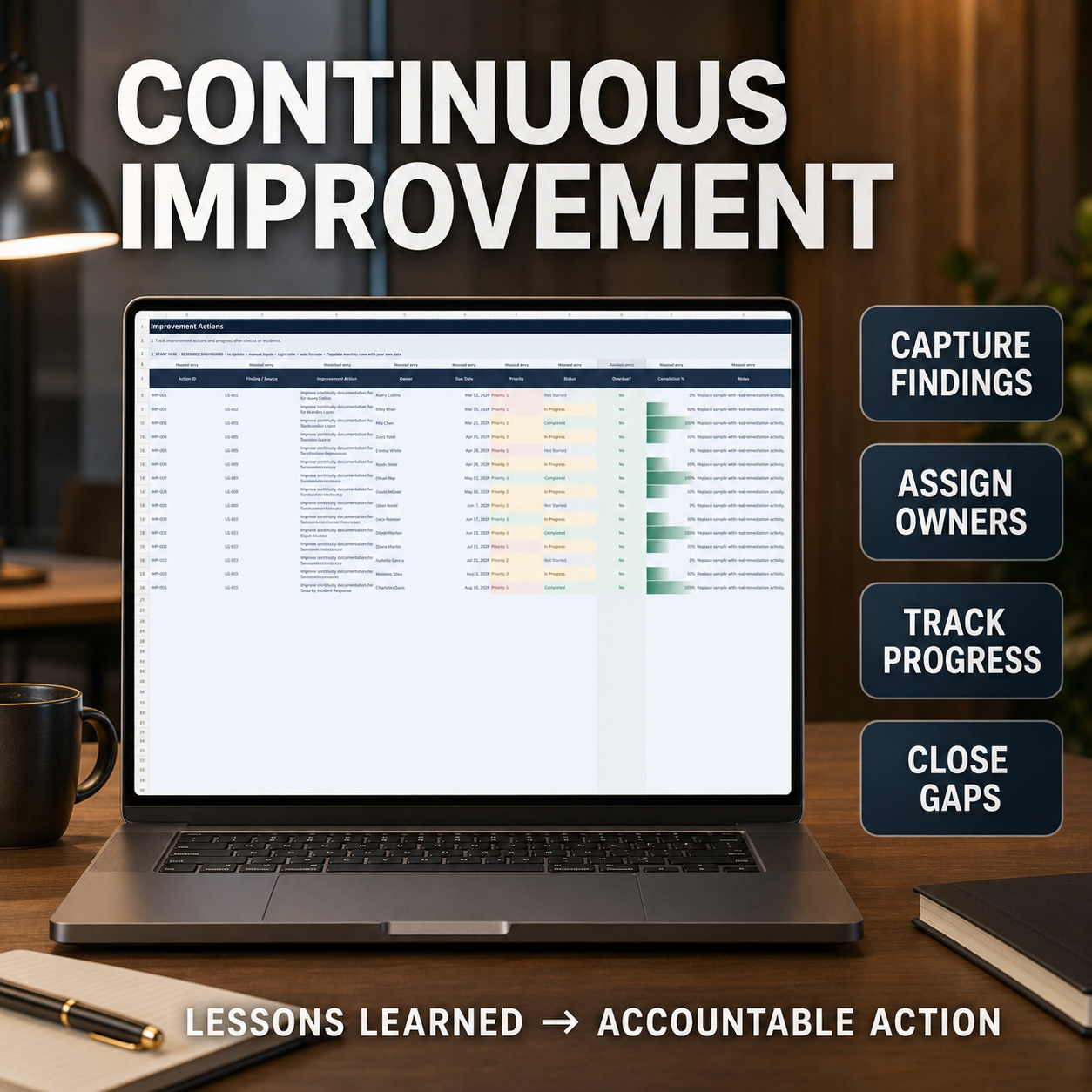
βœ… Improvement Actions
βœ… Plan Reviews


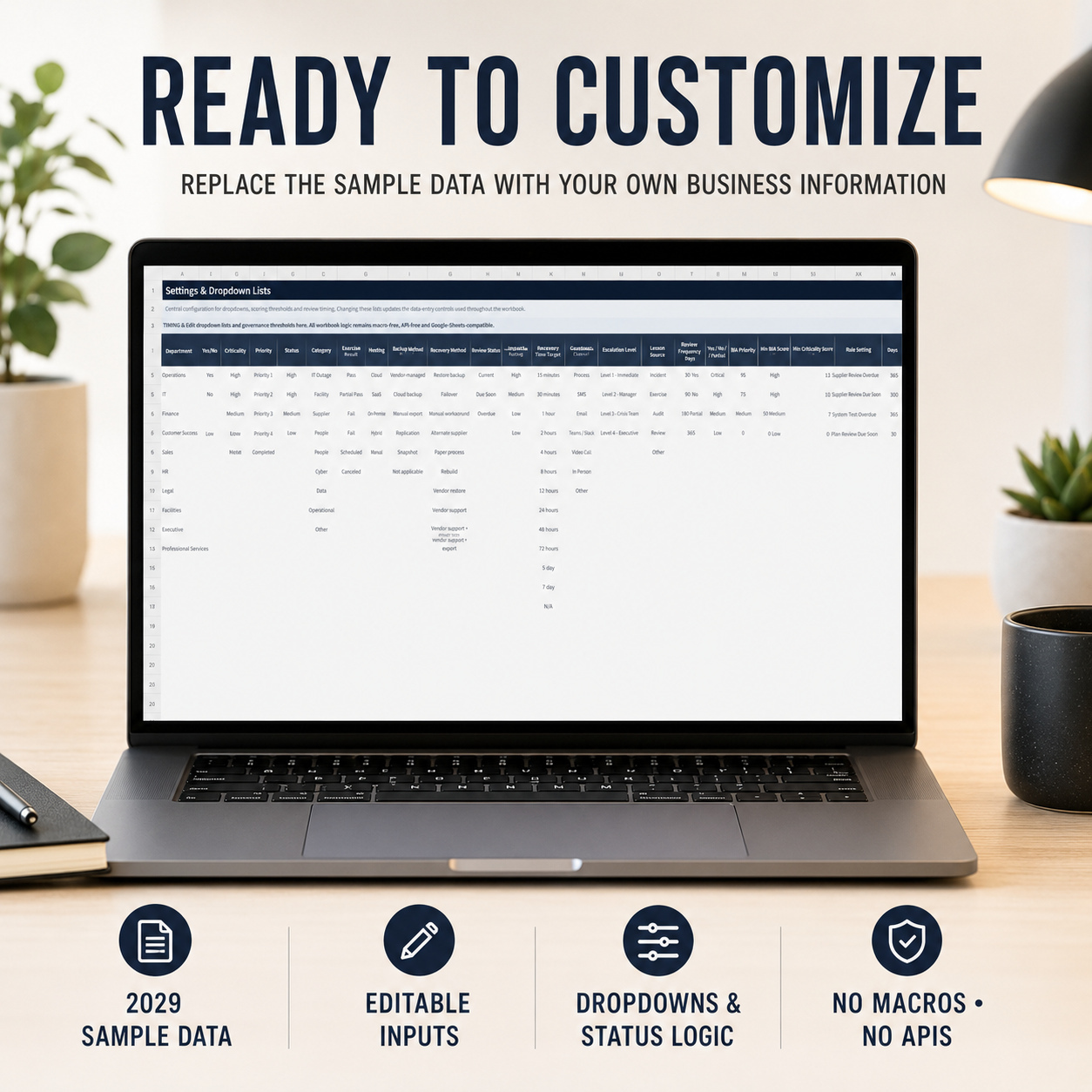
Realistic sample data is included throughout the operational registers to demonstrate the intended workflow before users replace it with organisation-specific information.


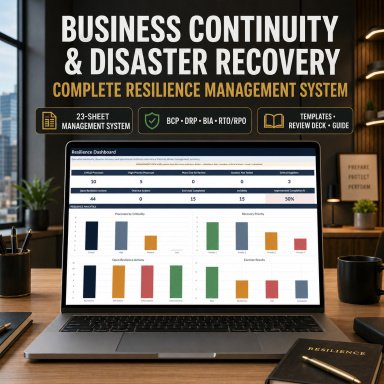
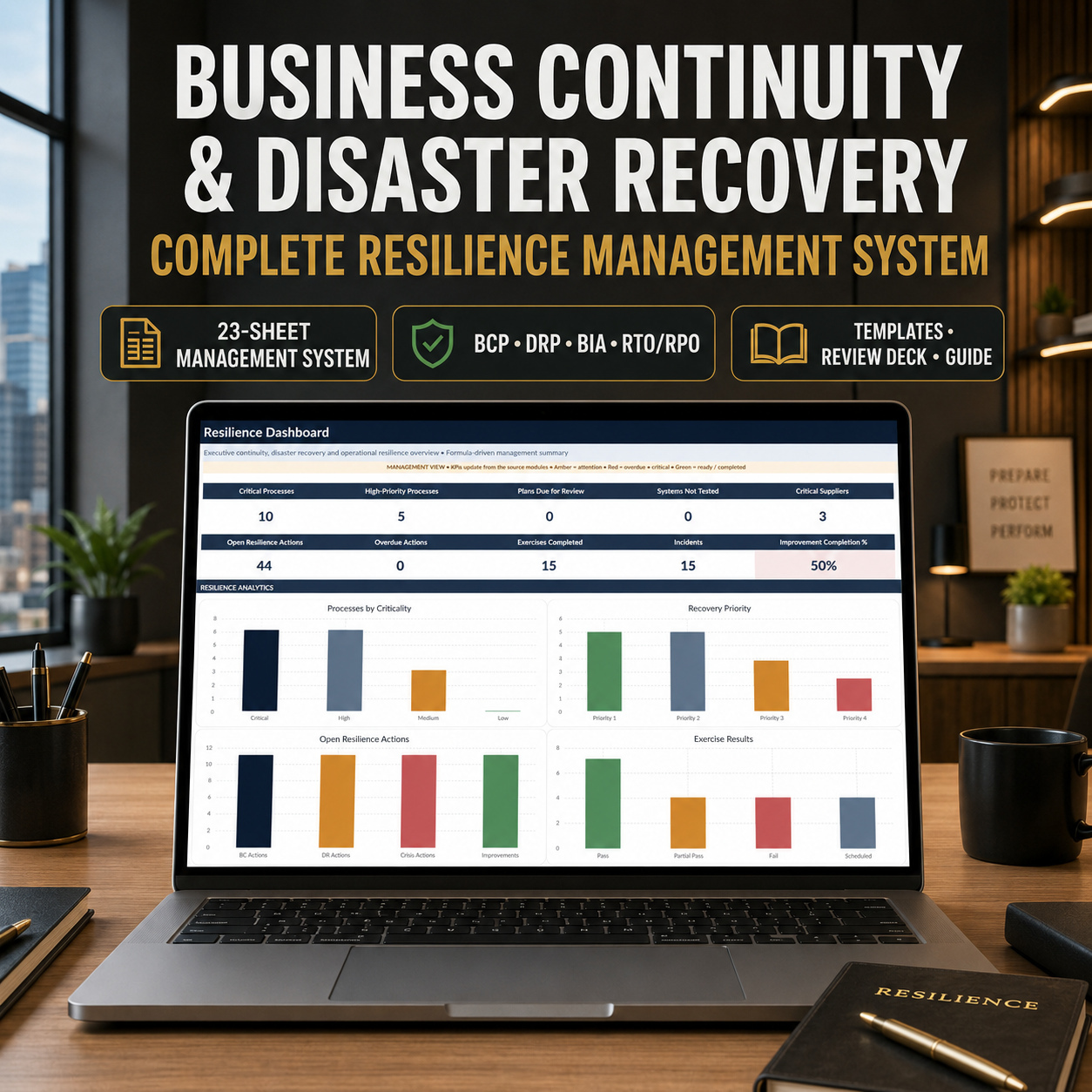
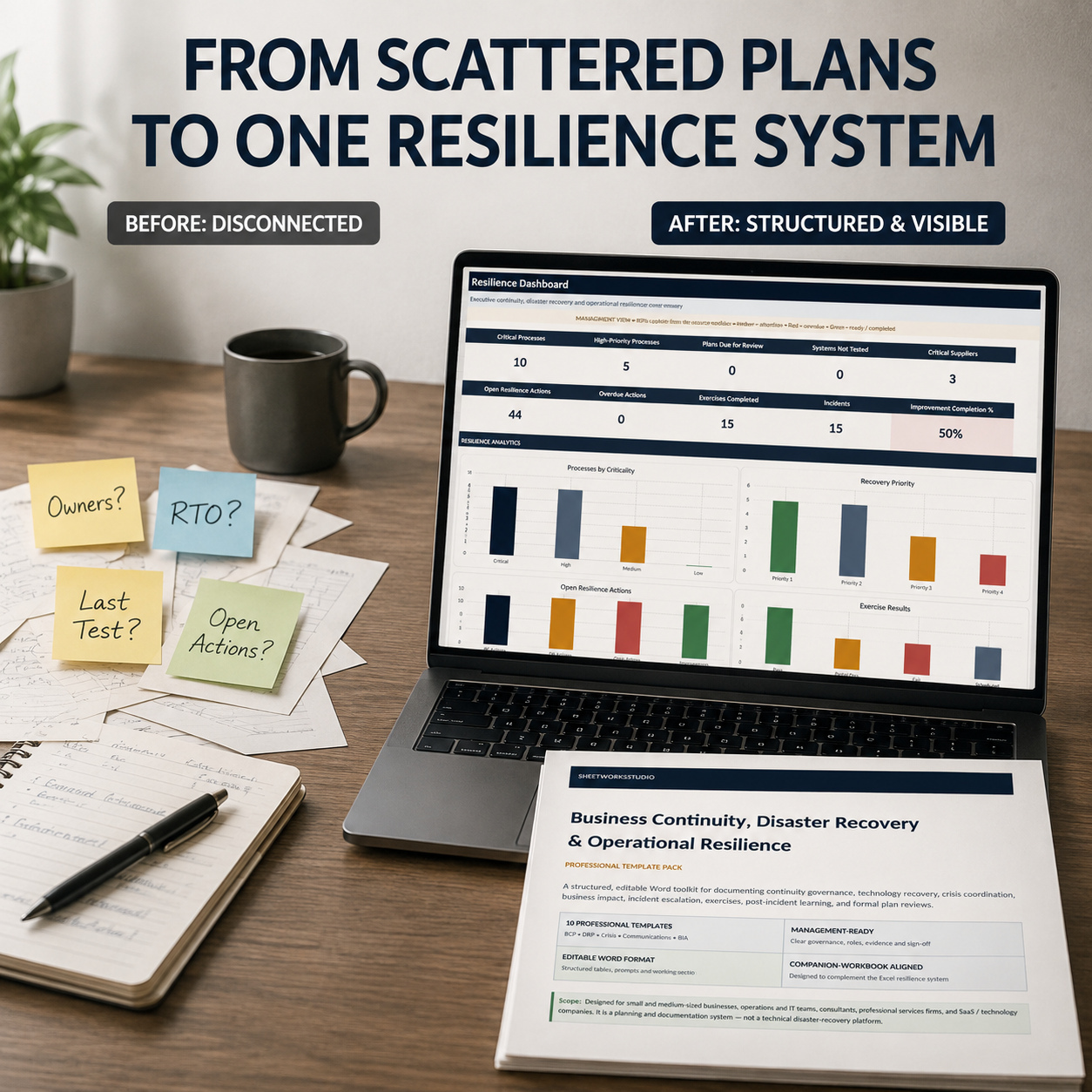
πŸ“ˆ EXECUTIVE RESILIENCE DASHBOARD
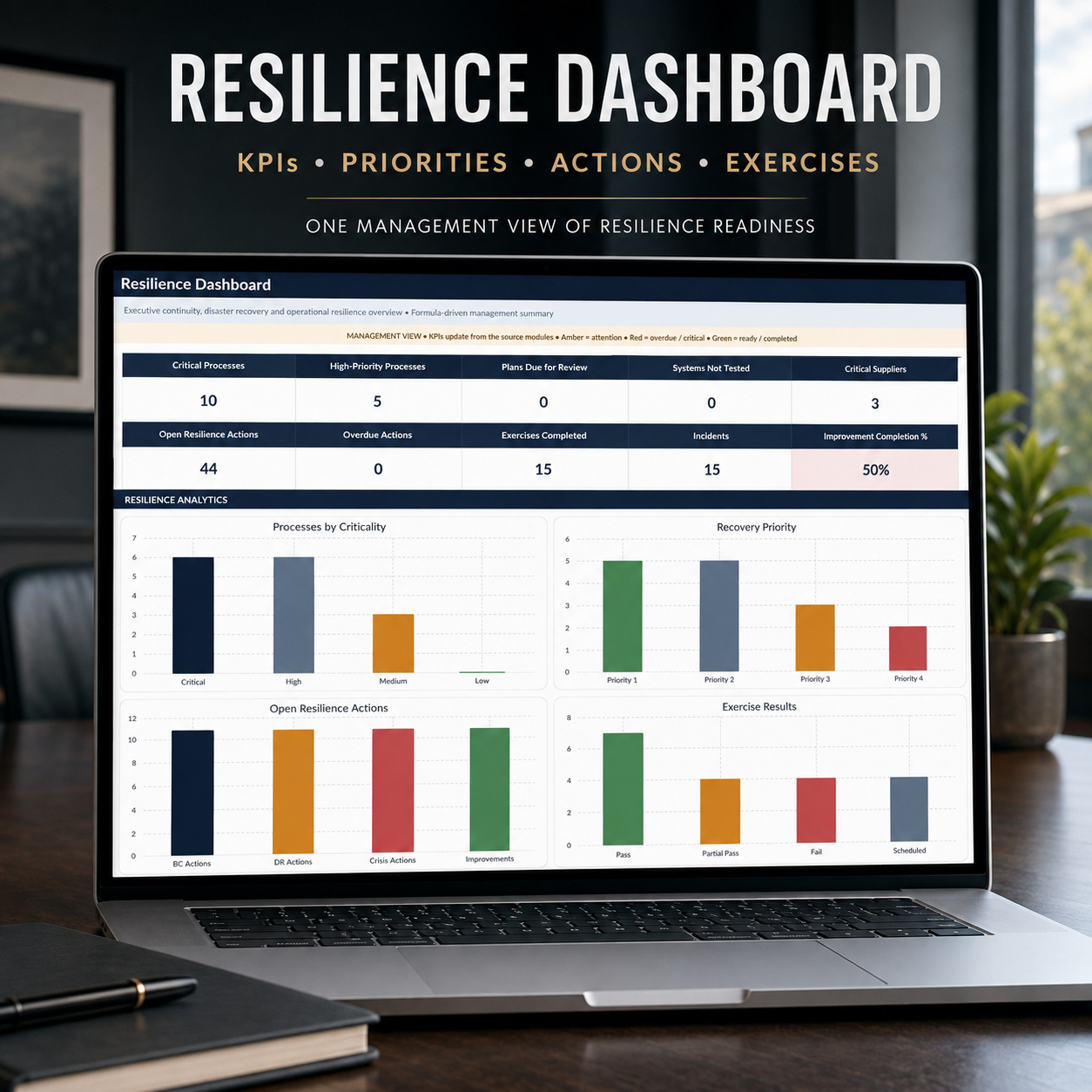
The Resilience Dashboard consolidates information from the source modules into a clear management view.


It provides 10 management KPIs covering:
πŸ“Œ Critical Processes
πŸ“Œ High-Priority Processes
πŸ“Œ Plans Due for Review
πŸ“Œ Systems Not Tested
πŸ“Œ Critical Suppliers
πŸ“Œ Open Resilience Actions
πŸ“Œ Overdue Actions
πŸ“Œ Exercises Completed
πŸ“Œ Incidents
πŸ“Œ Improvement Completion


Four management charts provide additional visibility into:
πŸ“Š Processes by Criticality
πŸ“Š Recovery Priority
πŸ“Š Open Resilience Actions
πŸ“Š Exercise Results


This gives leadership a concise view of readiness, exposure and outstanding resilience activities.


πŸ”Ž BUSINESS IMPACT ANALYSIS
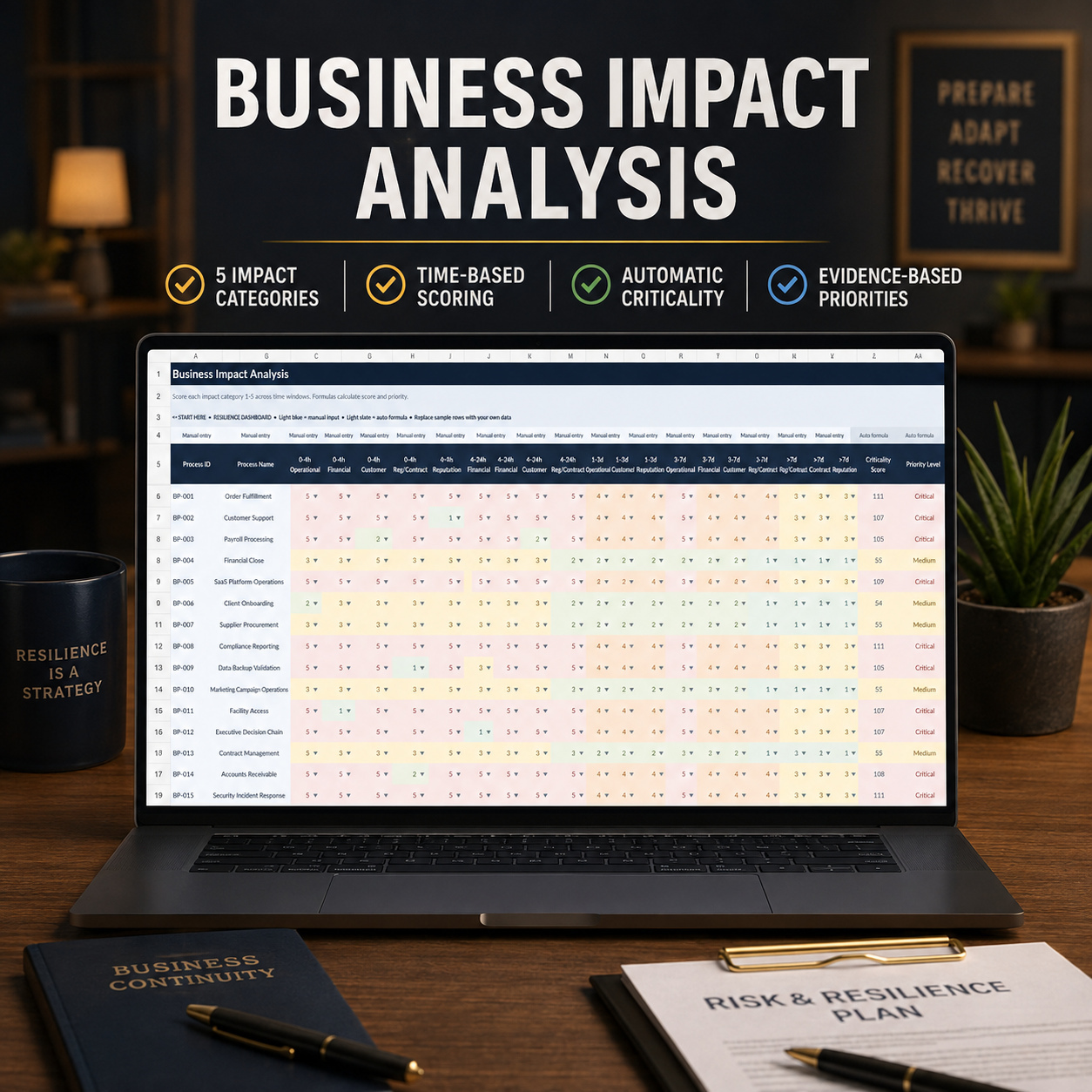
The Business Impact Analysis provides a structured method for evaluating disruption consequences across multiple impact areas and time horizons.


Assess impacts across:
βœ… Operational
βœ… Financial
βœ… Customer
βœ… Regulatory / Contractual
βœ… Reputation
The system evaluates impact across time periods ranging from 0–4 hours through more than 7 days, supporting automatic criticality and priority calculations.


⏱️ RTO, RPO & MTD RECOVERY PLANNING
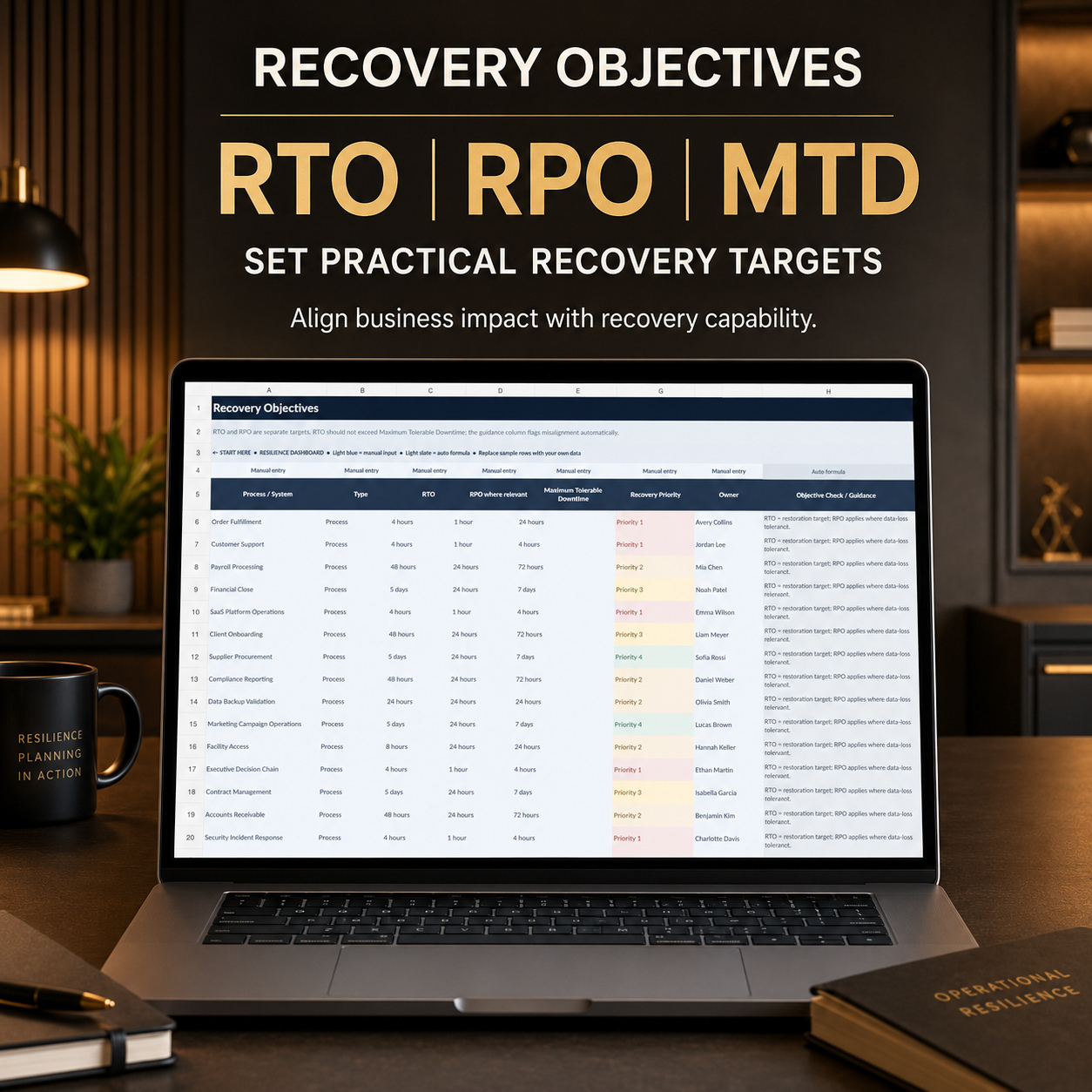
Document critical recovery objectives including:
βœ… Recovery Time Objective β€” RTO
βœ… Recovery Point Objective β€” RPO
βœ… Maximum Tolerable Downtime β€” MTD
βœ… Recovery Priority


This helps teams establish clear recovery expectations and identify processes requiring the fastest restoration.


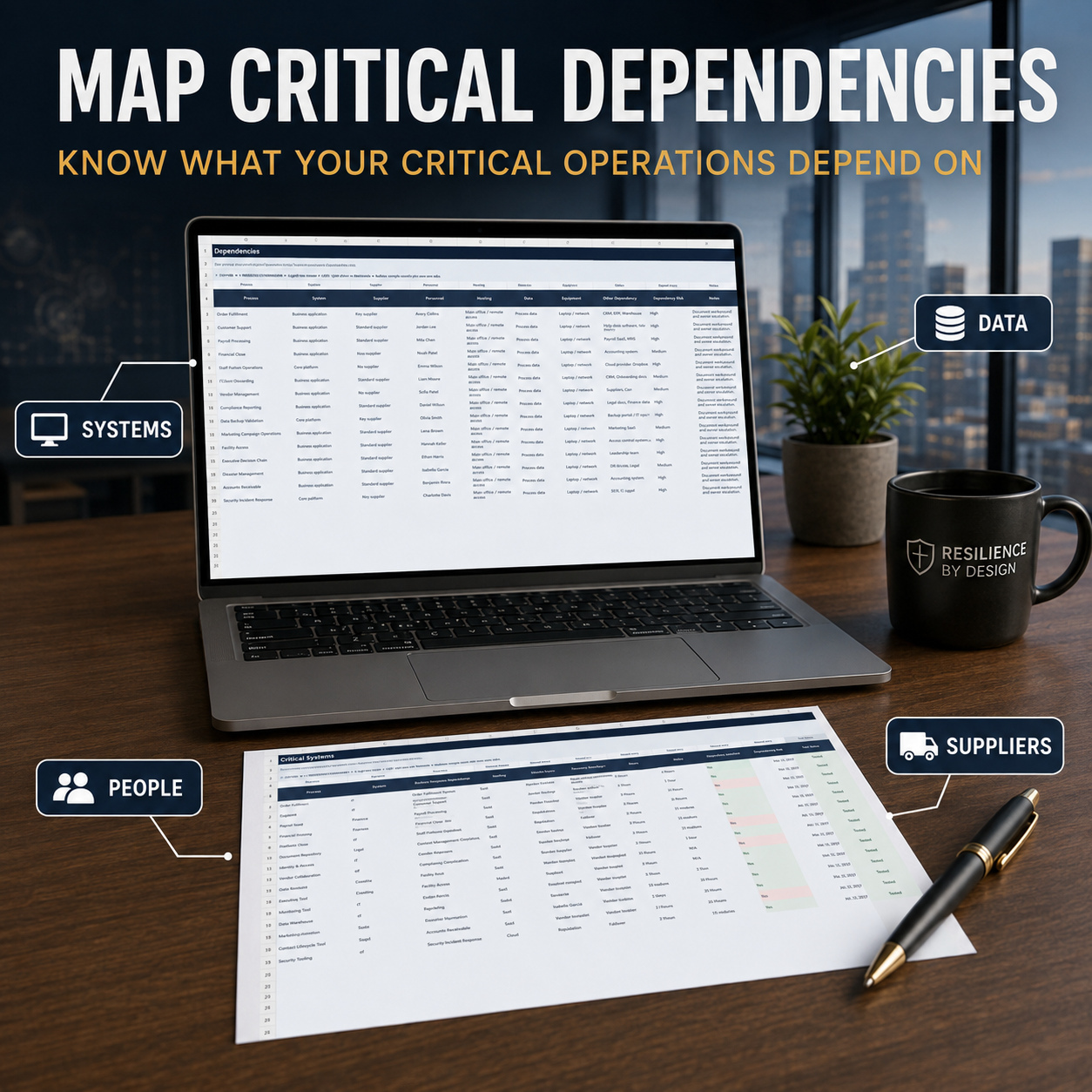
πŸ”— CRITICAL DEPENDENCY MANAGEMENT
Operational resilience depends on more than processes alone.
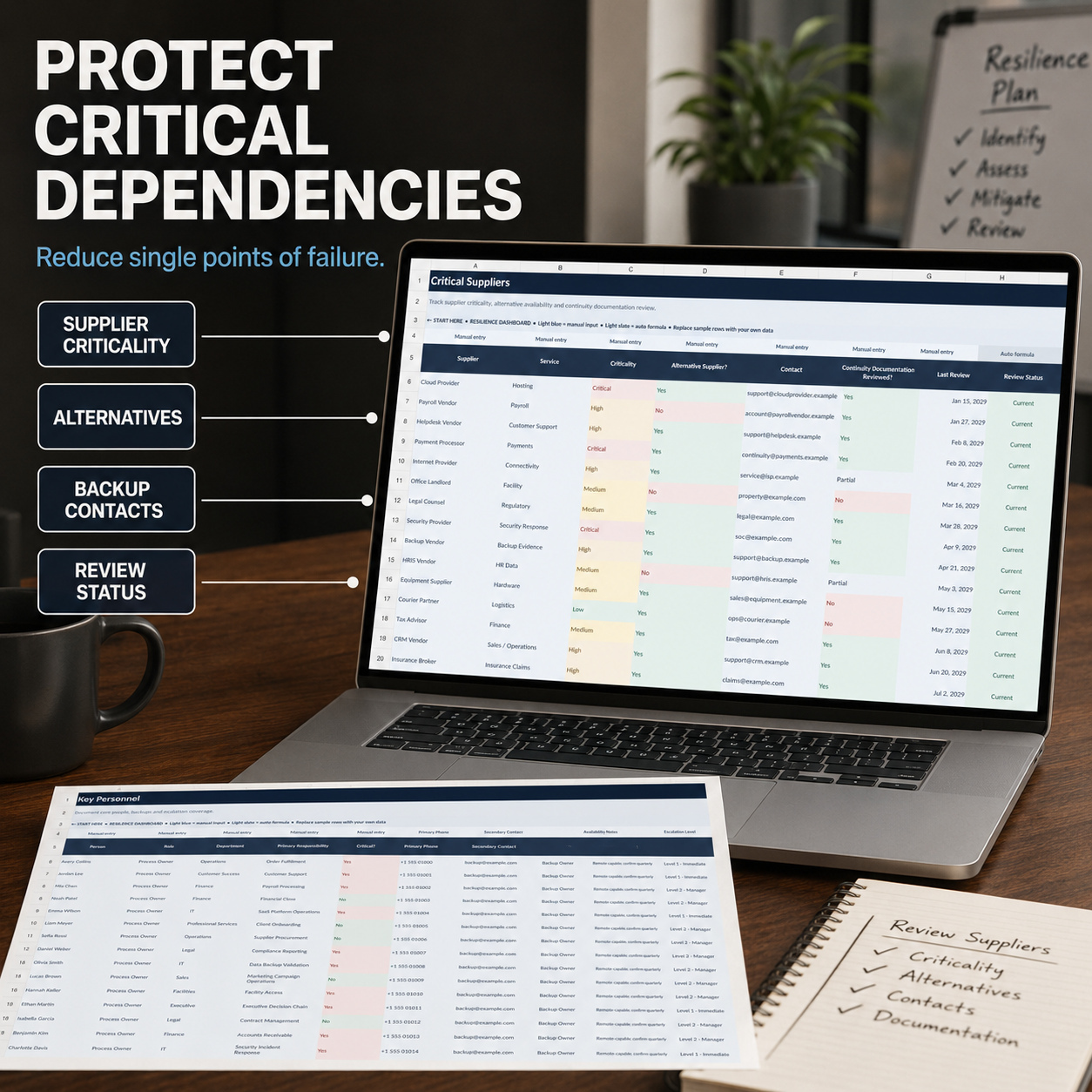
The toolkit provides dedicated registers for:
πŸ–₯️ Critical Systems
🀝 Critical Suppliers
πŸ‘₯ Key Personnel
πŸ”— Process Dependencies
πŸ“ž Communication Contacts


This helps organisations understand the people, technology and third parties required to maintain or restore critical operations.


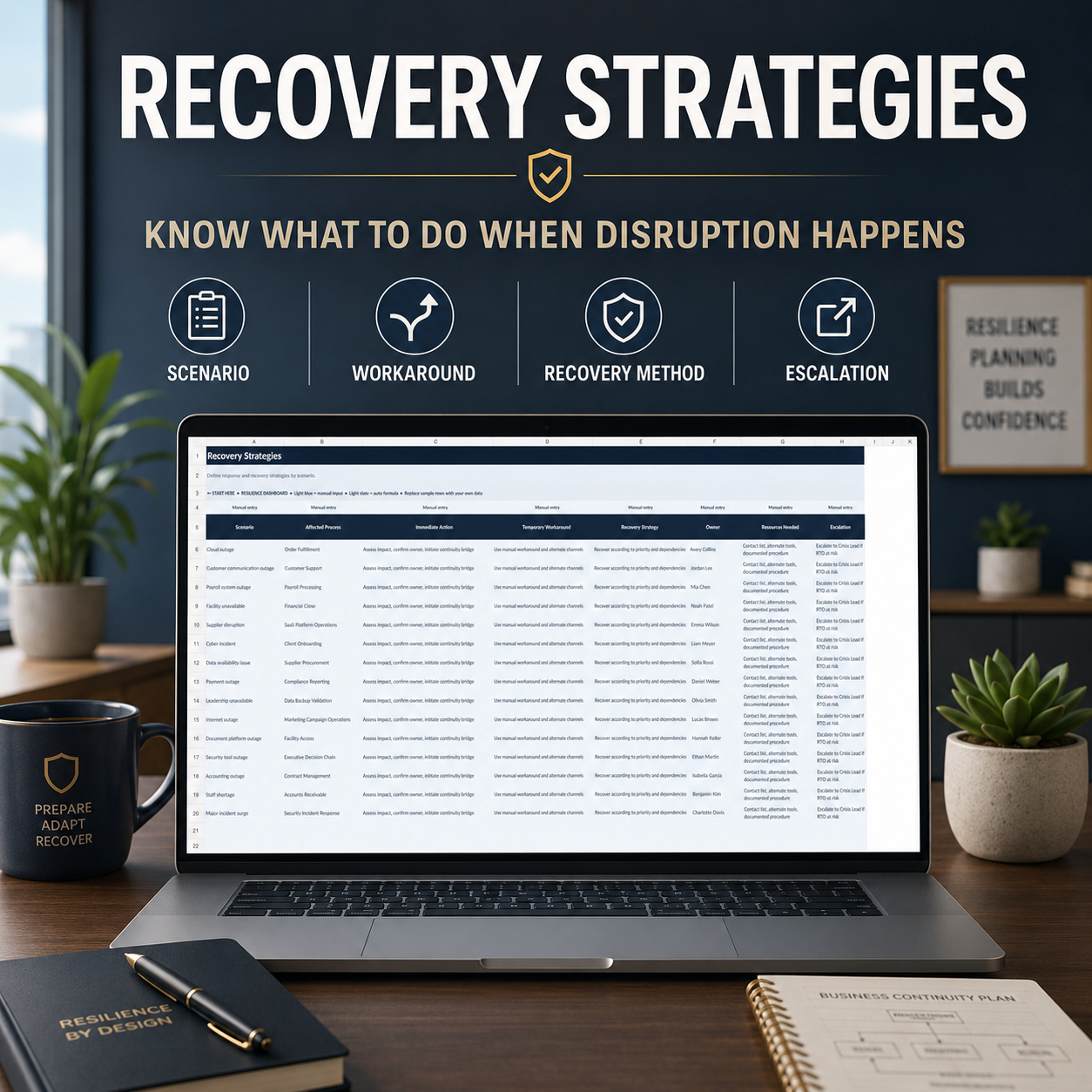
πŸ› οΈ RECOVERY STRATEGIES & ACTION MANAGEMENT
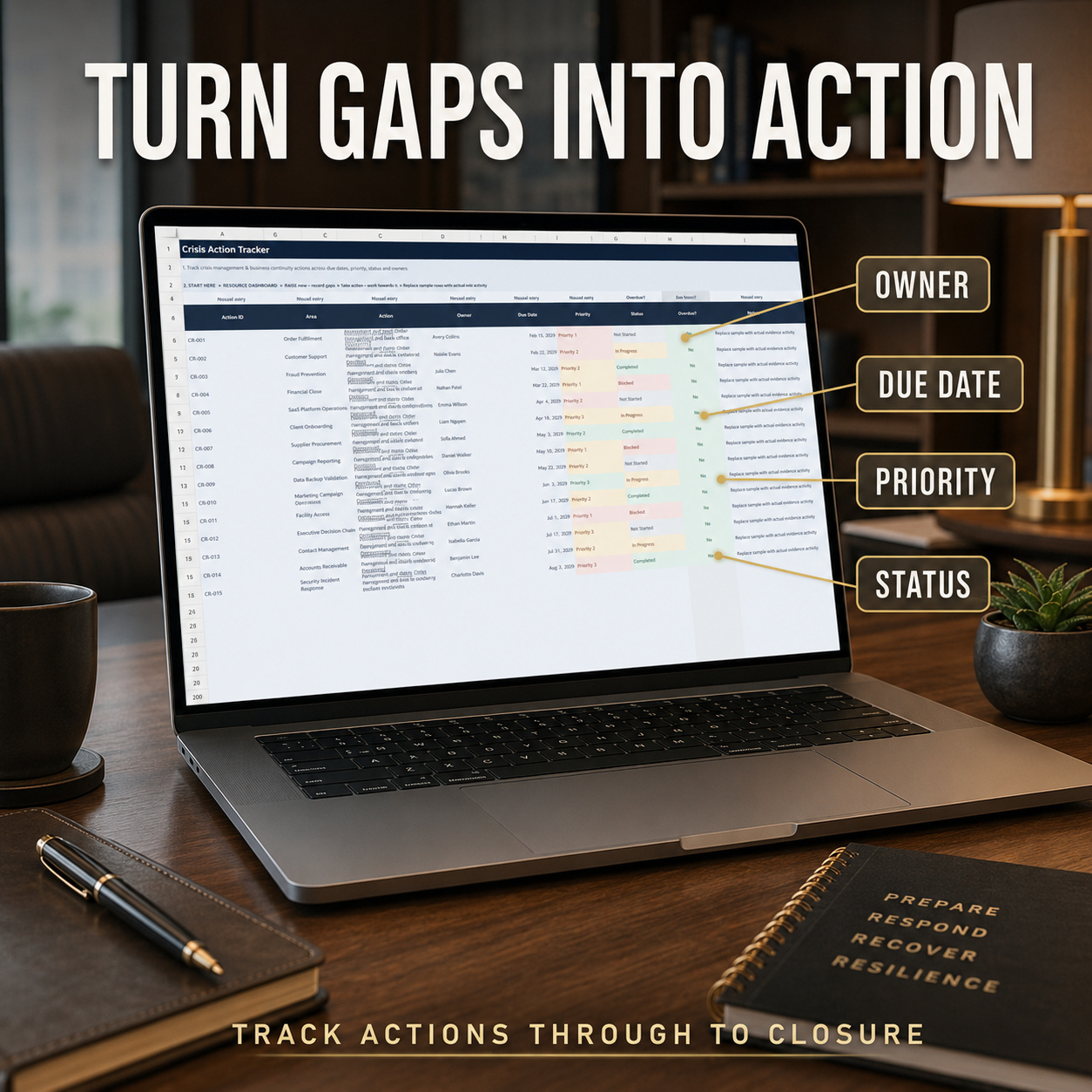
Document resilience and recovery strategies and translate identified gaps into accountable actions.
Dedicated Business Continuity, Disaster Recovery and Crisis Action modules support:
βœ… Ownership
βœ… Due dates
βœ… Priority
βœ… Status
βœ… Progress
βœ… Follow-up


This helps move resilience planning from documentation into active implementation.


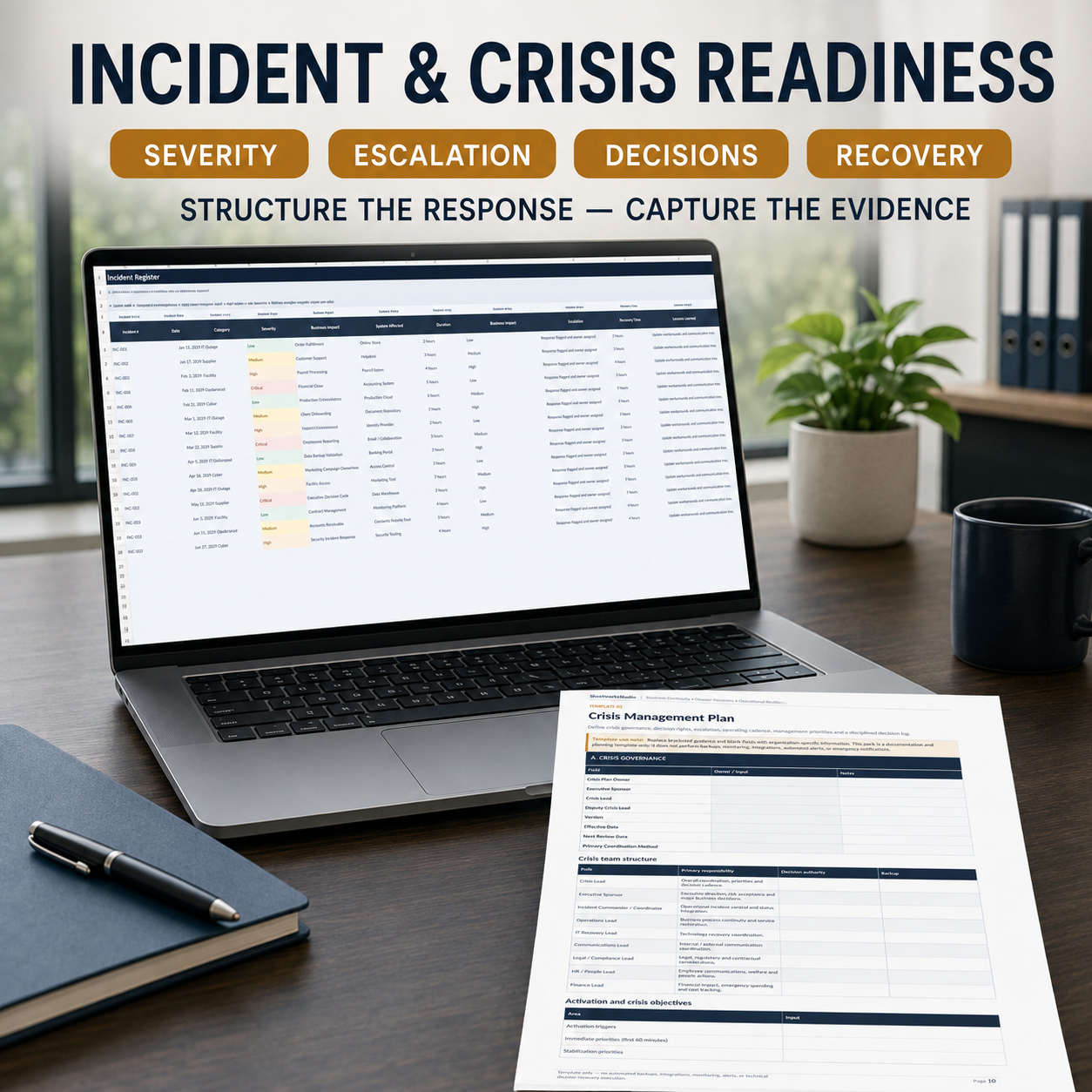
🚨 INCIDENT & CRISIS MANAGEMENT
Use the Incident Register and Crisis Action Tracker to document disruptive events and associated response activities.


The system supports structured recording, ownership and follow-up without pretending to be a live emergency-management or monitoring platform.


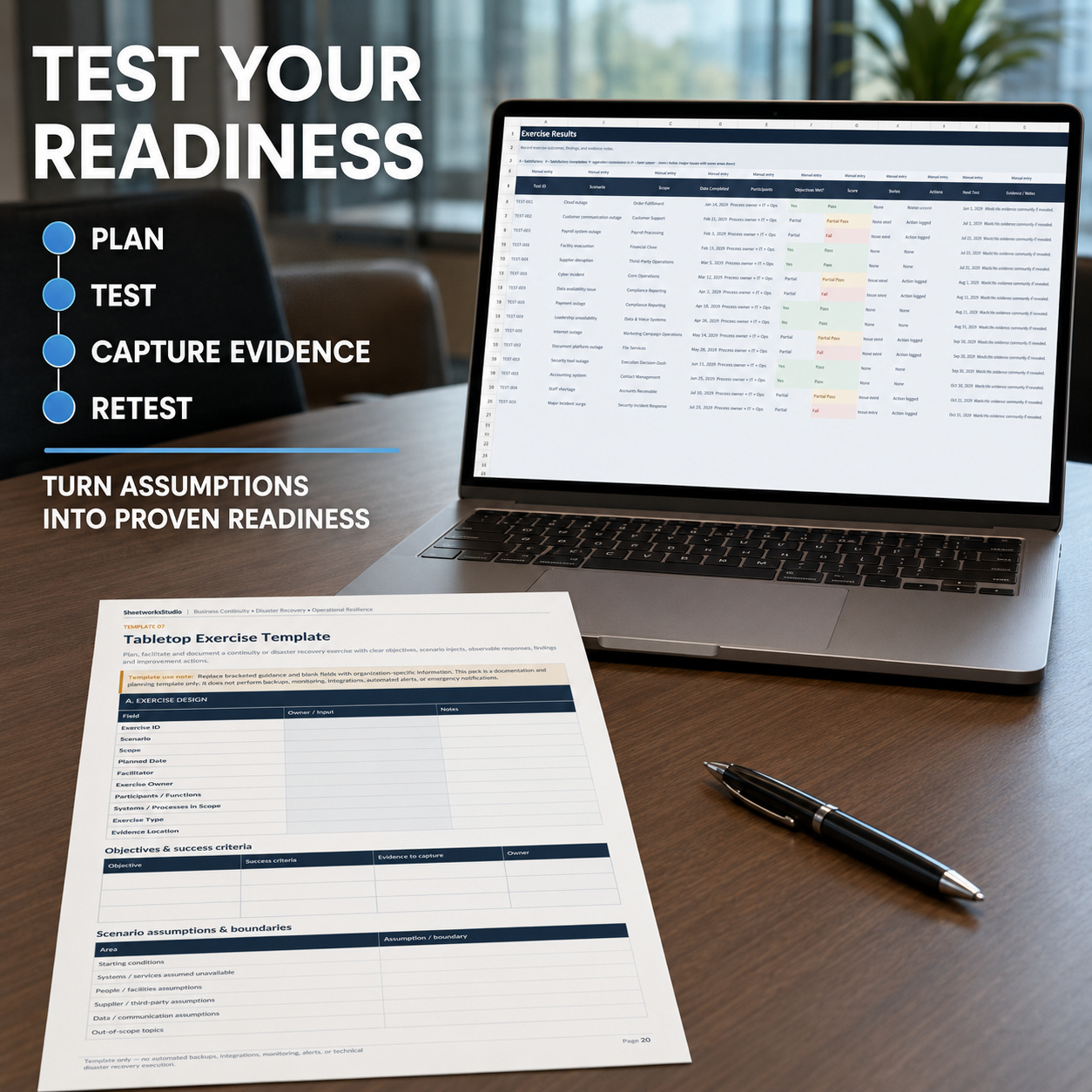
πŸ§ͺ EXERCISES, TESTING & EVIDENCE
Business continuity plans require recurring validation.
Use dedicated modules to:
βœ… Schedule exercises and tests
βœ… Document results
βœ… Capture observations
βœ… Identify lessons learned
βœ… Convert findings into improvement actions
βœ… Monitor recurring plan reviews


This creates a clear continuous-improvement loop rather than treating continuity plans as static documents.


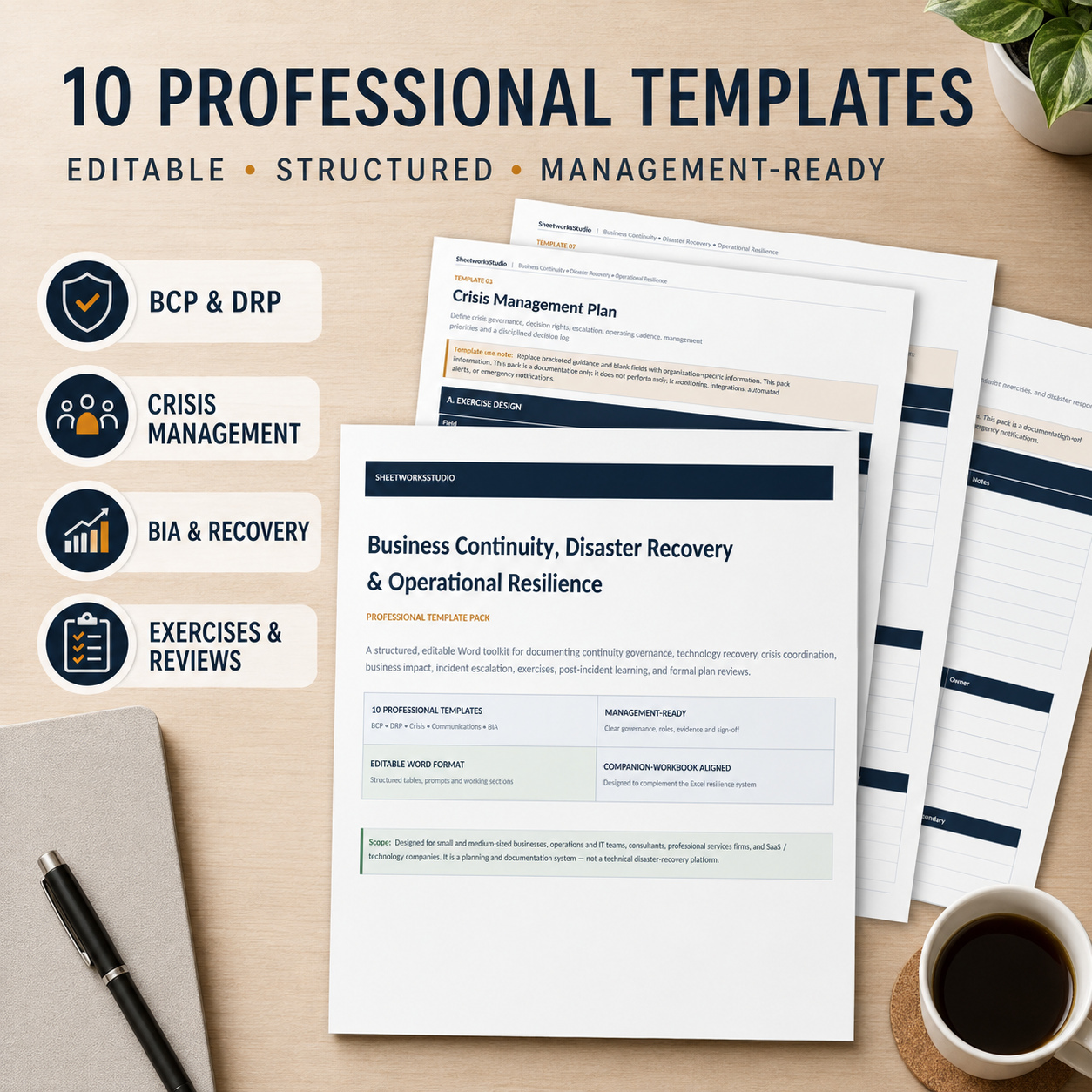
πŸ“ 10 PROFESSIONAL WORD TEMPLATES
The included editable Word document contains 10 structured professional templates across approximately 28 pages:
  1. Business Continuity Plan
  2. Disaster Recovery Plan
  3. Crisis Management Plan
  4. Emergency Communication Plan
  5. Business Impact Analysis Template
  6. Recovery Procedure Template
  7. Tabletop Exercise Template
  8. Incident Escalation Procedure
  9. Post-Incident Review
  10. Continuity Plan Review Checklist


The templates include structured sections for governance, responsibilities, recovery activities, evidence, decisions, approvals and review controls.


They are designed to complement the Excel management system rather than operate as disconnected generic documents.


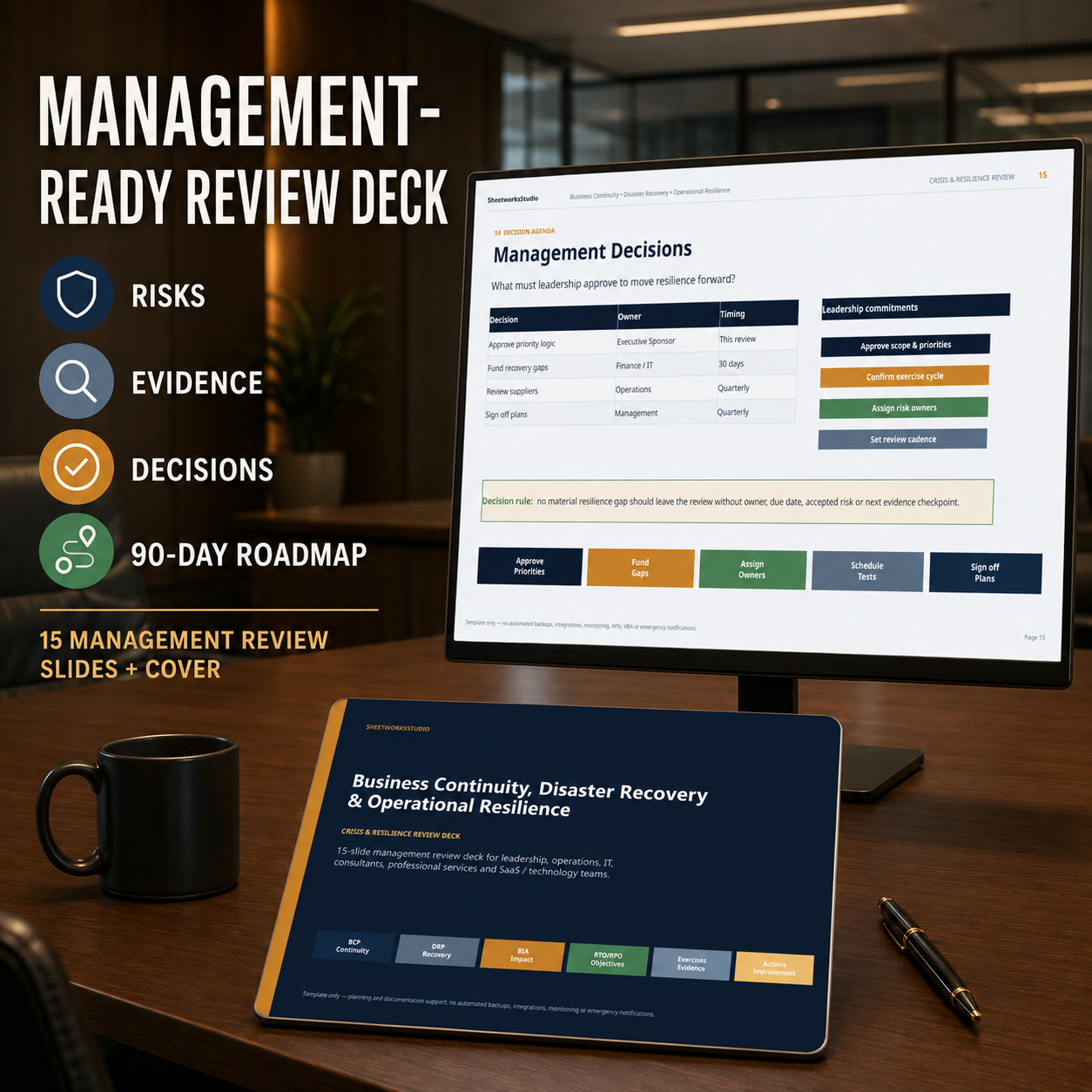
πŸ“½οΈ MANAGEMENT REVIEW POWERPOINT
The included Crisis & Resilience Management Review Deck provides 16 slides in total β€” 1 cover plus 15 management slides.


It covers:
βœ… Resilience Overview
βœ… Critical Processes
βœ… Business Impact
βœ… Recovery Objectives
βœ… System Resilience
βœ… Supplier Assurance
βœ… Recovery Strategies
βœ… Incident Readiness
βœ… Crisis Governance
βœ… Exercises & Evidence
βœ… Findings & Lessons
βœ… Improvement Actions
βœ… Major Risks
βœ… Management Decisions
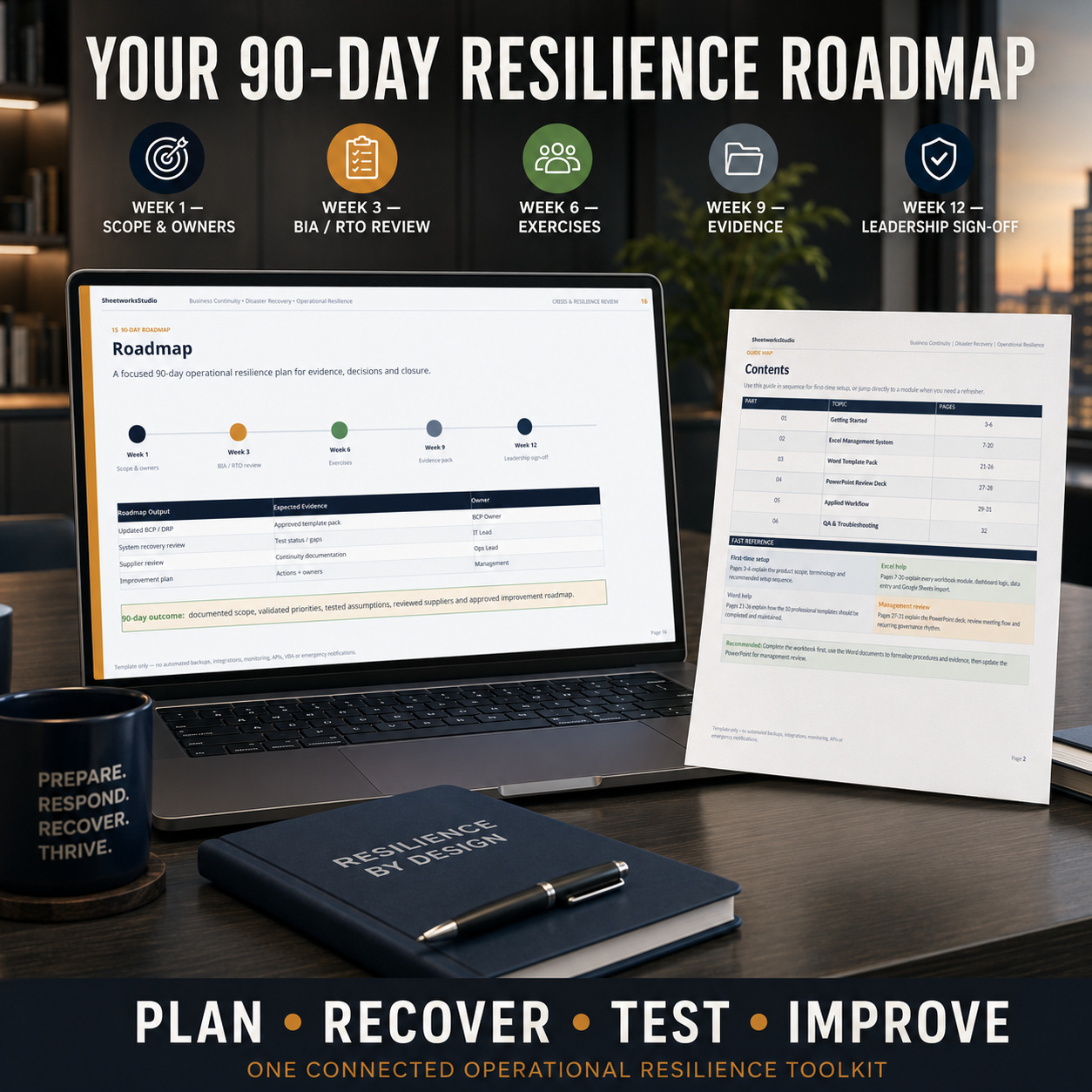
βœ… 90-Day Roadmap


The presentation provides a structured basis for leadership reviews, steering discussions and recurring resilience governance.


πŸ“˜ 32-PAGE IMPLEMENTATION GUIDE
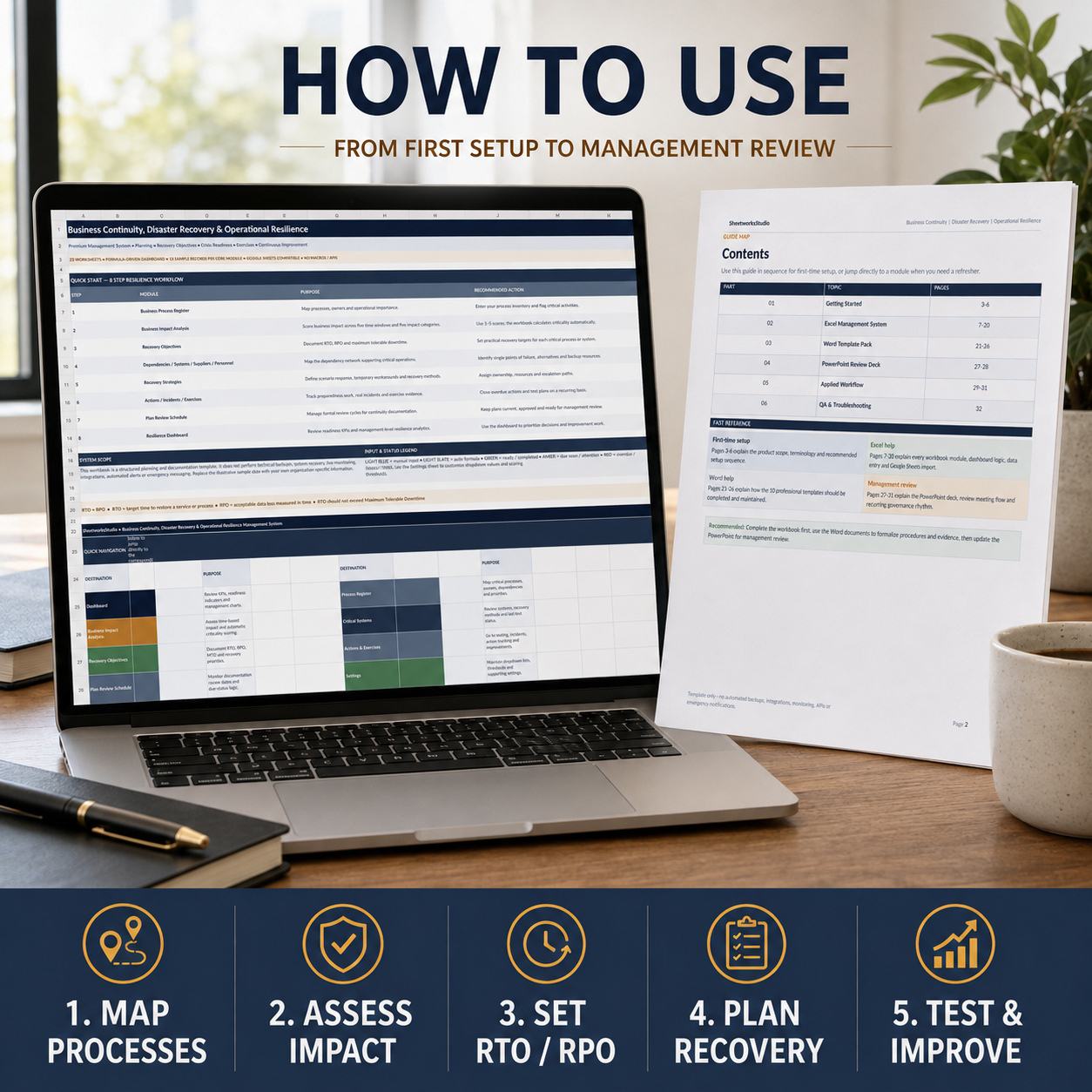
A detailed 32-page How-to-Use Guide explains how the entire system works together.
It covers:
βœ… Initial system setup
βœ… 8-step resilience workflow
βœ… Business Impact Analysis
βœ… RTO, RPO and MTD
βœ… Dependencies and critical resources
βœ… Recovery strategies
βœ… Incidents and crisis actions
βœ… Exercises and testing
βœ… Lessons learned
βœ… Improvement management
βœ… Word-template usage
βœ… Management review process
βœ… Google Sheets import considerations
βœ… 90-day implementation roadmap
βœ… Recurring governance
βœ… Troubleshooting and QA


✨ ONE CONNECTED RESILIENCE WORKFLOW
The key strength of this toolkit is the connection between the components:


Processes β†’ BIA β†’ Criticality β†’ Recovery Objectives β†’ Dependencies β†’ Systems & Suppliers β†’ Recovery Strategies β†’ Actions β†’ Incidents β†’ Exercises β†’ Lessons β†’ Improvements β†’ Management Review


Excel supports operational management.


Word supports controlled documentation.


PowerPoint supports executive review and decisions.


The PDF guide explains how to implement and maintain the complete framework.


πŸ‘€ IDEAL FOR
Business continuity teams, IT and disaster recovery functions, operational resilience managers, risk teams, operations departments, crisis coordinators, professional services firms, SaaS and technology organisations, SMEs and consultants supporting resilience programmes.


πŸ’Ž FROM BUSINESS IMPACT TO MANAGEMENT-READY RESILIENCE
Use one structured toolkit to understand critical operations, establish recovery objectives, document dependencies, prepare response strategies, test readiness and convert findings into measurable improvement activities.
The result is a practical and reusable resilience-management environment without requiring a full enterprise BCM platform.


βš–οΈ IMPORTANT NOTICE
This toolkit is intended for planning, documentation, organisational resilience and management purposes only. It does not constitute legal, regulatory, cybersecurity, IT, audit, compliance or professional business continuity advice and does not guarantee continuity, disaster recovery success, certification or successful restoration of operations.

This Best Practice includes
1Γ—Business Continuity Excel System, 1x Word Template Pack, 1x Crisis & Resilience Management Review Deck, 1xHow-to-Guide

Acquire business license for $49.90

Add to cart

Add to bookmarks

Discuss

Further information

β€’ Identify business-critical processes and resources
β€’ Assess disruption impact through structured BIA
β€’ Define RTO, RPO and MTD recovery objectives
β€’ Document critical systems, suppliers, personnel and dependencies
β€’ Establish practical recovery strategies and accountable actions
β€’ Test resilience through exercises and capture lessons learned
β€’ Provide management with clear resilience reporting and improvement visibility

This system works particularly well for organisations that:
- need a structured Business Continuity Management workflow
- currently manage resilience information across disconnected documents
- require formal BIA and recovery-objective documentation
- need visibility across systems, suppliers and key personnel
- conduct tabletop exercises or continuity testing
- need recurring resilience governance and management review
- want a flexible Excel/Word/PowerPoint solution without implementing enterprise BCM software

This toolkit is not intended to replace:
- automated disaster recovery infrastructure
- backup or replication technology
- automated failover systems
- live incident-monitoring platforms
- automated emergency notification systems
- enterprise BCM/GRC software requiring workflow integrations
- professional legal, regulatory, cybersecurity or IT advice
- certification assessments or regulatory assurance
It does not perform backups, restore systems, trigger failovers or monitor live infrastructure.


0.0 / 5 (0 votes)

please wait...