
Solar PV & Battery (BESS) Project Finance Model with DSCR-Sculpted Debt (Excel)
Originally published: 23/09/2026 16:30
Publication number: ELQ-84082-1
View all versions & Certificate
certified

Solar PV & Battery (BESS) Project Finance Model with DSCR-Sculpted Debt (Excel)

Solar and battery project finance without a circular reference: construction interest and DSCR-sculpted debt both solved in closed form, in visible columns.

Description
Two loops make project finance models fragile, and this one has neither.

Interest during construction depends on the debt balance, the balance depends on how much has to be funded, and the funding requirement includes the interest. Debt sizing has the same shape: the sculpted repayment depends on interest, interest depends on the balance, and the balance is what you are trying to size. The usual answer to both is to switch on iterative calculation and let the workbook settle. That makes the file behave differently on different machines, hides errors inside a converging loop, and leaves no reviewer able to trace a number back to its source.

HOW THE CONSTRUCTION LOOP IS REMOVED

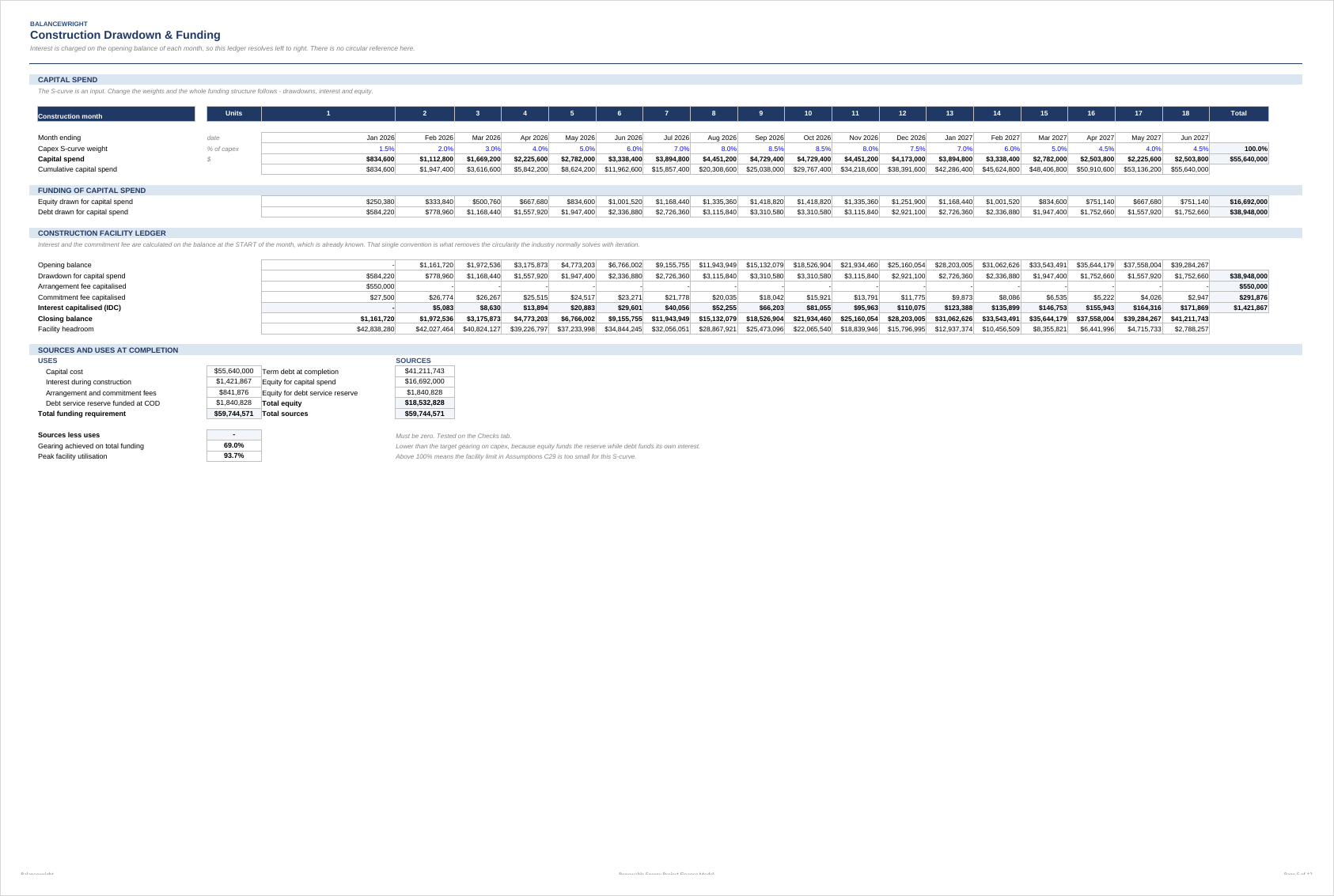
Interest and the commitment fee are charged on the balance at the start of each month, which is already known before anything is added to it. The ledger then resolves strictly left to right across eighteen monthly columns: opening balance, drawdown for capital spend, arrangement fee, commitment fee, interest, closing balance. At the end you have the debt at completion, the interest capitalised and the equity required, with no cell depending on itself.

HOW THE SIZING LOOP IS REMOVED

Sculpting sets principal equal to CFADS divided by the cover ratio, less interest on the opening balance. Roll that recursion forward and the balance after n periods is the opening balance compounded at the debt rate, less the compounded sum of CFADS divided by the ratio. Set the final balance to zero, rearrange, and the debt that exactly amortises is the present value of CFADS over the tenor divided by the cover ratio. Turn it around and the ratio a given facility achieves is that present value divided by the debt drawn. One division. No goal seek, no solver, no macro.

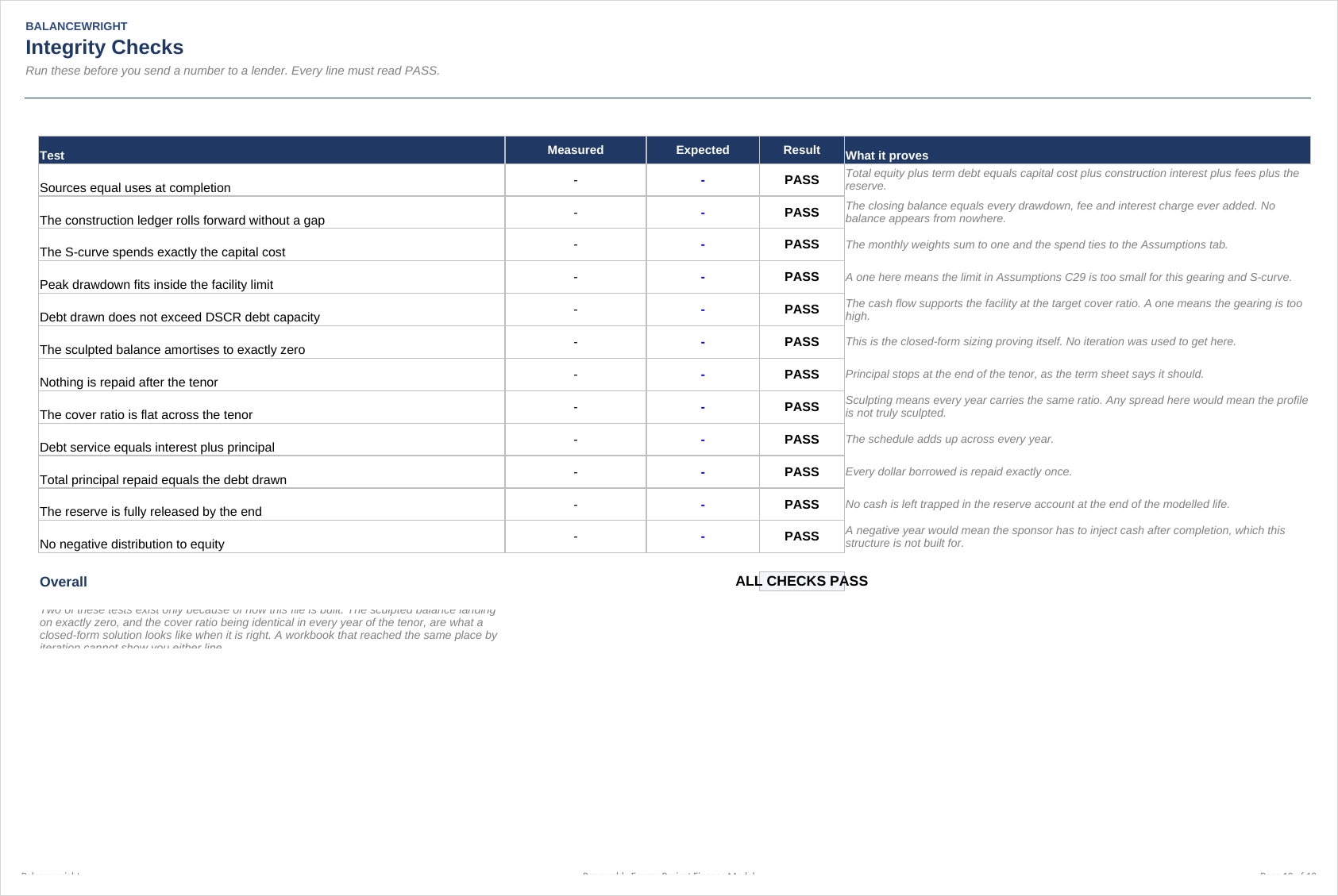
The Checks tab tests this rather than asserting it: the sculpted balance must land on exactly zero at the end of the tenor, and the cover ratio must be identical in every year of it. A workbook that reached the same place by iteration cannot show you either line.

TWENTY-FIVE OPERATING YEARS

Degradation, availability and curtailment. A contracted offtake that rolls off on schedule into merchant pricing. The battery modelled separately: cycles, round-trip efficiency, arbitrage spread and capacity revenue. Operating cost, maintenance capital and a battery augmentation year escalate to EBITDA and then to CFADS. Tax runs on straight-line depreciation with loss carry-forward and the interest deduction, so the post-tax cover ratio sits next to the sizing ratio rather than replacing it.

WHAT COMES OUT

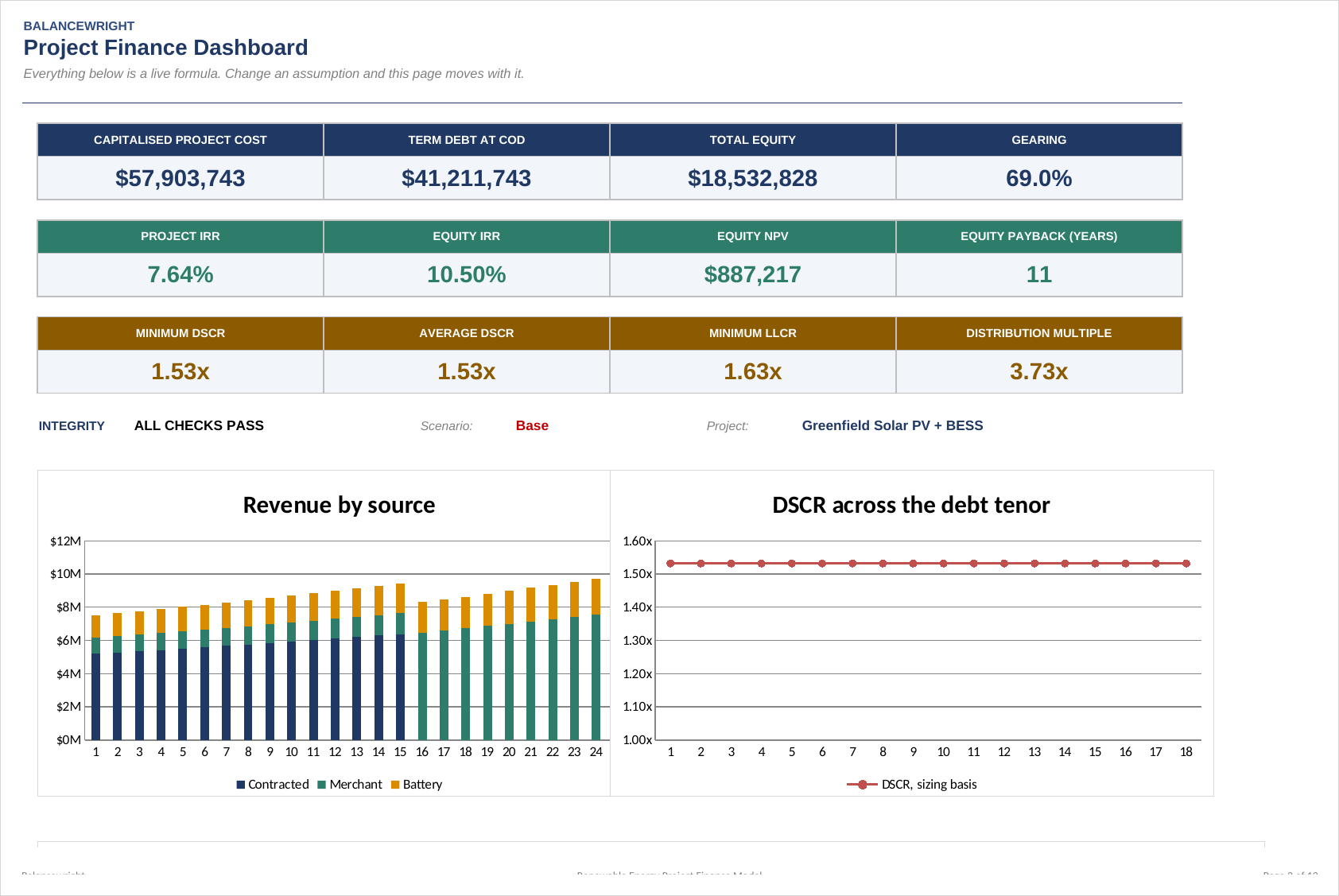
Project IRR and NPV on the unlevered cash flow. Equity IRR and NPV, payback and the distribution multiple. Minimum and average DSCR, and the loan life cover ratio year by year. Two one-way sensitivity tables are exact rather than interpolated: every case is a full twenty-five year recalculation with tax recomputed and the rate of return re-solved, and the workings sit on the same tab so you can audit them.

THE WORKED EXAMPLE

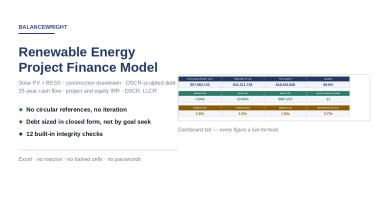
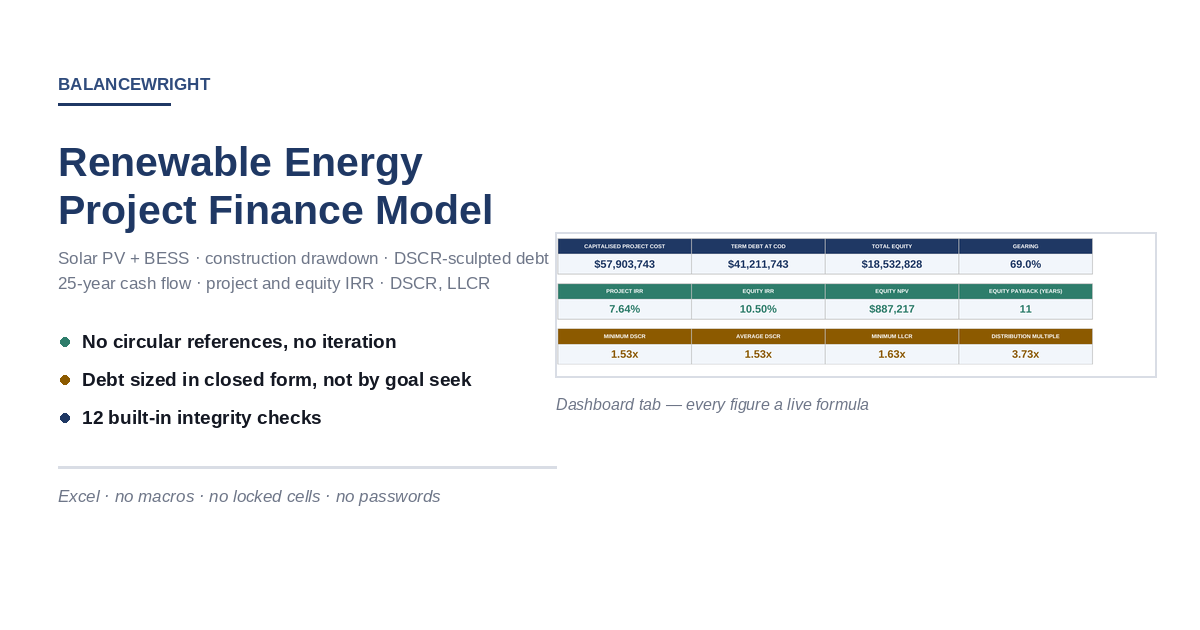
A fifty megawatt solar plant with a twenty megawatt, forty megawatt-hour battery. Capitalised project cost of 57.9 million, term debt of 41.2 million, equity of 18.5 million, project IRR of 7.6 per cent, equity IRR of 10.5 per cent, a minimum DSCR of 1.53 times and a minimum LLCR of 1.63 times. Every figure recomputes when you change an assumption.

TWELVE INTEGRITY CHECKS

Sources equal uses. The construction ledger rolls forward without a gap. The S-curve spends exactly the capital cost. The peak drawdown fits inside the facility limit. The debt drawn does not exceed the cover ratio capacity. The sculpted balance amortises to exactly zero. Nothing is repaid after the tenor. The cover ratio is flat across it. Debt service equals interest plus principal. Total principal repaid equals the debt drawn. The reserve is fully released. No year needs a negative distribution.

Eleven tabs, live formulas throughout. No macros, no add-ins, no external links, no locked cells and no passwords, and iterative calculation stays off.

Most templates ask you to trust them. This one shows its working.

This workbook models the arithmetic of your own project. It is not investment advice, and the worked example is invented.

This Best Practice includes
1 Excel workbook (11 tabs, 2,807 live formulas) and 1 seven-page PDF guide.

Acquire business license for $69.00

Add to cart

Add to bookmarks

Discuss

Further information

Decide whether a solar and storage project is worth building and whether a bank would fund it at the gearing you assumed, and be able to show a lender exactly how the debt was sized.

You are appraising or financing a utility-scale solar plant, with or without storage; you need a bankable answer rather than a spreadsheet that only computes NPV; you have to defend the debt sizing to a credit committee; you distrust any model that needs iterative calculation switched on.

You need multiple debt tranches, mezzanine, cash sweeps, refinancing, tax equity or transferability, monthly operating periods, or a dispatch model for the battery. This is one project, one tranche, one currency, annual operating periods.


0.0 / 5 (0 votes)

please wait...