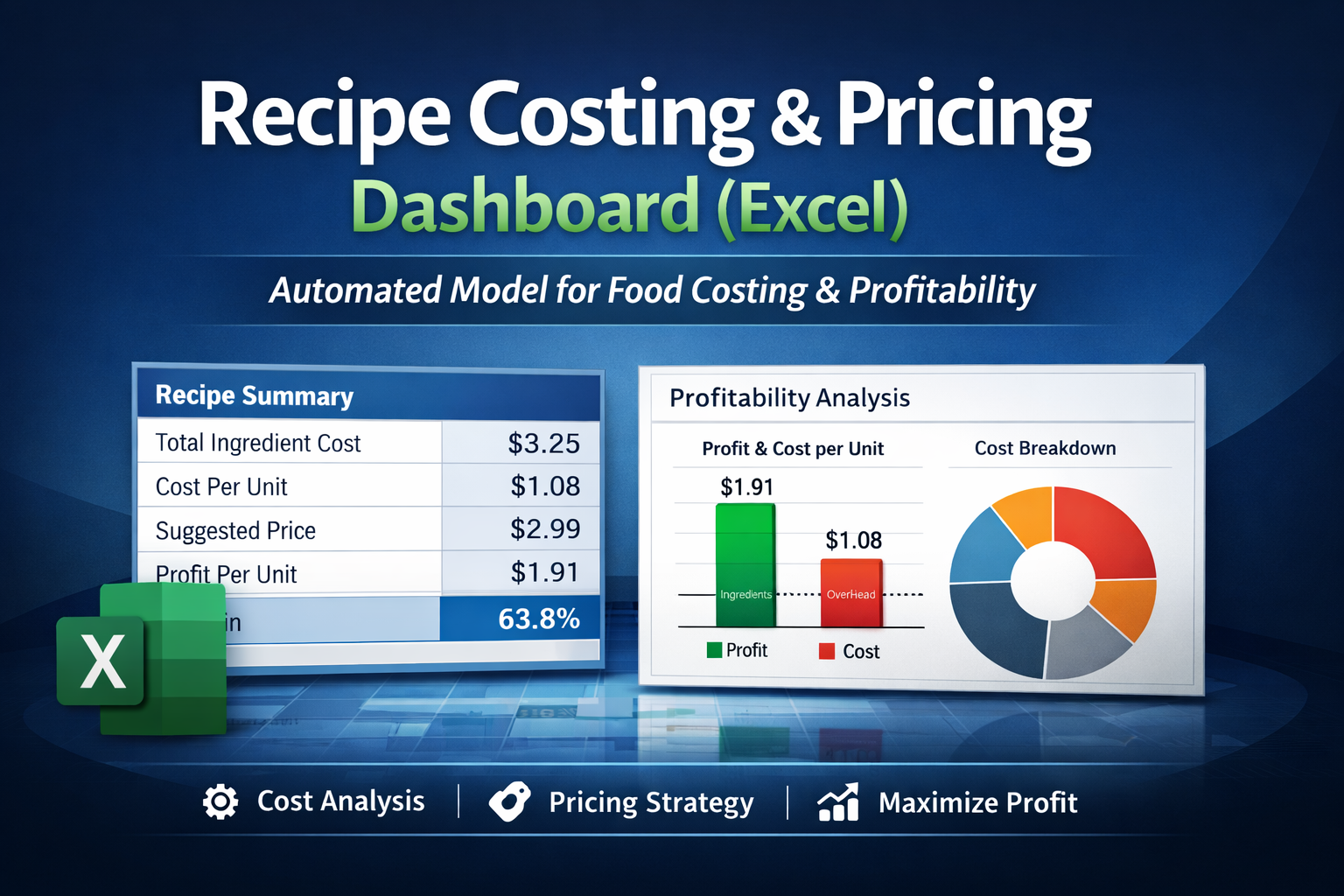

Recipe Costing & Pricing Dashboard (Excel) – Complete Template for Food Costing & Profitability
Originally published: 07/05/2026 16:04
Publication number: ELQ-97866-1
View all versions & Certificate
certified

Recipe Costing & Pricing Dashboard (Excel) – Complete Template for Food Costing & Profitability

Automated Excel model to calculate recipe costs, margins, suggested price, and break‑even units. Includes Example Version + Blank Version.

Description
This Excel model is a fully automated Recipe Costing & Pricing Dashboard designed for chefs, food entrepreneurs, restaurants, bakeries, and product developers who need a reliable and professional tool to calculate recipe costs and profitability.

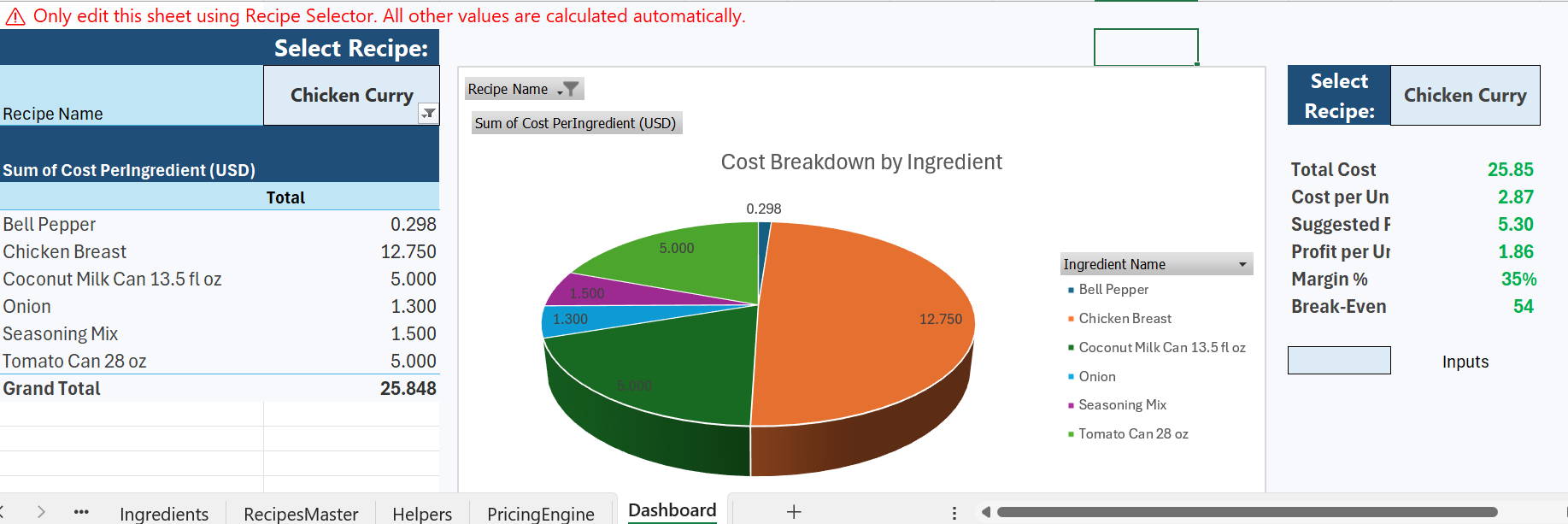
The dashboard calculates:
  • Total ingredient cost
  • Cost per unit
  • Suggested selling price
  • Profit per unit
  • Margin %
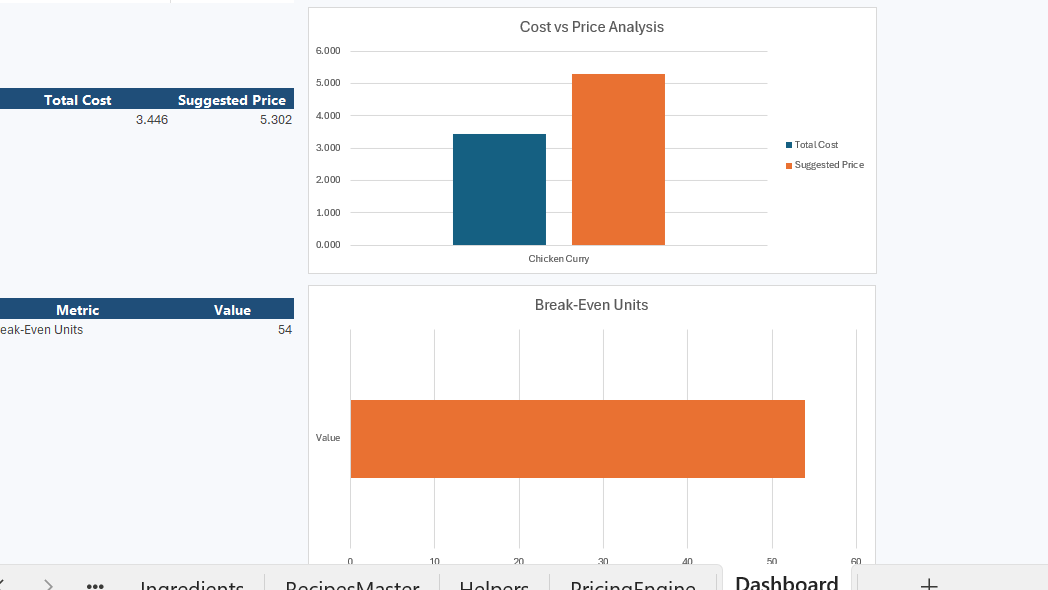
  • Break‑even units
  • Cost breakdown by ingredient
  • Top cost drivers

The model includes:
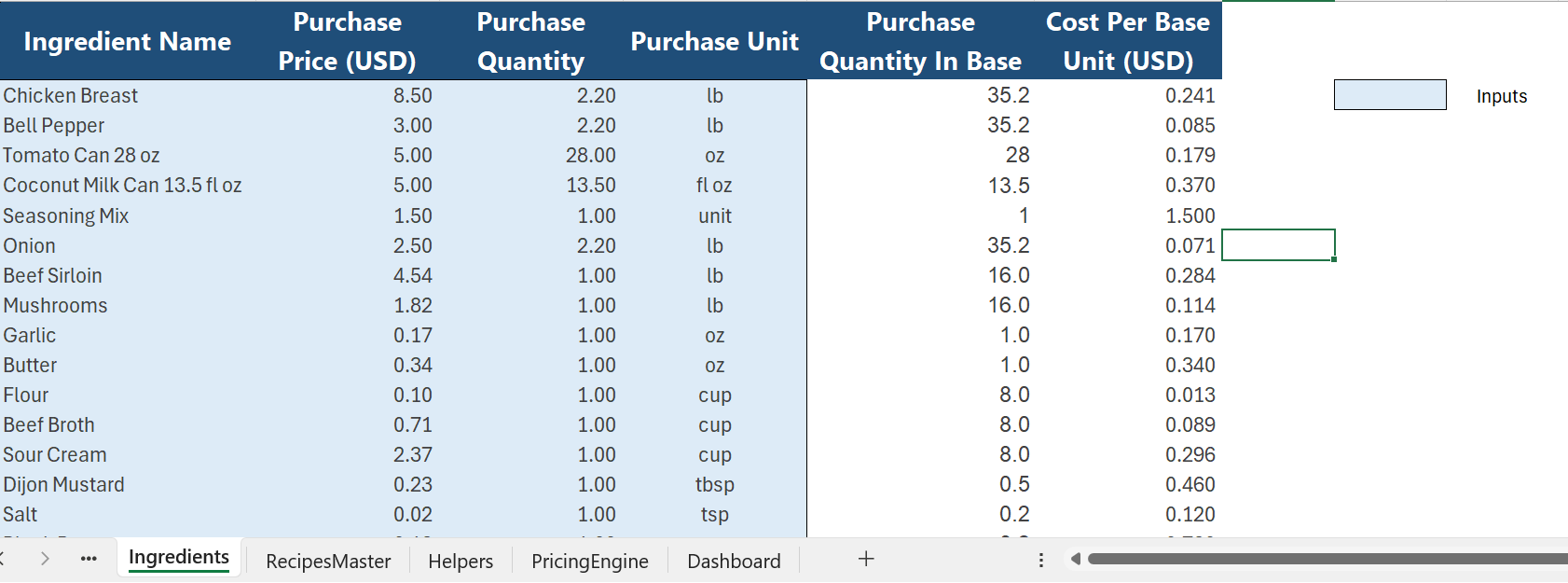
✔ Ingredients DatabaseEnter your ingredients, purchase prices, units, and quantities. The model automatically converts everything to a base unit and calculates cost per unit.
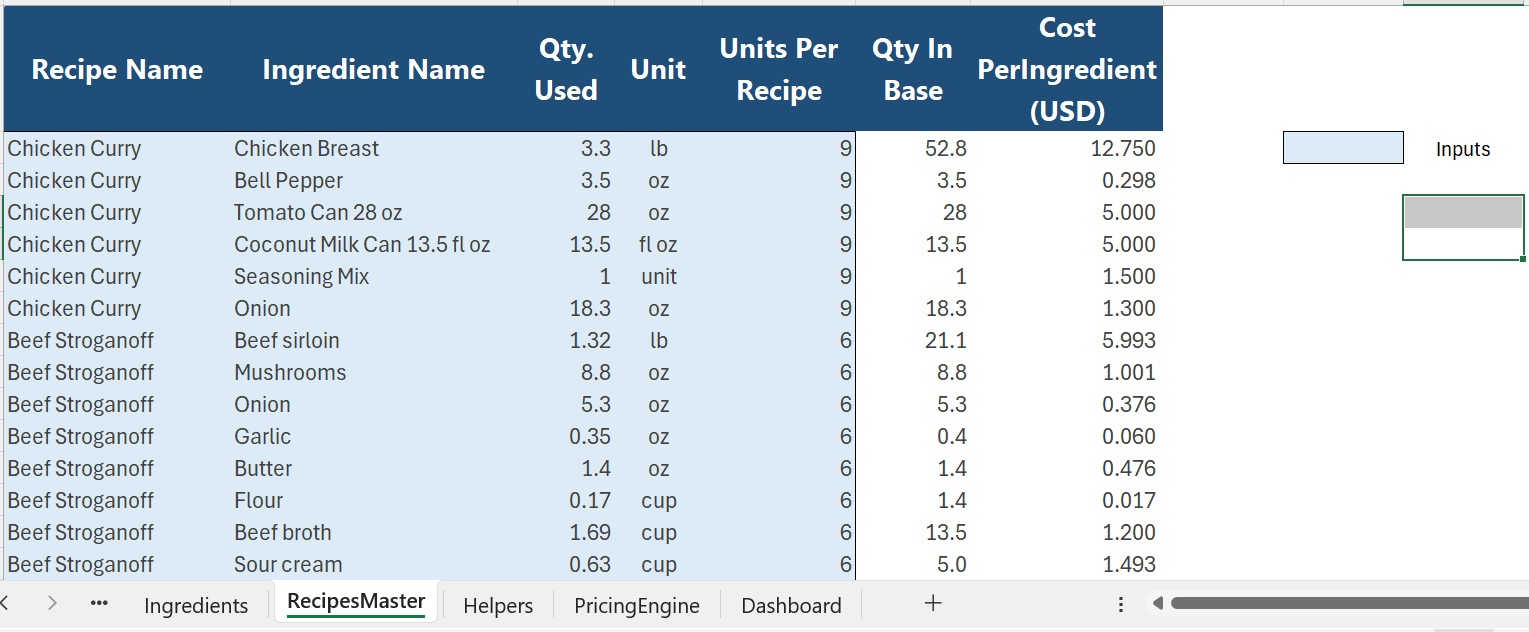
✔ RecipesMaster SheetBuild your recipes by selecting ingredients, quantities, and units. The model calculates total cost and cost per unit automatically.
✔ PricingEngine (Automated Calculations)This sheet performs all calculations behind the scenes. It is fully protected to avoid accidental changes.
✔ Interactive DashboardSelect any recipe and instantly see all KPIs, charts, and profitability metrics.

⭐ WHAT’S INCLUDED
  • Example Version (with sample recipes and ingredients)
  • Blank Version (ready for users to start from scratch)
  • Fully automated calculations
  • Clean, professional design
  • Protected formulas
  • Clear input fields
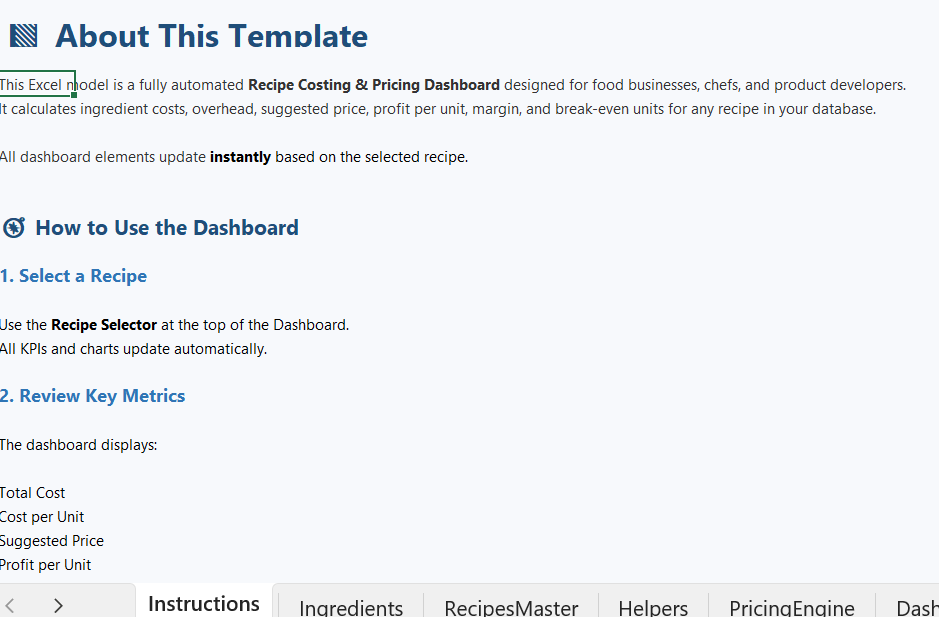
  • Instructions sheet included

⭐ KEY BENEFITS
  • Save hours calculating recipe costs manually
  • Avoid errors with automated unit conversions and protected formulas
  • Price your products correctly with suggested price and margin analysis
  • Understand profitability with break‑even and cost structure charts
  • Scale your business with a clean, professional, and user‑friendly model
  • Ready to use: includes example file + blank template

⭐ IDEAL FOR
  • Restaurants
  • Cafés
  • Bakeries
  • Food trucks
  • Meal prep businesses
  • CPG / packaged food startups
  • Chefs & culinary professionals
  • Food cost consultants

This tool gives you a professional, reliable, and scalable way to calculate recipe costs and profitability.
Whether you’re launching a new product or optimizing an existing menu, this dashboard gives you the clarity you need to make smarter pricing decisions.

Download the template, enter your ingredients and recipes, and start pricing your products with confidence.

This Best Practice includes
Two Excel files: example Version (with sample data) and Blank Version (ready to use), PDF file: Quick Start Guide

Acquire business license for $29.00

Add to cart

Add to bookmarks

Discuss

Further information

This Best Practice aims to give food businesses a simple, accurate, and professional way to calculate recipe costs and set profitable prices.
Key objectives:
Automate recipe costing with a clean, structured Excel model.
Support smart pricing decisions using margin targets, overhead %, and fixed costs.
Provide instant profitability insights through an interactive dashboard.
Eliminate manual errors with protected formulas and automated conversions.
Offer two versions: an Example file to learn from and a Blank file to start from scratch.
Deliver a scalable tool suitable for restaurants, bakeries, meal prep, and food startups.

This Best Practice is most useful when:
You need a quick, accurate way to calculate recipe costs.
Ingredient prices change frequently and must be updated easily.
You want consistent pricing based on margins and overhead.
You need instant profitability insights for each recipe.
You want a clean, protected, and ready‑to‑use Excel model for your food business.

This Best Practice is not ideal when:
A business requires complex manufacturing costing (multiple production stages, labor routing, batch yields).
The user needs multi‑location inventory management or stock tracking.
The operation depends on real‑time system integrations (POS, ERP, or accounting software).
Pricing must follow advanced financial modeling (scenario simulations, elasticity, multi‑currency).
The user expects a fully automated database rather than a structured Excel tool.


0.0 / 5 (0 votes)

please wait...