Publication number: ELQ-56753-1
View all versions & Certificate

Utility Value Analysis
Utility Value Analysis in Microsoft Excel to download.
Further information
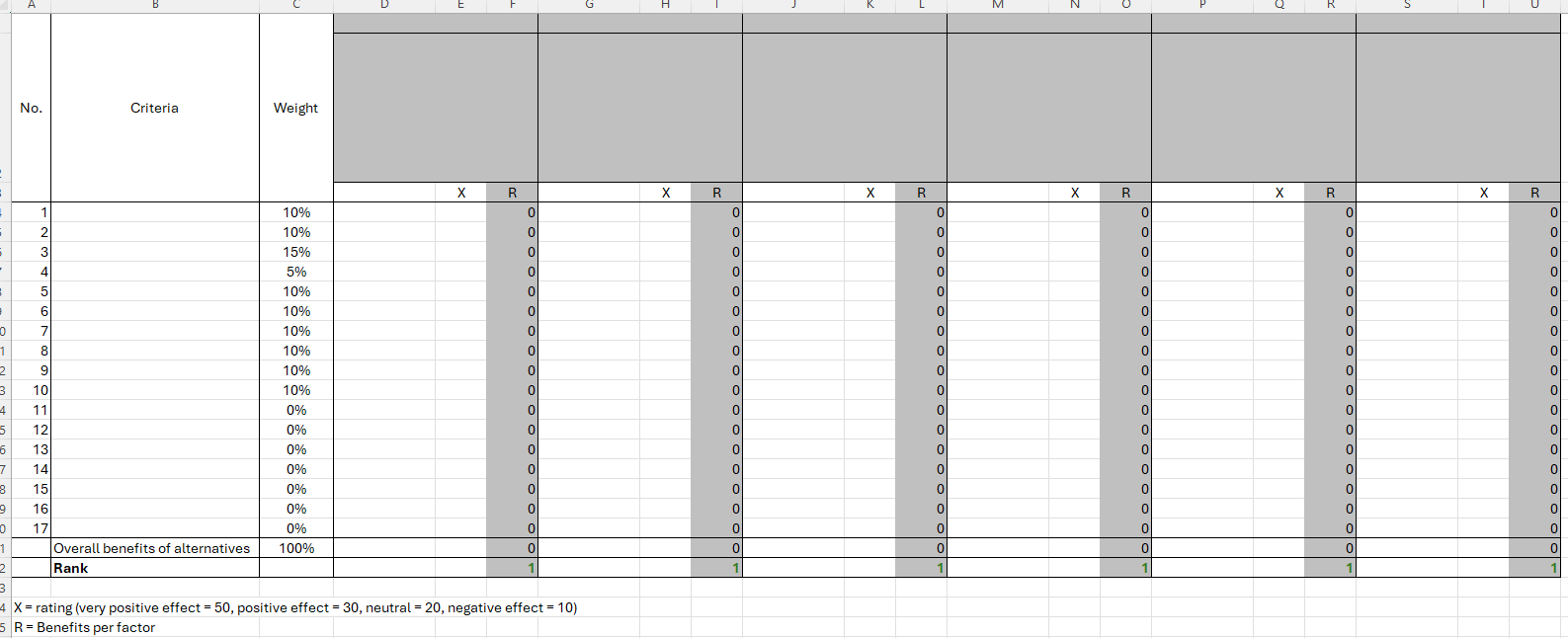
The Utility Value Analysis Excel tool is designed to support structured, data-driven decision-making by providing a transparent framework for evaluating multiple alternatives against a set of weighted criteria. Its primary objective is to help individuals and teams make informed choices by quantifying the relative benefits of each option based on predefined priorities.
Each criterion is assigned a weight that reflects its importance, and each alternative is rated according to its expected impact—ranging from very positive to negative. These ratings are then translated into numerical scores, which are aggregated to produce a total utility value for each alternative. This allows decision-makers to compare options objectively and identify the most beneficial path forward.
The tool is particularly useful in strategic planning, project selection, product evaluation, and policy analysis. It simplifies complex decisions into a repeatable and transparent process, reducing bias and improving clarity. By using a consistent scoring system and weighting structure, it ensures that all relevant factors are considered and that decisions are aligned with organizational goals or personal priorities.
Ultimately, this best practice tool empowers users to make confident, well-supported decisions in environments where multiple competing options must be evaluated.
The Utility Value Analysis Excel tool is best applied in decision-making scenarios where multiple alternatives must be evaluated against a consistent set of criteria. It is particularly effective when decisions involve both qualitative and quantitative factors that can be weighted and scored to determine the most beneficial option.
Ideal conditions include:
Strategic planning where various initiatives or investments need to be compared based on impact, feasibility, or alignment with goals.
Project selection in environments with limited resources, requiring prioritization based on expected value.
Product or service evaluation where multiple features or concepts are assessed for market fit or technical viability.
Policy analysis or procurement decisions where transparency and objectivity are essential.
Team-based decision-making where structured scoring helps reduce bias and align stakeholders.
This tool is especially useful when clarity, consistency, and repeatability are important. It supports rational decision-making by converting subjective judgments into measurable scores, helping users identify the most advantageous option based on weighted benefits.
Whether used in business, engineering, or public sector contexts, the model provides a reliable framework for evaluating complex choices with confidence and precision.
The Utility Value Analysis Excel tool is designed for structured decision-making based on weighted criteria and benefit scoring. However, it may not apply ideally in certain contexts where the decision-making process is highly subjective, lacks measurable criteria, or requires real-time adaptability.
Less suitable conditions include:
Creative or intuitive decision-making where outcomes depend on personal judgment, emotion, or brainstorming rather than structured evaluation.
Situations with insufficient or unreliable data, making it difficult to assign meaningful weights or ratings to criteria.
Decisions requiring real-time responsiveness, such as emergency management or live operational adjustments, where static models are too slow or rigid.
Highly complex scenarios involving interdependent variables, where simple additive scoring may not capture the full dynamics or trade-offs.
Environments with rapidly changing priorities, where fixed weights and criteria may become outdated quickly.
In such cases, more flexible, qualitative, or dynamic decision-making tools may be more appropriate. While the Utility Value Analysis model offers clarity and consistency, it is best used when decisions can be broken down into discrete, comparable elements with stable evaluation parameters.