Originally published: 14/11/2025 09:10
Publication number: ELQ-82792-1
View all versions & Certificate
Publication number: ELQ-82792-1
View all versions & Certificate

Theatrical Show Production Financial Model
Theatrical show production template providing forecasts, budgeting insights, and profitability analysis to assess viability and guide decision-making.
theatrical show financial modeltheatre project cash flow modeltheatre business model templateticket sales revenuerecoupment schedule modelprofit participation modeltheatrical show
Description
A theatrical show production involves bringing a live performance to life through coordinated work across writing, directing, casting, staging, and technical design. It includes developing the script, selecting actors, building sets, designing lighting and sound, and managing rehearsals to ensure a polished performance. Production teams handle logistics, budgeting, marketing, and venue coordination. The goal is to create an engaging, seamless experience that connects with audiences through storytelling, performance, and visual impact.
Theatrical Show production consists of below major phases:
Model Structure:
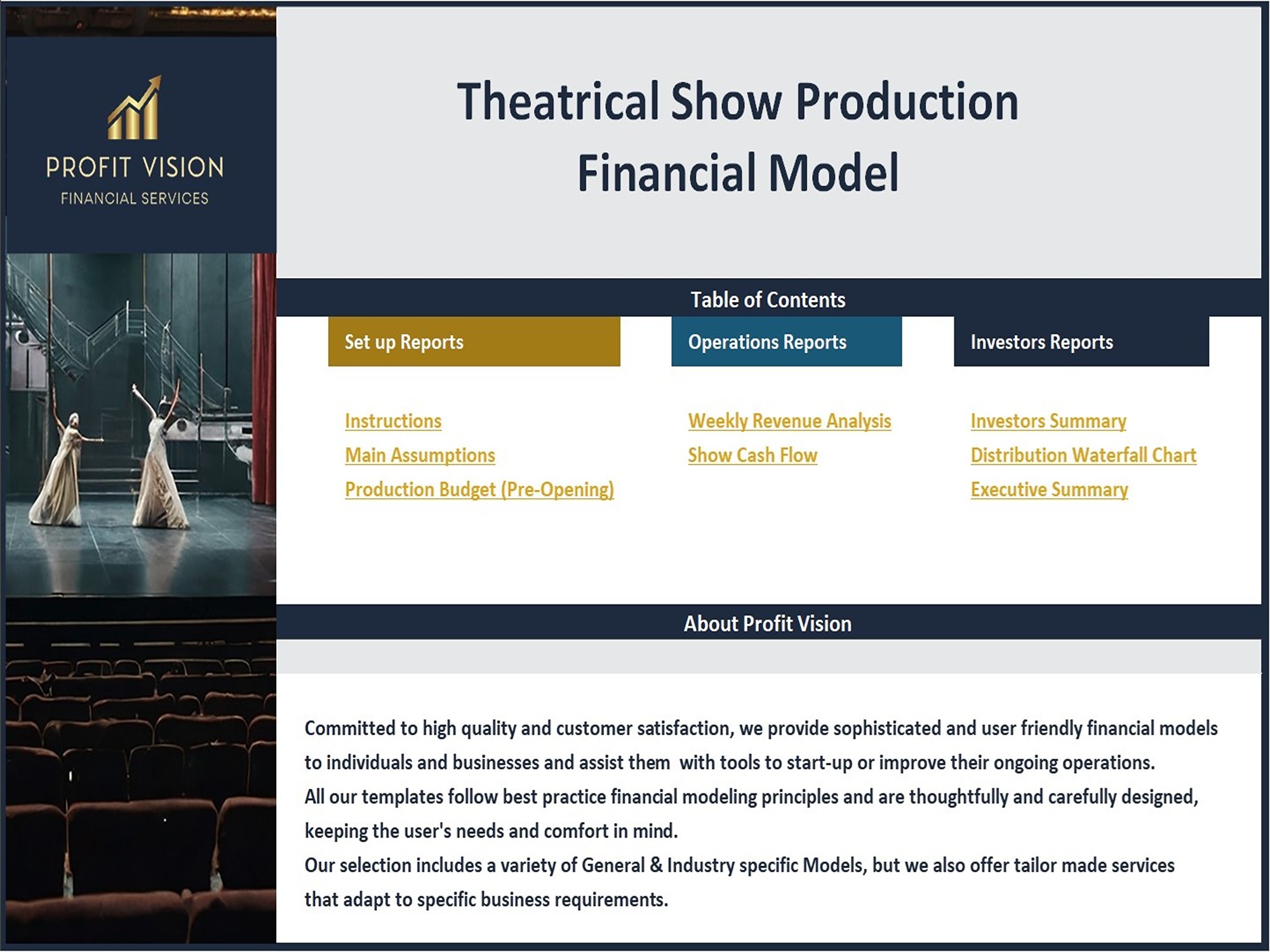
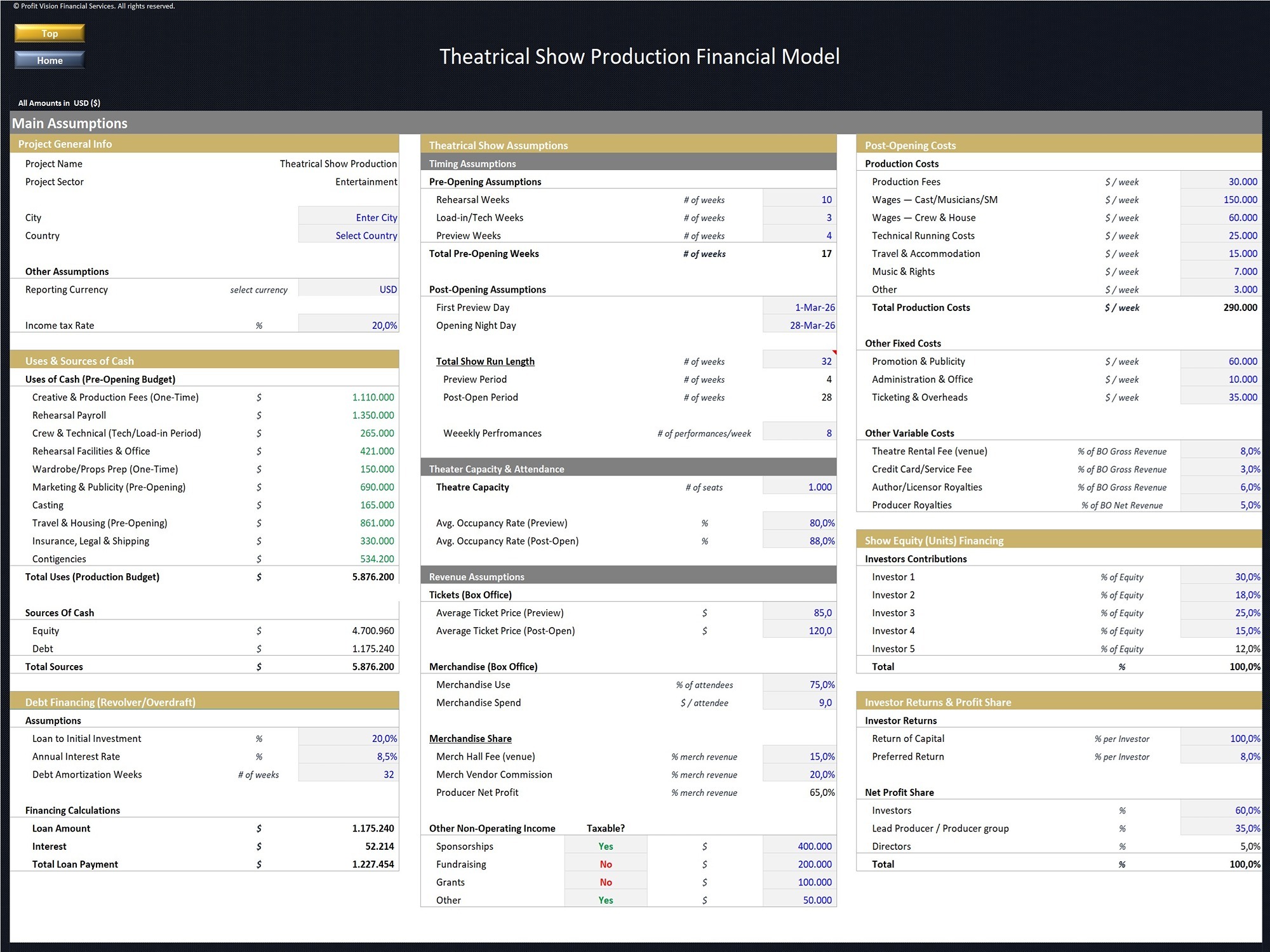
Main Assumptions
General Project Assumptions including Pre-opening and Post-opening timing Assumptions (rehearsal period, preview period, post-open period, weekly performances), Revenue Sources (tickets, merchandise, sponsorships, fundraising, etc), Post-opning costs (production, marketing, venue rental fees, royalties, etc.), Film Financing (Equity & Debt), Investors Equity (Units) Contributions, Profit Share Assumptions (Investors’ and Producer’s Pool)
Production Budget
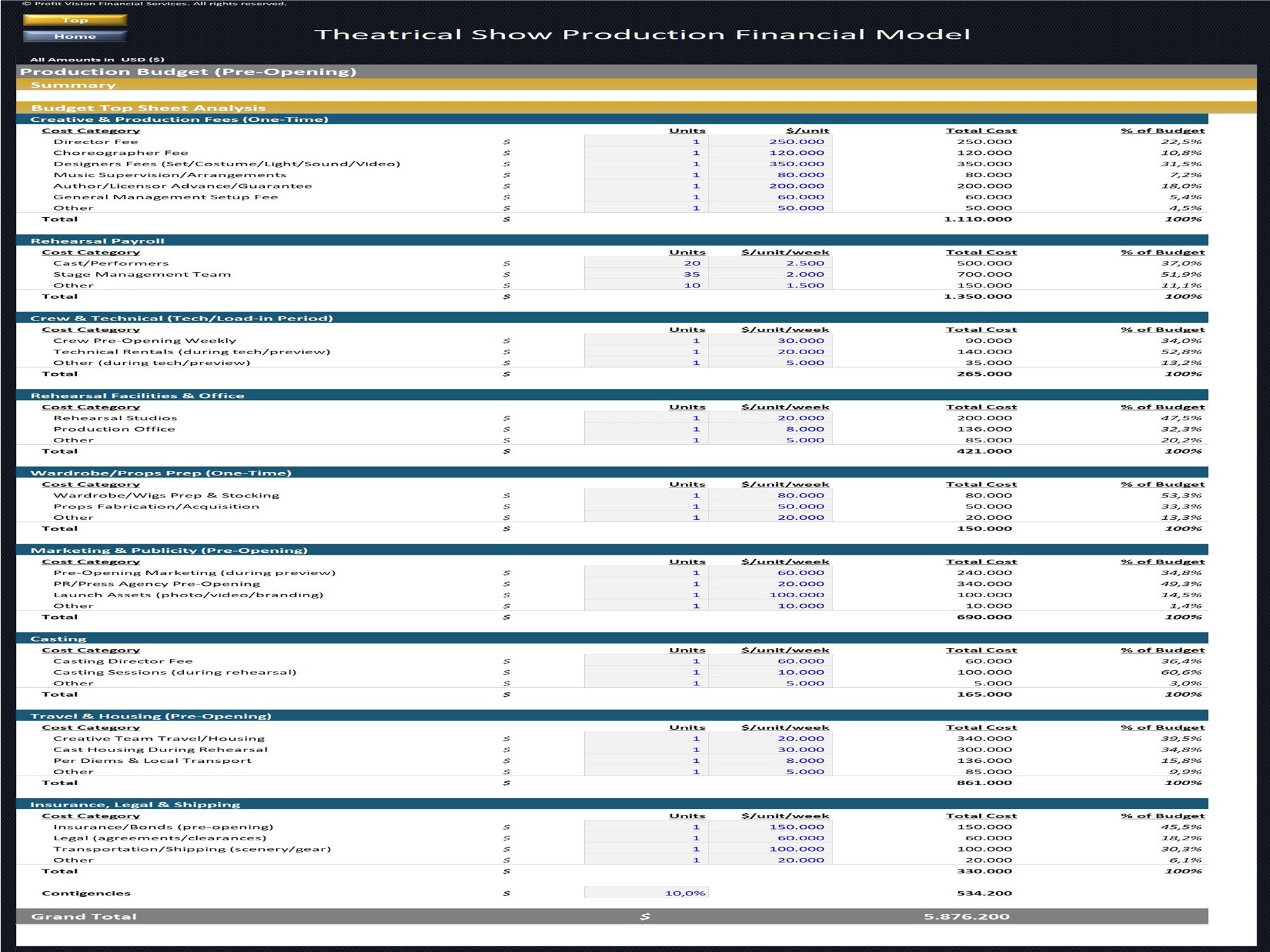
Show's pre-opening production Budget split into several (9) main categories, each including sub-categories allowing users to capture all costs of the production. The total amount of the Production Cost is the basis for calculating Investor’s Equity Contributions (based on Equity Financing %)
Weekly Revenue
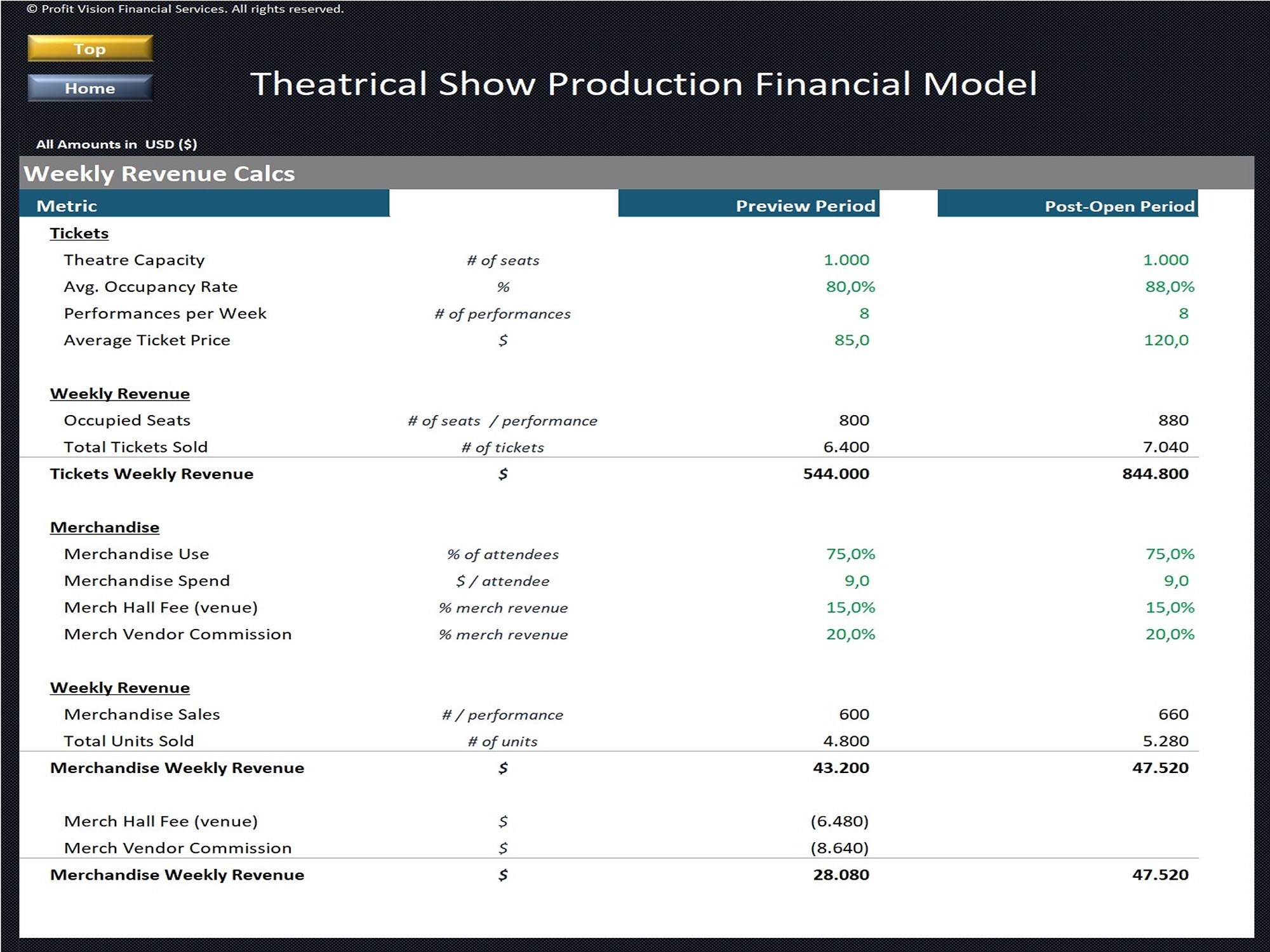
Supporting calculations of Box Office Revenue sources (tickets and merchandise) for the Preview and Post-Open Period. Calculations are based on theatre's capacity, occupancy rates, weekly performances and related prices for each source.
Show Cash Flow
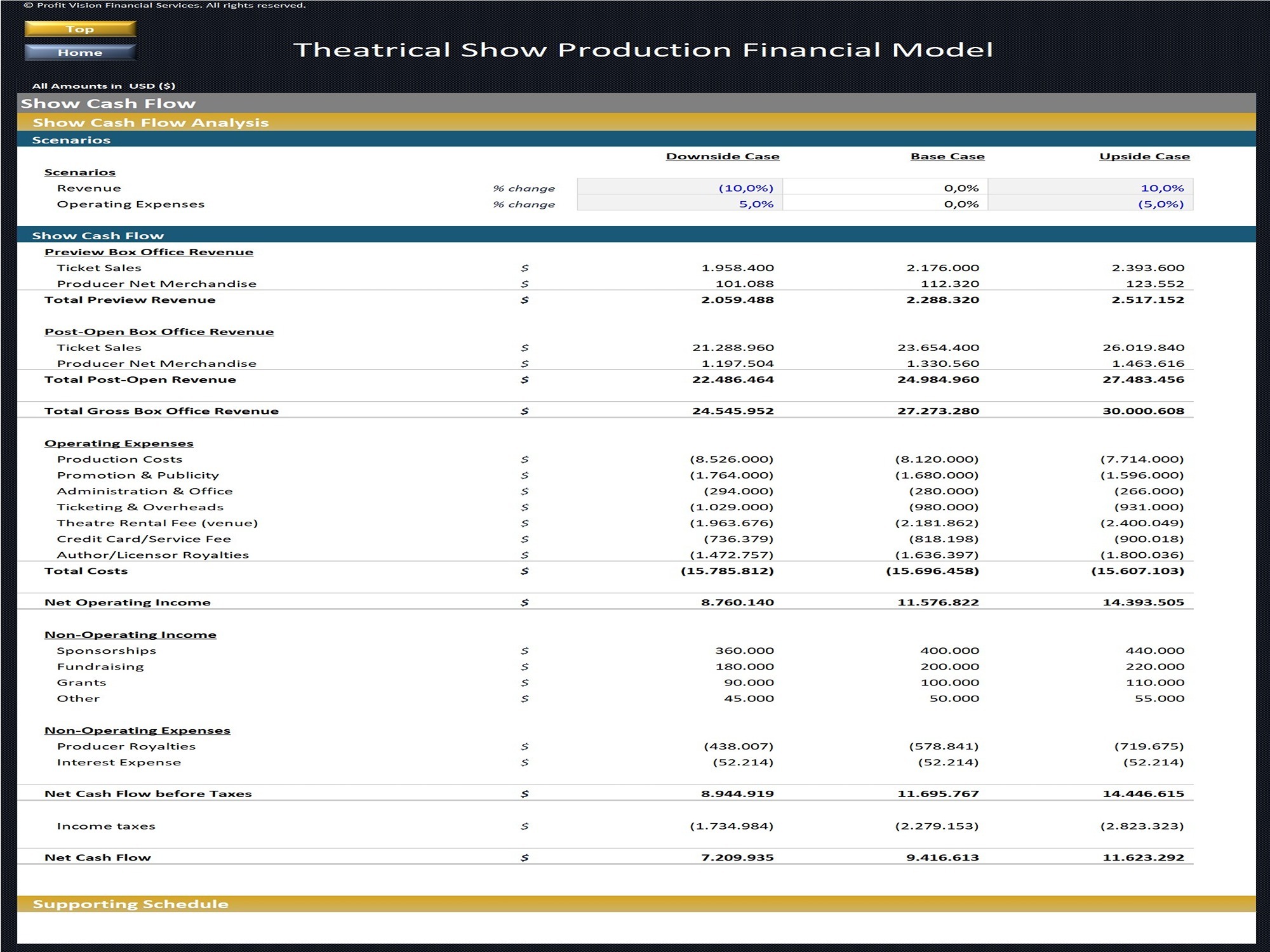
Show's Cash Flow analysis, starting from Gross revenue and ending to Net Cash Flow after taxes. The analysis provides a Base, Downside, and Upside Scenario, enabling users to check the profitability of the Show under three different cases.
Investors Summary
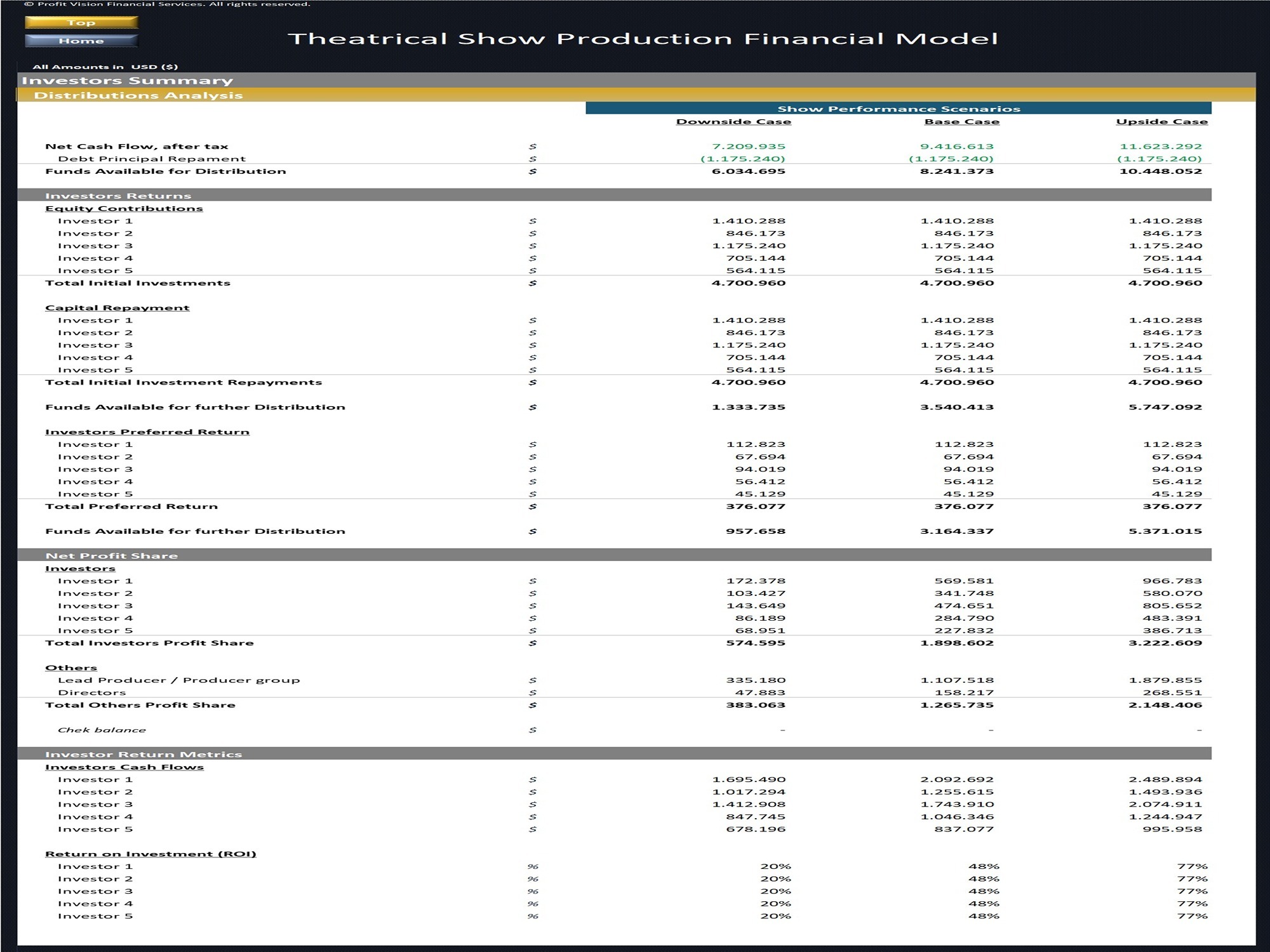
The model calculates first the Net Distributable Cash Flow of the Production Company after deducting Debt Service Costs. The Distributable Cash Flow is then used from the Production Company to repay Investors’ Capital and Preferred Returns, and the remaining available funds are distributed to Profit Share Beneficiaries according to the Profit Share % set by the user in the Main Assumptions tab.
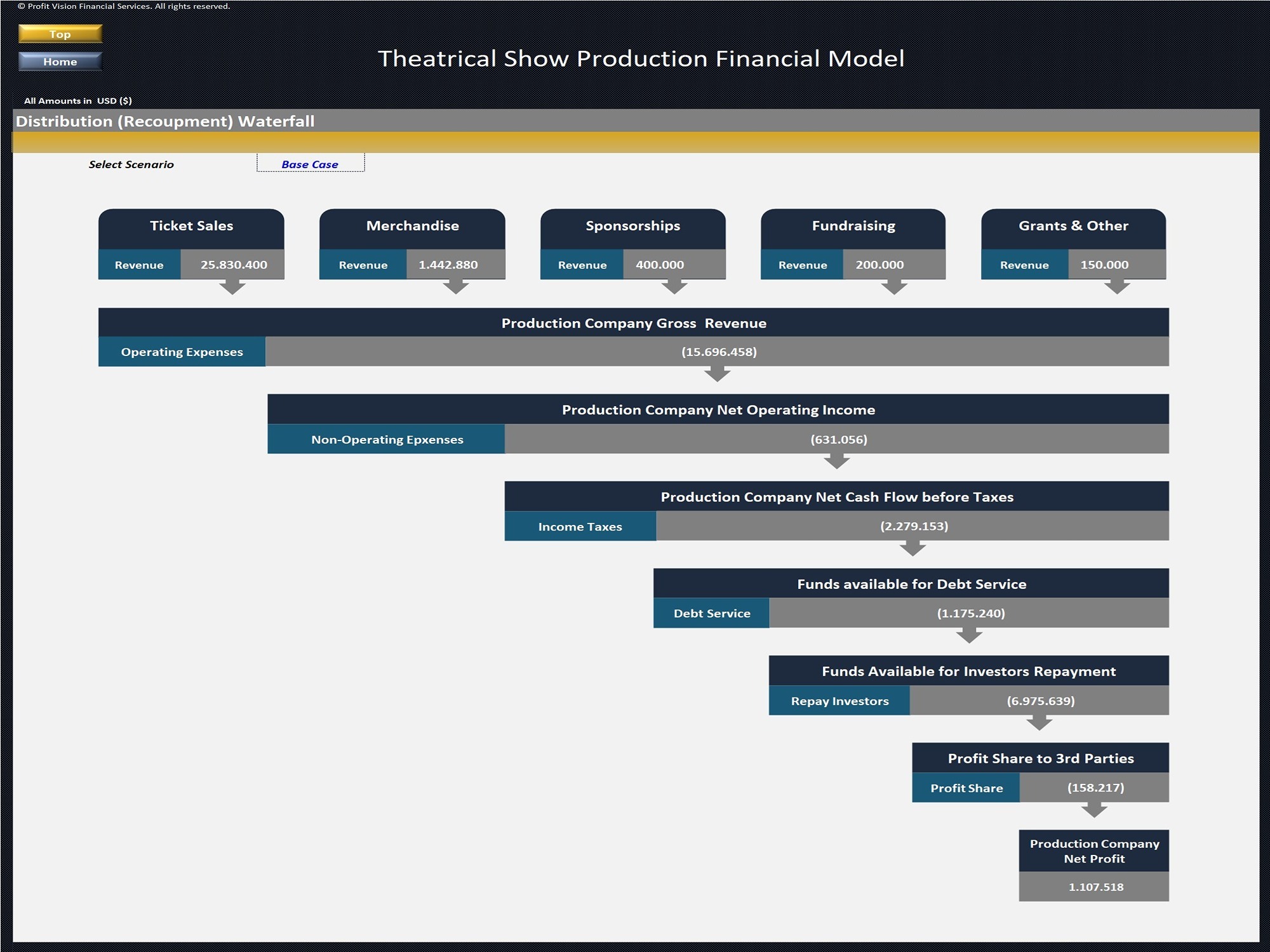
Distribution (Recoupment) Waterfall Chart
The way a show’s income is collected and distributed is known as the Recoupment Waterfall.
Income comes in from a variety of sources, and the money is then handed back to the showmakers.
Showmakers then pay all show related expenses, as well as other obligations (interest, taxes, etc.)
What’s left is the cash available for distributions and other parties.
The final part of the waterfall is when the remaining money needs to be divided. Typically, the investors are first repaid in full. The remaining available funds are finally split between the Investors’ Pool (profit share for the investors) and the Producers’ Pool (profit share for certain members of cast and crew ) based on the Profit Share agreement contract.
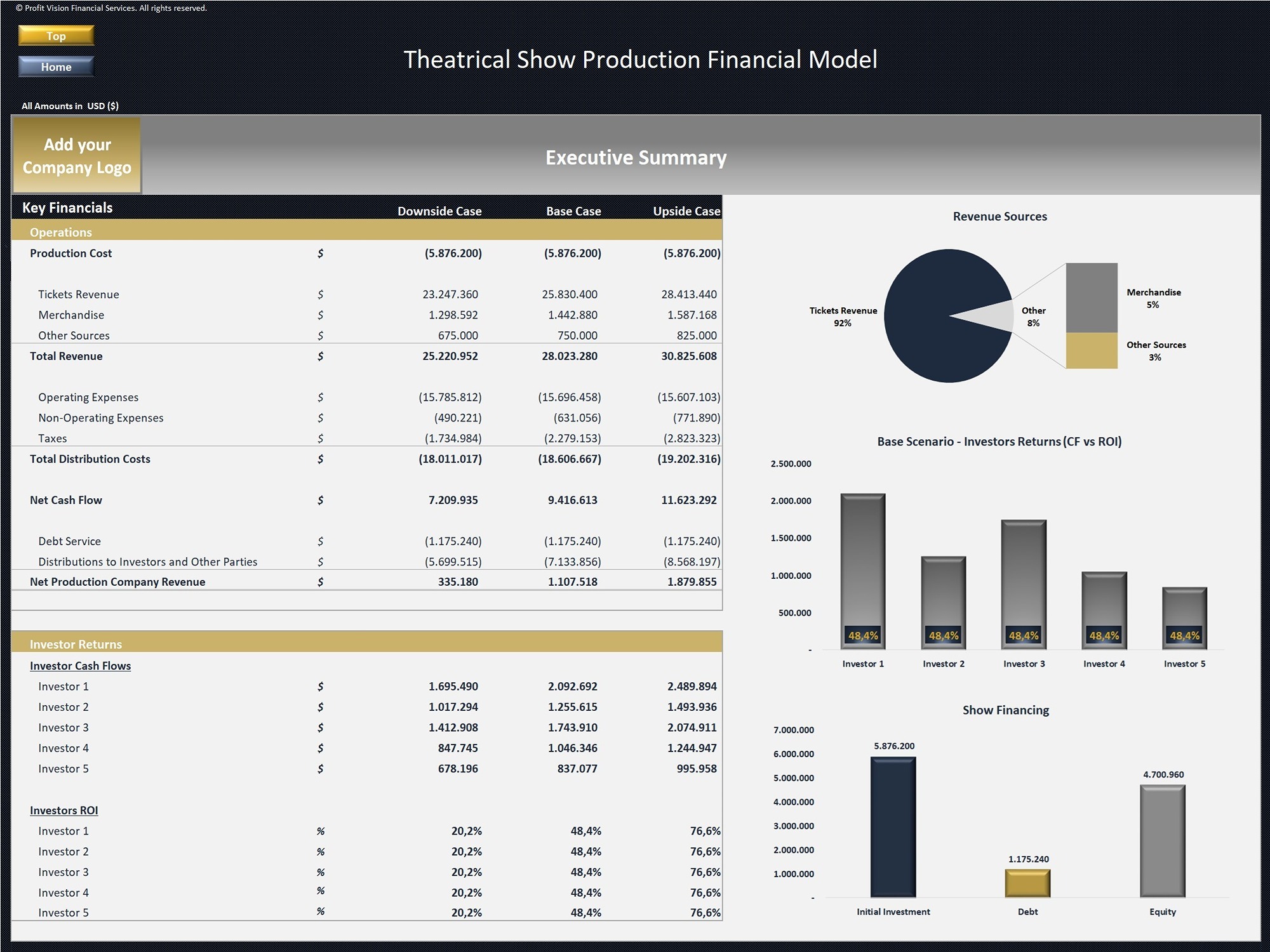
Executive Summary
A summary of the project’s performance, including key financial figures under the three scenarios, Investors’ Cash Flows and ROI, and several charts.
Help & Support
Committed to high quality and customer satisfaction, all our templates follow best-practice financial modeling principles and are thoughtfully and carefully designed, keeping the user’s needs and comfort in mind.
Whether you have no experience or are well-versed in finance, accounting, and the use of Microsoft Excel, our professional financial models are the right tools to boost your business operations!
If you experience any difficulty while using this template and cannot find the appropriate guidance in the provided instructions, please feel free to contact us for assistance.
If you need a template customized for your business requirements, please e-mail us and provide a brief explanation of your specific needs.
A theatrical show production involves bringing a live performance to life through coordinated work across writing, directing, casting, staging, and technical design. It includes developing the script, selecting actors, building sets, designing lighting and sound, and managing rehearsals to ensure a polished performance. Production teams handle logistics, budgeting, marketing, and venue coordination. The goal is to create an engaging, seamless experience that connects with audiences through storytelling, performance, and visual impact.
Theatrical Show production consists of below major phases:
- Concept & Rights Acquisition: This is where the initial idea for the show is formed and the legal rights to produce it are secured.
- Script / Material Development: The writers and creative team develop and refine the script, score, and lyrics through drafts, readings, and workshops.
- Financing & Producing Setup: The producer builds the budget, raises funds, forms the production company, and defines the basic business plan.
- Pre-Production: The creative team is assembled, designs are created, casting is completed, the venue is booked, and marketing is planned.
- Rehearsals: Cast and creative team work in a rehearsal space to block scenes, learn music and choreography, and shape performances.
- Technical Rehearsals (“Tech”): The production moves into the theatre to integrate sets, lights, sound, costumes, and all technical elements with the performance.
- Previews: The show is performed for paying audiences while the creative team observes reactions and makes final adjustments.
- Opening Night: The official premiere performance takes place, critics attend, reviews are published, and the show is considered “frozen.”
- Performance Run: The show plays its regular schedule with ongoing marketing, maintenance, and cast or crew changes as needed.
- Closing, Strike & Post-Production: The final performance is given, the set and equipment are removed or stored, accounts are settled, and future plans (tour, transfer, licensing) are decided.
Model Structure:
Main Assumptions
General Project Assumptions including Pre-opening and Post-opening timing Assumptions (rehearsal period, preview period, post-open period, weekly performances), Revenue Sources (tickets, merchandise, sponsorships, fundraising, etc), Post-opning costs (production, marketing, venue rental fees, royalties, etc.), Film Financing (Equity & Debt), Investors Equity (Units) Contributions, Profit Share Assumptions (Investors’ and Producer’s Pool)
Production Budget
Show's pre-opening production Budget split into several (9) main categories, each including sub-categories allowing users to capture all costs of the production. The total amount of the Production Cost is the basis for calculating Investor’s Equity Contributions (based on Equity Financing %)
Weekly Revenue
Supporting calculations of Box Office Revenue sources (tickets and merchandise) for the Preview and Post-Open Period. Calculations are based on theatre's capacity, occupancy rates, weekly performances and related prices for each source.
Show Cash Flow
Show's Cash Flow analysis, starting from Gross revenue and ending to Net Cash Flow after taxes. The analysis provides a Base, Downside, and Upside Scenario, enabling users to check the profitability of the Show under three different cases.
Investors Summary
The model calculates first the Net Distributable Cash Flow of the Production Company after deducting Debt Service Costs. The Distributable Cash Flow is then used from the Production Company to repay Investors’ Capital and Preferred Returns, and the remaining available funds are distributed to Profit Share Beneficiaries according to the Profit Share % set by the user in the Main Assumptions tab.
Distribution (Recoupment) Waterfall Chart
The way a show’s income is collected and distributed is known as the Recoupment Waterfall.
Income comes in from a variety of sources, and the money is then handed back to the showmakers.
Showmakers then pay all show related expenses, as well as other obligations (interest, taxes, etc.)
What’s left is the cash available for distributions and other parties.
The final part of the waterfall is when the remaining money needs to be divided. Typically, the investors are first repaid in full. The remaining available funds are finally split between the Investors’ Pool (profit share for the investors) and the Producers’ Pool (profit share for certain members of cast and crew ) based on the Profit Share agreement contract.
Executive Summary
A summary of the project’s performance, including key financial figures under the three scenarios, Investors’ Cash Flows and ROI, and several charts.
Help & Support
Committed to high quality and customer satisfaction, all our templates follow best-practice financial modeling principles and are thoughtfully and carefully designed, keeping the user’s needs and comfort in mind.
Whether you have no experience or are well-versed in finance, accounting, and the use of Microsoft Excel, our professional financial models are the right tools to boost your business operations!
If you experience any difficulty while using this template and cannot find the appropriate guidance in the provided instructions, please feel free to contact us for assistance.
If you need a template customized for your business requirements, please e-mail us and provide a brief explanation of your specific needs.
This Best Practice includes
Excel Financial Model
Further information
Provides a forecast of show's revenues, costs, cash flows, and investor returns over its life in order to assess viability, optimize budgeting, and support informed investment decisions.