Procurement Savings Methodology and Benefits Tracking — Six Benefit Types, Baselining Tree, P&L Linkage
Originally published: 31/08/2026 11:36
Publication number: ELQ-75406-1
View all versions & Certificate
certified

Procurement Savings Methodology and Benefits Tracking — Six Benefit Types, Baselining Tree, P&L Linkage

Settle the argument with finance about what counts as a saving, before you claim anything.

Description
Procurement functions lose credibility in one specific way. They claim a number, finance cannot find it in the budget, and every subsequent claim is discounted for years.

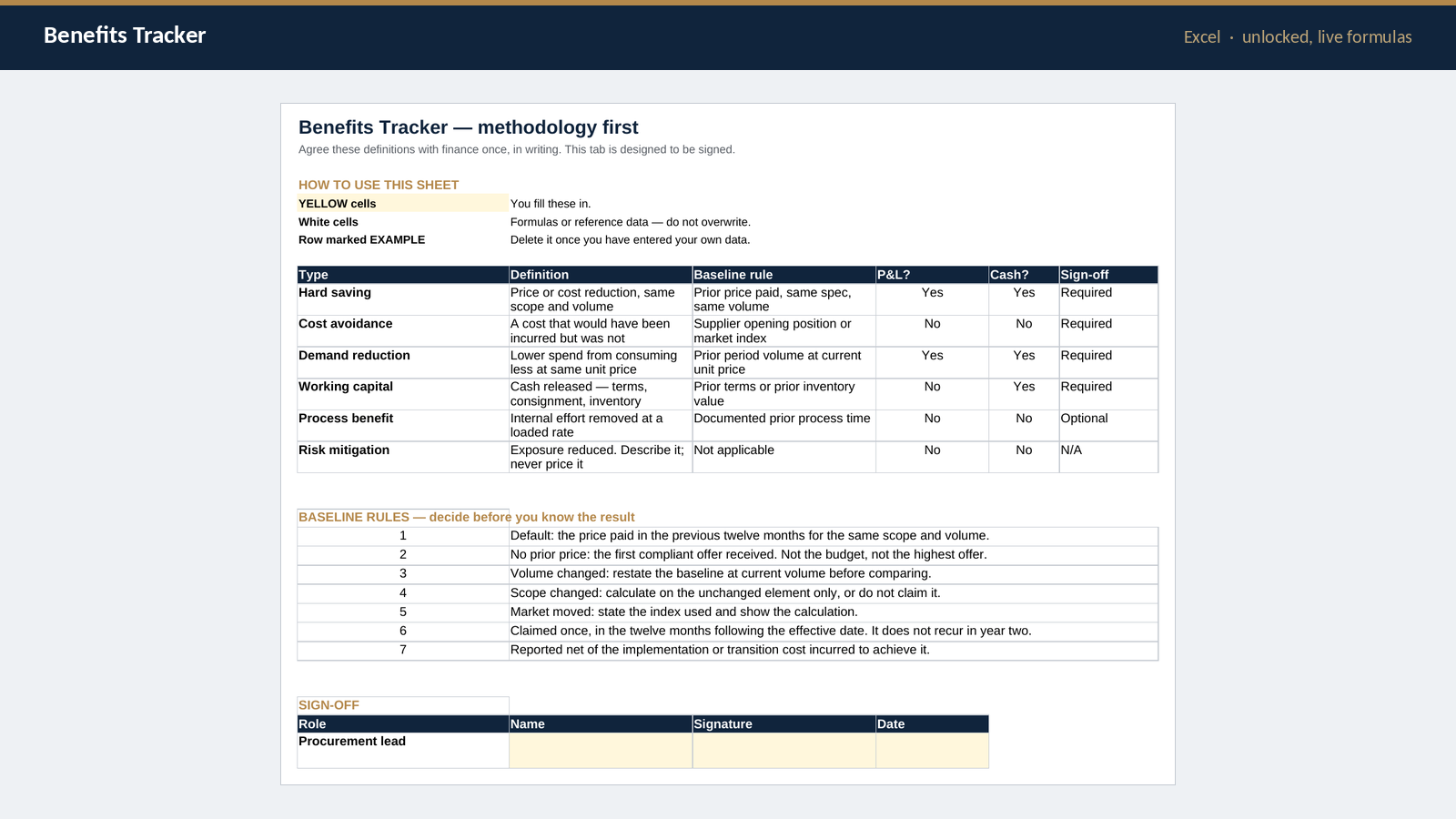
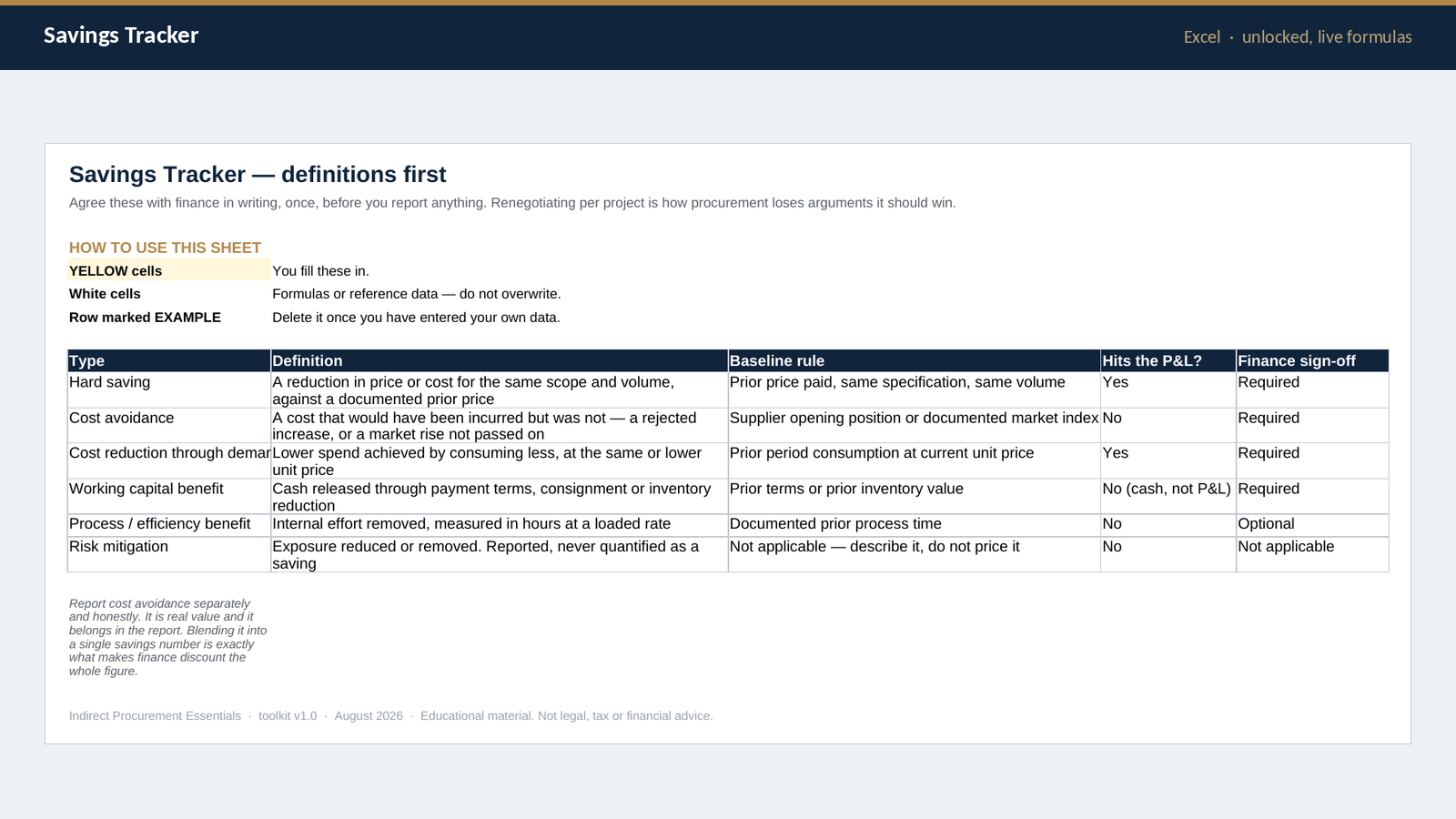
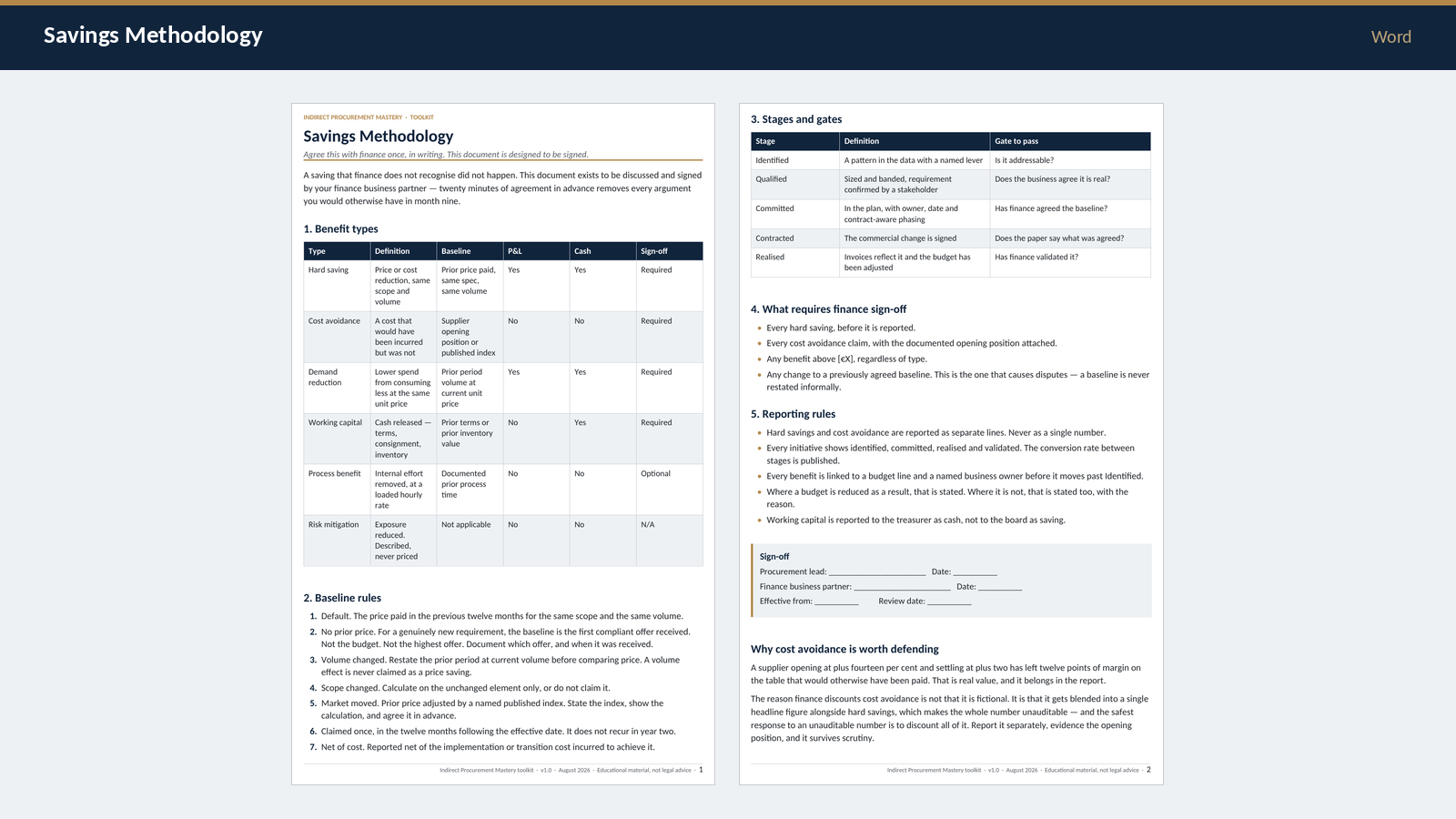
This toolkit is the conversation that prevents that, held in advance and written down. It defines six benefit types — hard savings, cost avoidance, demand reduction, working capital, process efficiency and risk mitigation — states how each is calculated, and states plainly which ones will and will not appear in the P&L.

The baselining decision tree handles the cases that are genuinely hard rather than the easy ones: no prior contract, volume changed, specification changed, market index moved, one-off purchase, first-time buy. Each has a defined path and a defensible answer.

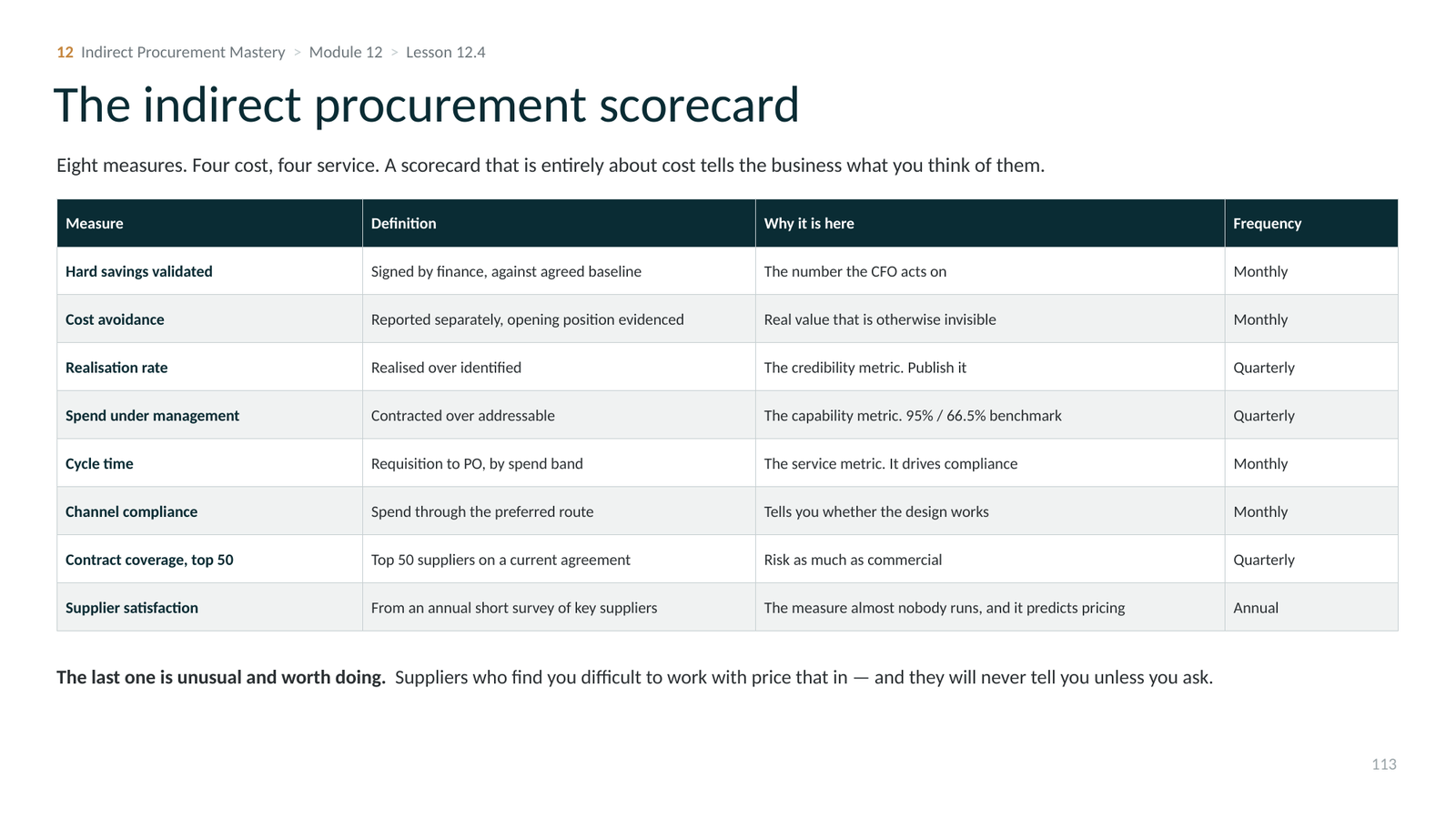
The trackers link initiative-level benefit to the period it lands in, separate run-rate from in-year, and carry the baseline method on every line so that validation is a check rather than an argument. The scorecard reports procurement performance on more than savings, which is what protects the function in a year when savings are structurally hard to find.

Who it is for: procurement leads who have to agree a savings methodology with finance, category managers whose numbers get challenged, and finance business partners who validate them. The value is in having the argument once, in writing, before the first claim rather than after it.

What it is not: it is not an accounting standard and it cannot tell you what your finance function will accept. It gives you a defensible position for each of the genuinely hard cases and the language to present it. The one thing it will not do is make a cost avoidance look like a hard saving, and that restraint is the entire point of the method.

This Best Practice includes
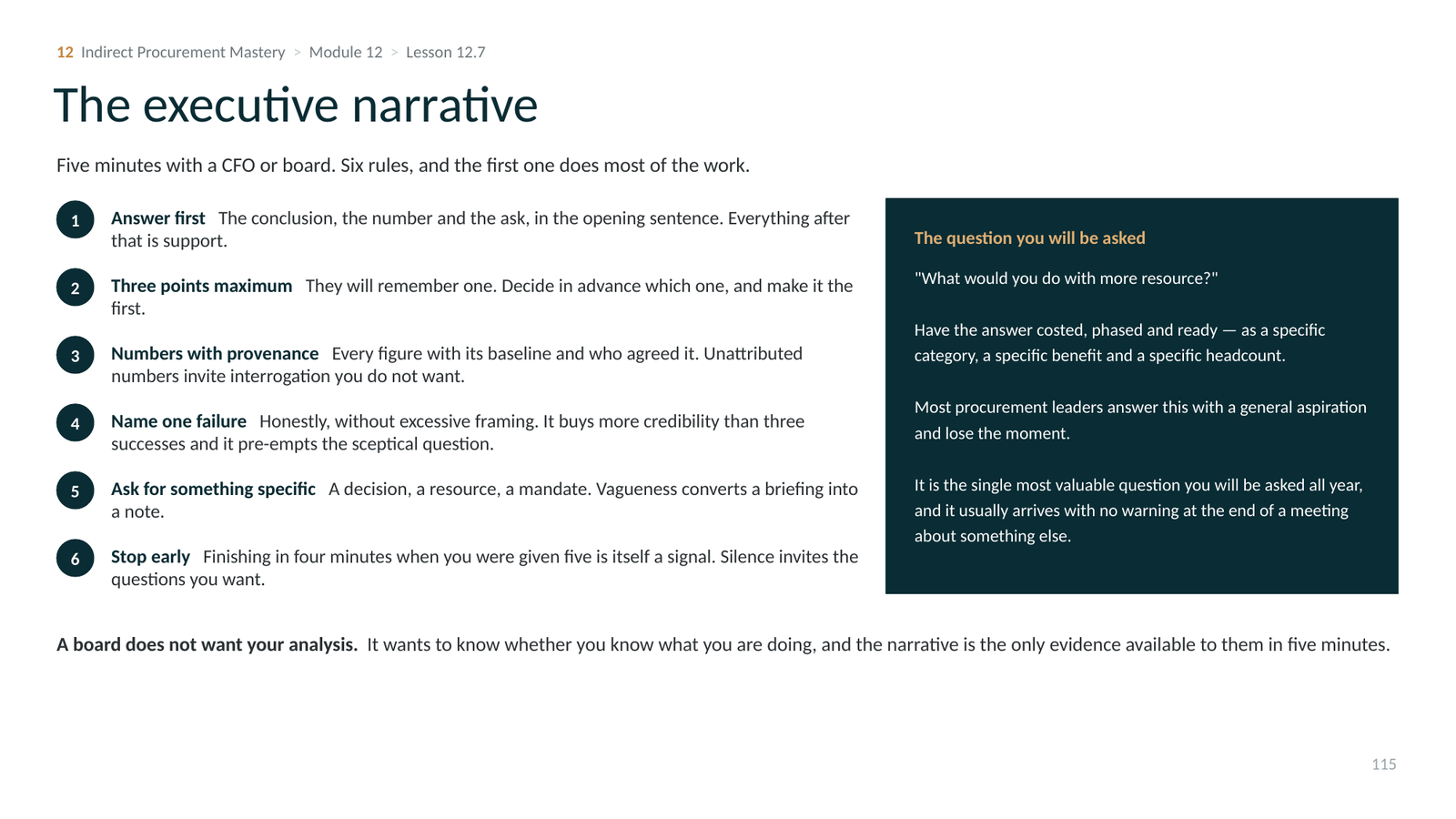
1 PowerPoint guide (11 slides), 3 Excel trackers, 3 Word method documents. Unlocked, live formulas.

Acquire business license for $49.00

Add to cart

Add to bookmarks

Discuss

Further information

• Agree six benefit definitions with finance before any number is announced.
• Resolve ambiguous baselines with a defined decision path rather than case-by-case negotiation.
• Track benefit by type, with run-rate and in-year reported separately.
• Report procurement performance on more than a single savings figure.

• You report savings to a finance function and want the number to be believed.
• You are setting up benefits tracking for the first time, or rebuilding after a dispute.
• You need a written methodology a CFO can sign.

• Your organisation already has an agreed, enforced savings methodology you are happy with.
• You want benchmark savings percentages by category; none are included.
• You need an integrated benefits module inside an S2P platform rather than workbook models.


0.0 / 5 (0 votes)

please wait...