The Twelve Procurement KPIs
Originally published: 14/09/2026 09:07
Publication number: ELQ-43720-1
View all versions & Certificate
certified

The Twelve Procurement KPIs

Twelve procurement measures, defined precisely and how each one gets gamed.

Description
A KPI without a measurement method is not a measure. It is an argument, scheduled for the next review meeting.

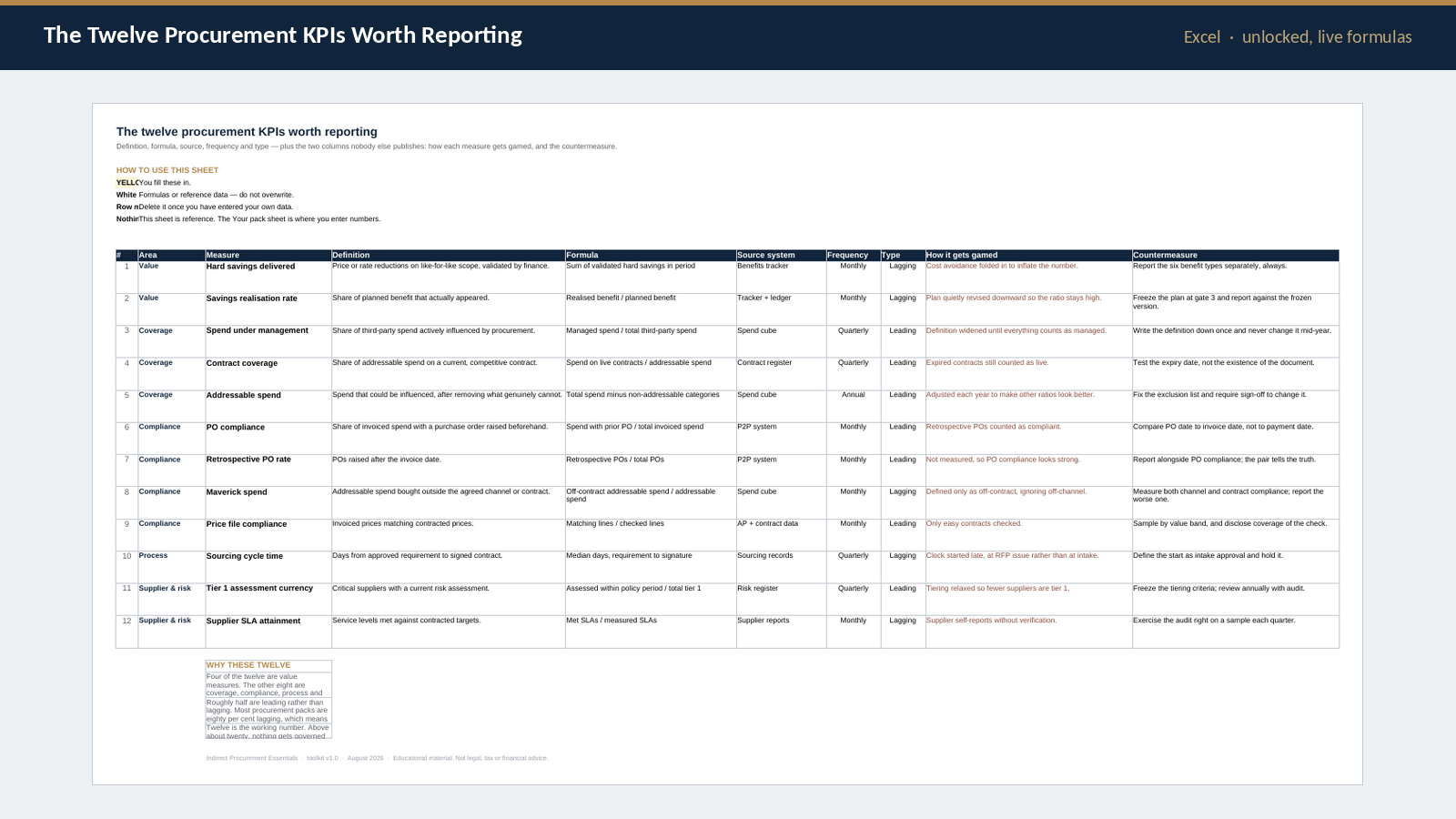
Most procurement KPI material lists metrics, which is the easy part. This file gives you twelve measures written out to the level of precision that ends the argument: the exact definition, the formula, the source system, the frequency, and whether the measure leads or lags.

It also does something no other KPI material does. Every one of the twelve carries a gaming risk and a countermeasure. Spend under management, with the definition quietly widened until everything counts as managed. PO compliance, with retrospective orders counted as compliant. Price file compliance, checked only on the easy contracts. Savings realisation rate, held high by revising the plan downward. None of these require anyone to state a falsehood, which is exactly why they are so common — and why naming them in your own documentation earns trust from finance rather than inviting doubt.

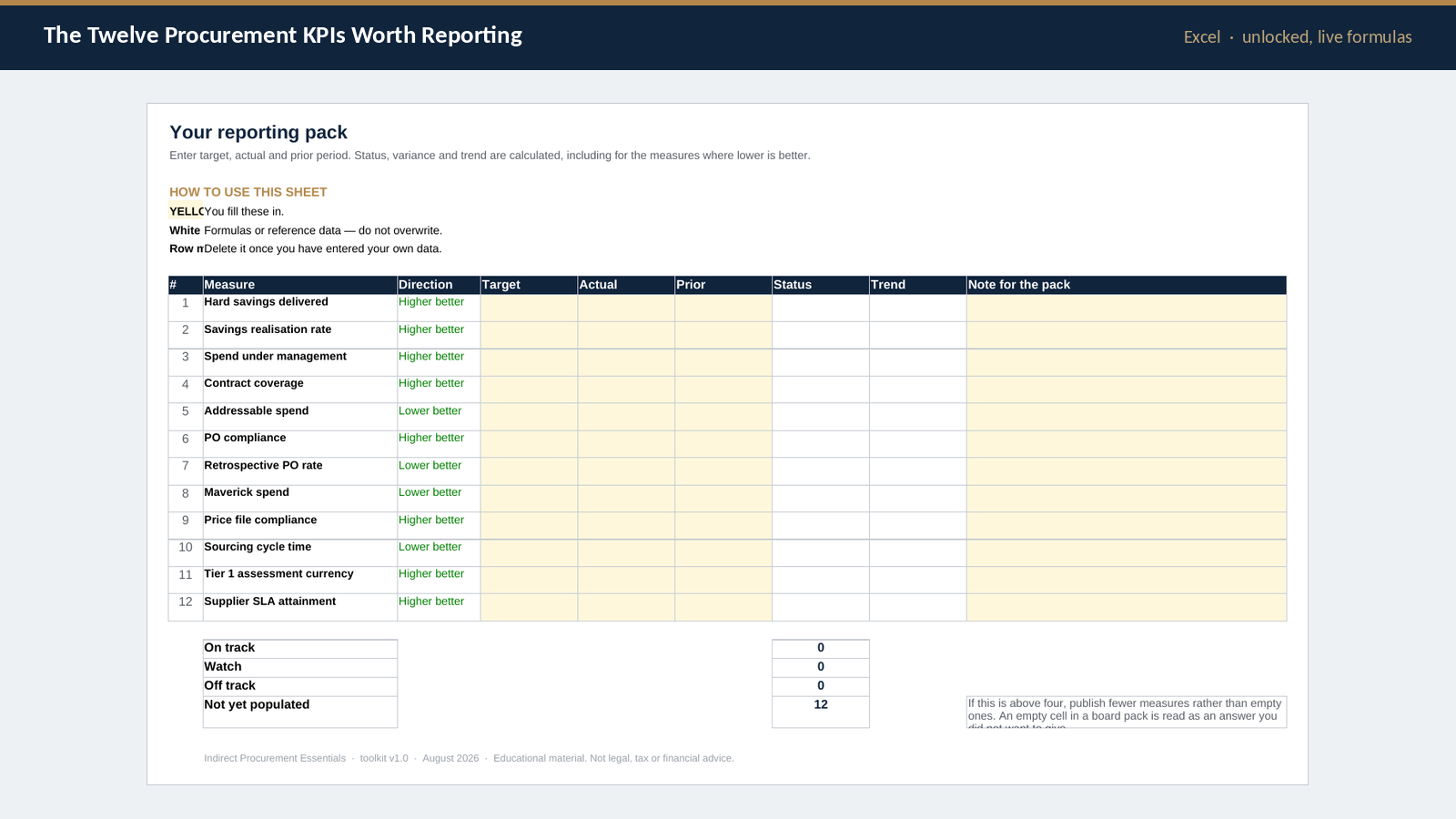
The second sheet is a working reporting pack. Enter target, actual and prior period, and status, variance and trend calculate themselves, handling correctly the measures where lower is better. It counts the measures you have left blank, deliberately: an empty cell in a board pack is read as an answer you did not want to give, and it is better to publish eight measures you can source honestly than twelve where four are estimates.

Four of the twelve are value measures and eight are coverage, compliance, process and risk. That balance is intentional. A pack that reports only savings invites a difficult question in the year when savings are structurally hard to find.
Free, unlocked, no password.

This Best Practice includes
1 Excel file, 2 sheets plus read me and licence. Unlocked, live formulas. Free.

Davide Sferrazza offers you this Best Practice for free!

download for free

Add to bookmarks

Discuss

Further information

- Publish twelve precise definitions so that no procurement measure is renegotiated mid-year.
- Report a balanced pack rather than a savings-only one, with roughly half the measures leading.
- Name how each measure gets manipulated, in your own documentation, before anyone else raises it.
- Establish honestly which measures you can source today and which need the data fixing first.

- You are building or rebuilding a procurement reporting pack.
- Your numbers get challenged by finance and you want the definition agreed once, in writing.
- You are new in role and need a defensible starting set rather than the pack you inherited.

- You want benchmark target values. There are none here: the correct target is your own baseline plus a movement you can defend.
- You need the full library. This is twelve measures; the paid library carries sixty, with a cascade model and a definition handbook.
- You have not yet agreed a savings methodology with finance. Do that first — two of these twelve depend on it.


0.0 / 5 (0 votes)

please wait...