Supplier Margin Estimator from Published Accounts — Gross and Operating Margin, and What Your Ask Would Do
Originally published: 14/09/2026 09:12
Publication number: ELQ-80557-1
View all versions & Certificate
certified

Supplier Margin Estimator from Published Accounts — Gross and Operating Margin, and What Your Ask Would Do

Estimate the room in a supplier price from accounts they have already filed.

Description
Negotiations run on assertion until somebody introduces a fact. This model introduces one, from a source the supplier cannot dispute: their own filed accounts.

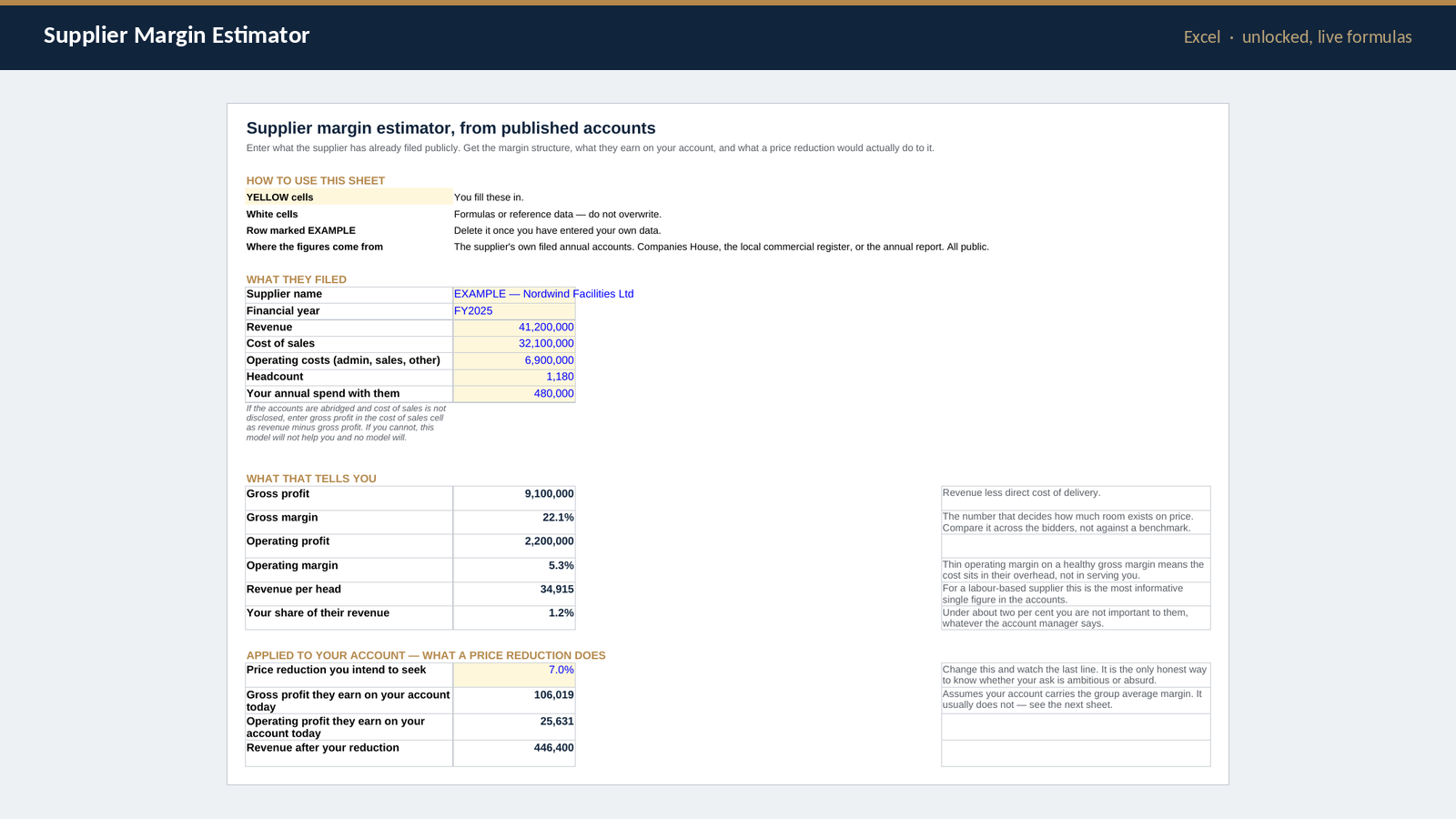
Enter revenue, cost of sales, operating costs, headcount and your annual spend, all of which are public for most incorporated suppliers. The model returns gross margin, operating margin, revenue per head and your share of their revenue. It then applies the group margin to your own spend to estimate what they earn on your account, and models what the reduction you intend to seek would do to that margin — including the reduction at which it reaches zero.

The worked example shows why this matters. A supplier filing a twenty-two per cent gross margin and a five per cent operating margin can absorb a seven per cent price reduction on gross, but it takes the operating margin on that account below zero. Knowing that before you open your mouth is the difference between an ambitious ask and an absurd one.

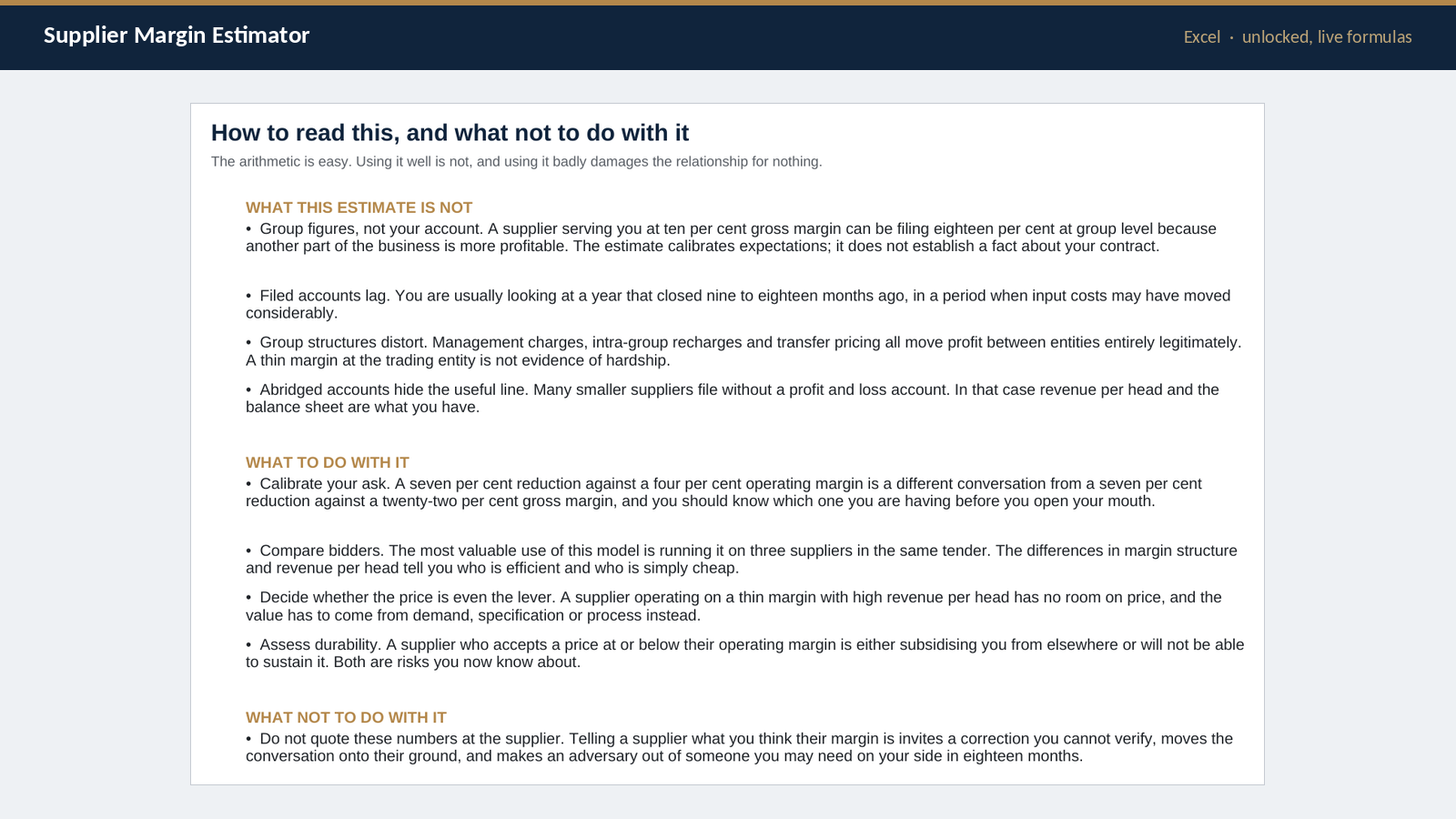
A full sheet is devoted to reading the result honestly, because the arithmetic is easy and using it well is not. Filed accounts are group level, not account level. They lag by nine to eighteen months. Intra-group recharges and transfer pricing move profit legitimately between entities. Abridged accounts hide the useful line entirely. All four limitations are stated, because a finance business partner will find them in four minutes and it is better if you found them first.

The same sheet states plainly what not to do: never quote these numbers at the supplier. It invites a correction you cannot verify and makes an adversary of someone you may need in eighteen months. The model is for calibrating your own ask, and for comparing three bidders in the same tender — which is where it is most valuable.

This Best Practice includes
1 Excel file, 2 sheets plus read me and licence. Unlocked, live formulas, one worked example.

Acquire business license for $25.00

Add to cart

Add to bookmarks

Discuss

Further information

• Calibrate a price reduction against what the supplier can plausibly absorb, from public evidence.
• Compare bidders in the same tender on margin structure and revenue per head, not just on price.
• Decide whether price is even the right lever, or whether the value has to come from demand and specification.
• Assess whether a price a supplier has accepted is durable, or will come back through scope and variation.

• You are preparing a negotiation with an incorporated supplier who files accounts publicly.
• You are comparing several bidders and want to understand who is efficient rather than merely cheap.
• You need to sense-check a reduction target somebody else has set for you.

• The supplier is a subsidiary reporting only at group level, or files fully abridged accounts.
• You want a credit or financial health assessment. This says nothing about solvency or going concern.
• You want industry margin benchmarks. None are included, because a fabricated benchmark is worse than none.


0.0 / 5 (0 votes)

please wait...