Payment Terms and Working Capital Calculator — Value of Extending Terms, Cost to the Supplier, Break-Even Price
Originally published: 14/09/2026 09:12
Publication number: ELQ-22362-1
View all versions & Certificate
certified

Payment Terms and Working Capital Calculator — Value of Extending Terms, Cost to the Supplier, Break-Even Price

What extending terms is worth, and the most you should concede to get it.

Description
Payment terms are the most frequently requested and least frequently valued concession in procurement. A target arrives from treasury, the category manager asks every supplier for sixty days, and nobody establishes what the request is worth or what it costs the person being asked. The cost comes back later, in the unit price, where it is invisible.

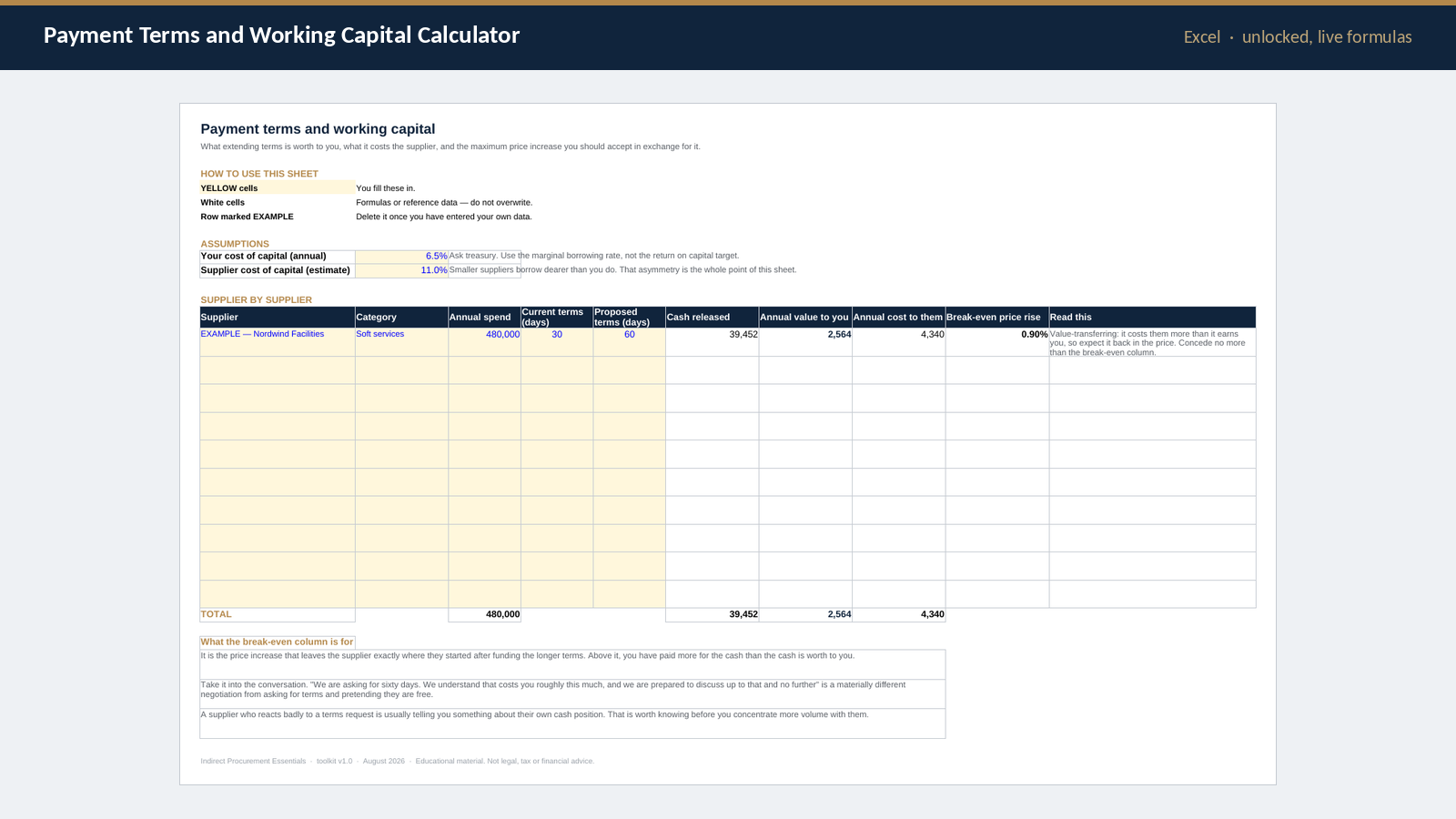
This model prices both sides. Enter your annual spend, the current and proposed terms, and two cost of capital assumptions — yours and an estimate of the supplier's. It calculates the cash released, what that cash is worth to you annually, and what funding it costs them.

Then it produces the number that should govern the conversation: the break-even price rise. That is the increase which leaves the supplier exactly where they started after funding the longer terms. Above it, you have paid more for the cash than the cash is worth to you. Below it, you have a genuine trade. Taking that number into the discussion changes its character entirely — "we are asking for sixty days, we understand roughly what that costs you, and we will discuss up to this and no further" is a materially different conversation from asking for terms and pretending they are free.

The model also flags when the trade transfers value rather than creating it. Where your capital is cheaper than theirs, extending terms is efficient. Where it is not — and with smaller private suppliers it usually is not — you are moving cost into the price, and the sheet says so plainly.

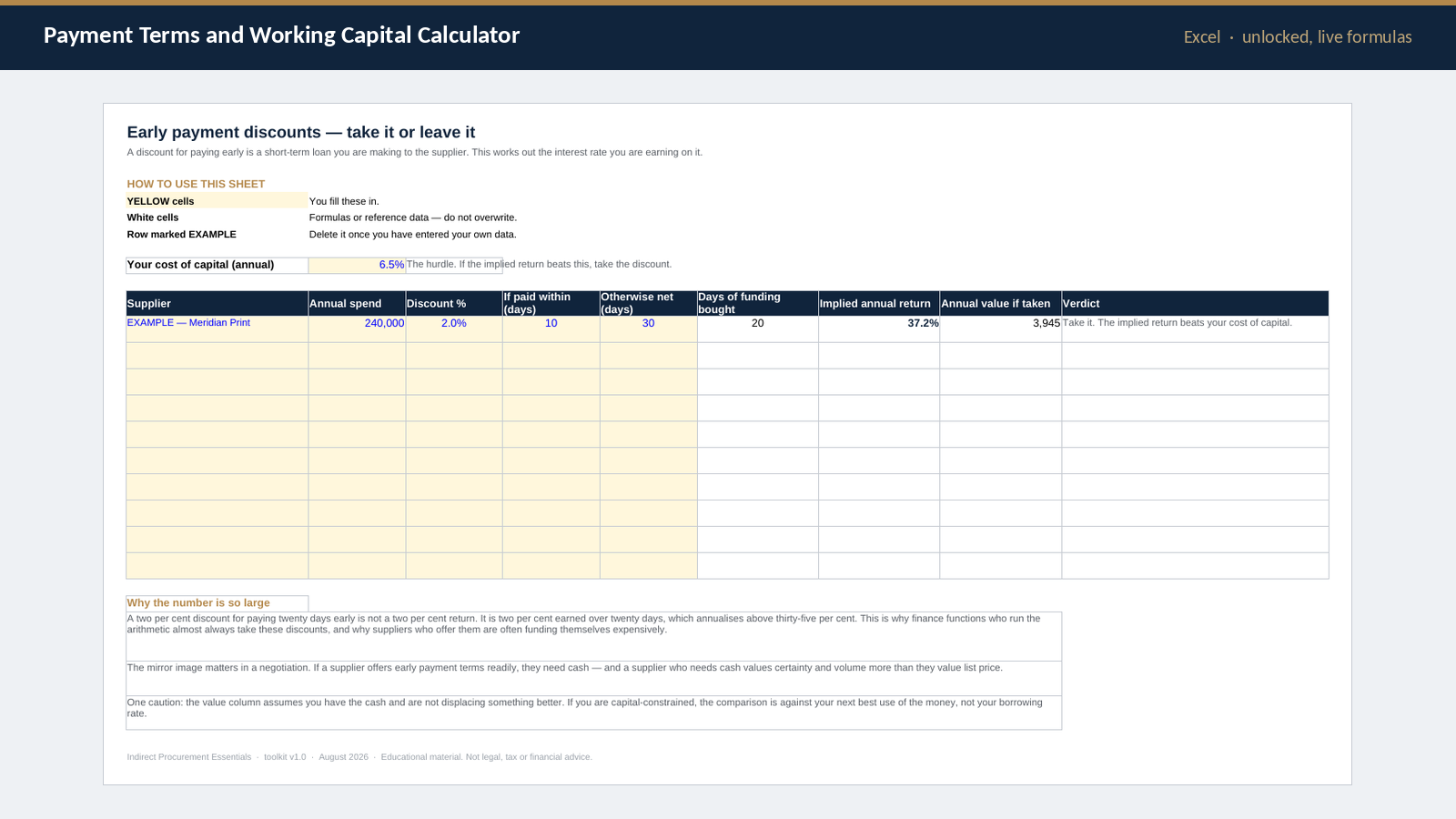
The second sheet handles the mirror image. An early payment discount is a short-term loan you are making, and two per cent for paying twenty days early annualises above thirty-seven per cent. The sheet calculates the implied return and compares it to your own cost of capital.

This Best Practice includes
1 Excel file, 2 sheets plus read me and licence. Unlocked, live formulas, ten supplier rows each.

Acquire business license for $25.00

Add to cart

Add to bookmarks

Discuss

Further information

• Value a payment terms extension in money rather than in days.
• Establish the maximum price increase worth conceding in exchange for the terms, before opening the conversation.
• Distinguish trades that create value from trades that simply move cost into the unit price.
• Decide correctly whether to take an early payment discount, on the arithmetic rather than by policy.

• You have a working capital or days-payable target and a list of suppliers to approach.
• A supplier has asked for shorter terms, or offered an early payment discount, and you need to price it.
• You want to arrive at the conversation with a defensible limit rather than an open ask.

• You need a treasury or group cash flow model. This values one lever on one relationship.
• You want an argument that longer terms are always right. Where your capital is dearer, the model says otherwise.
• You need legal guidance on late payment rules. Several jurisdictions cap what may be imposed on smaller suppliers.


0.0 / 5 (0 votes)

please wait...