Volume Commitment and Rebate Modeller — Expected Rebate, Breakage, and the Break-Even Volume on a Commitment
Originally published: 14/09/2026 09:12
Publication number: ELQ-92484-1
View all versions & Certificate
certified

Volume Commitment and Rebate Modeller — Expected Rebate, Breakage, and the Break-Even Volume on a Commitment

What the rebate will really pay, and what the commitment costs if volume slips.

Description
A tiered rebate is quoted at its top tier and earned at its expected tier. The difference is breakage, and the supplier priced the deal knowing you would land in it. A volume commitment is agreed on a forecast and paid for whether the forecast arrives or not. Both are common, both are announced internally at their headline number, and both are modelled far less often than they should be.

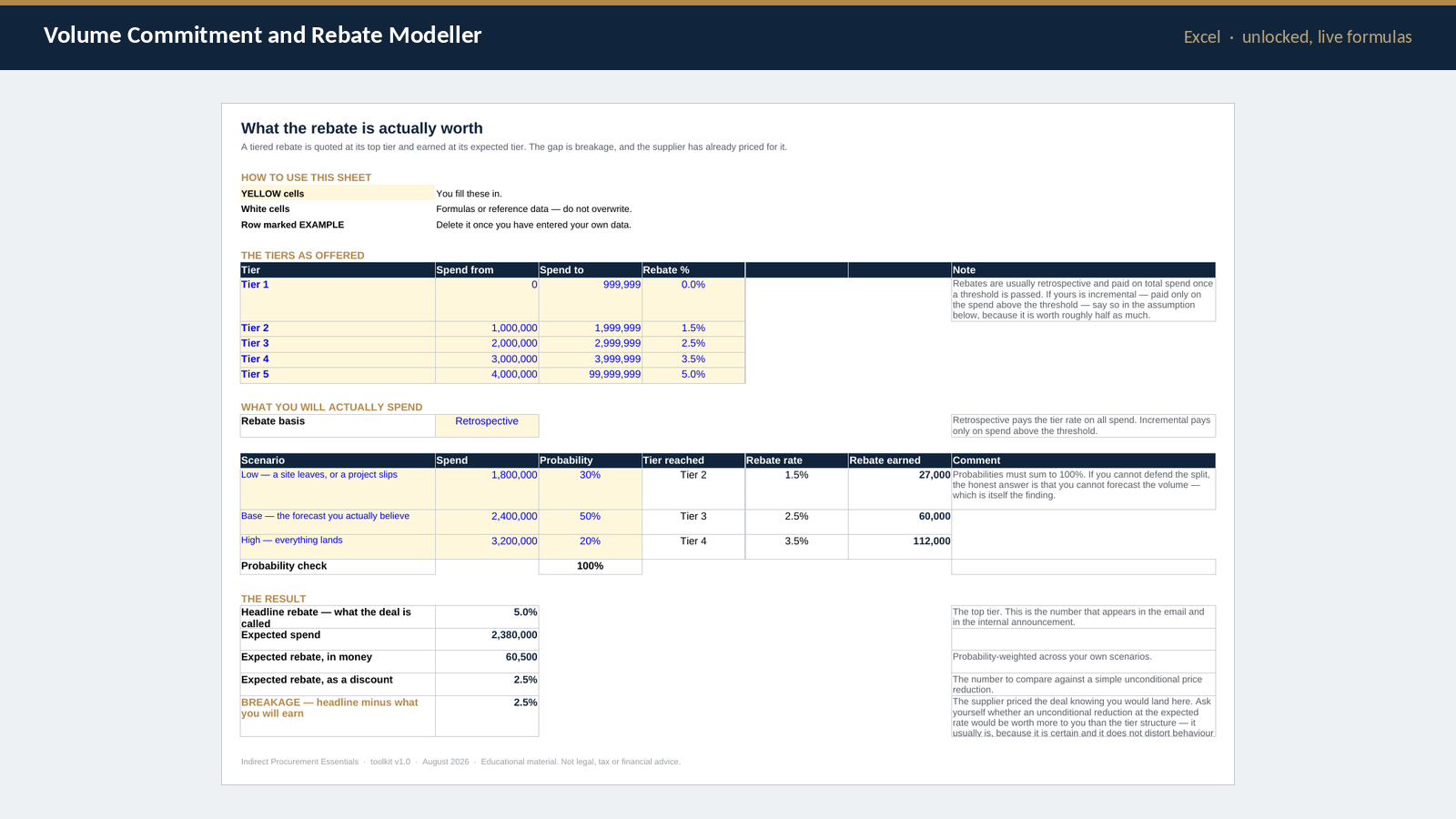
This file models them properly. On the rebate side, enter the tiers as offered, then three volume scenarios with the probabilities you actually believe rather than the ones in the business case. The model finds the tier each scenario reaches, calculates the rebate earned, and produces a probability-weighted expected rebate in money and as an effective discount. Breakage is stated explicitly: in the worked example, a headline five per cent becomes an expected 2.5 per cent.
That number is the one to compare against an unconditional price reduction. A smaller certain discount frequently beats a larger conditional one, because it is certain and because it does not distort behaviour at year end.

The model also handles retrospective and incremental rebate bases separately. The two are routinely confused, the schedule is often ambiguous about which applies, and one is worth roughly half the other.

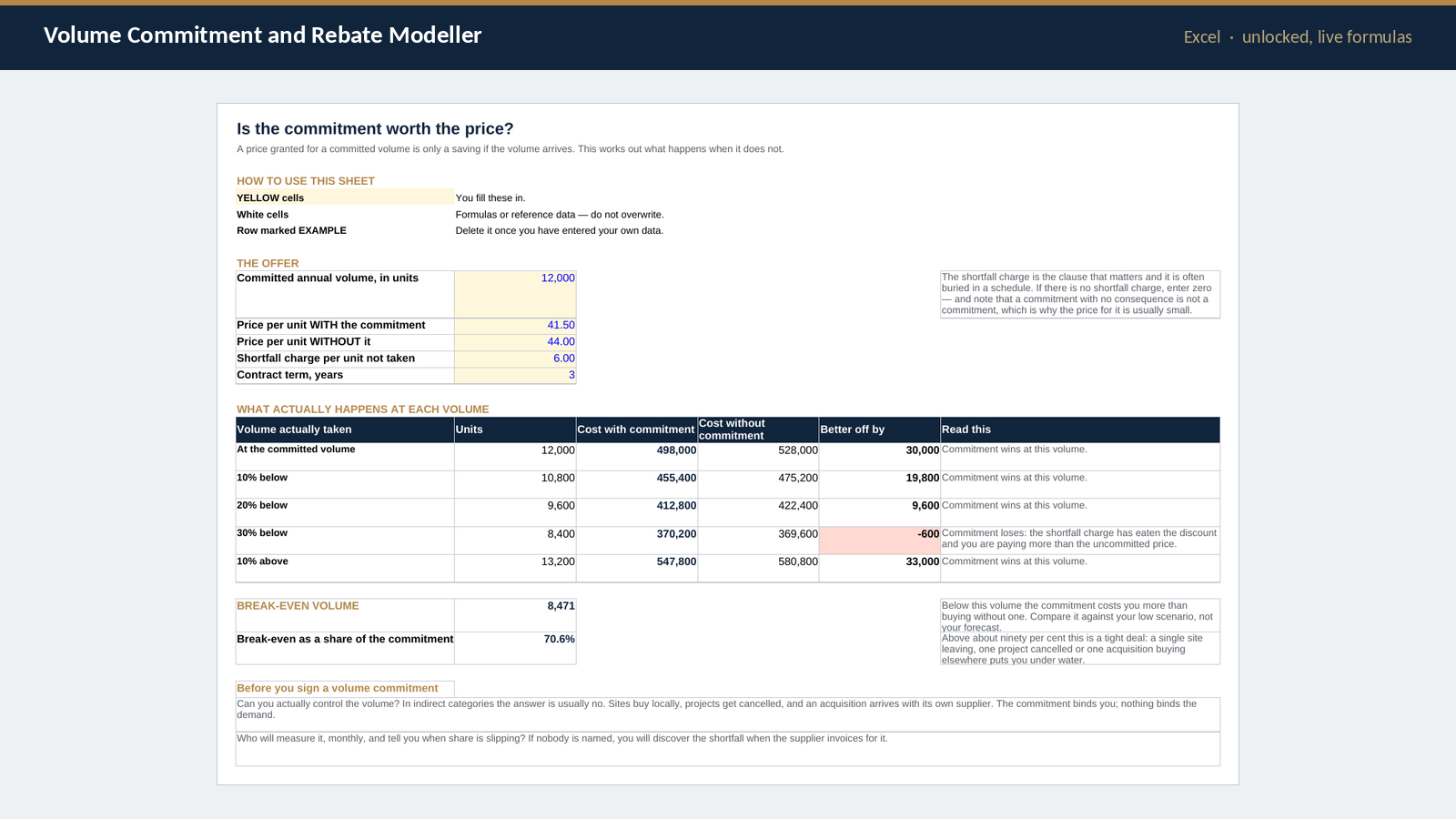
The commitment sheet works the same problem from the other side. Enter the price with and without the commitment and the shortfall charge, and it shows the cost at five volume outcomes and calculates the break-even volume below which the commitment costs more than buying without one. Expressed as a share of the commitment, it is usually a number that stops the conversation — because in indirect categories you rarely control the volume you have just promised.

This Best Practice includes
1 Excel file, 2 sheets plus read me and licence. Unlocked, live formulas, worked example.

Acquire business license for $25.00

Add to cart

Add to bookmarks

Discuss

Further information

• Value a tiered rebate at what it will actually pay rather than at its headline rate.
• Quantify breakage, and compare the rebate against an unconditional reduction on the same spend.
• Establish the volume below which a commitment costs more than buying without one.
• Decide whether you control the volume well enough to promise it for three years.

• A supplier has offered a tiered rebate, a growth rebate, or a price conditional on volume.
• You are being asked to sign a volume or spend commitment with a shortfall clause.
• You need to compare a conditional structure against a simple unconditional discount.

• You need a demand forecast. The scenarios and probabilities are yours; the model only weights them.
• You need clause drafting. Rebate and shortfall wording decides what is owed and belongs with your adviser.
• You want an argument against rebates. On a category you genuinely control, they are good business.


0.0 / 5 (0 votes)

please wait...